






Indian agricultural governance structure has entered a transformative stage shaped by targeted applications of Artificial Intelligence (AI) to support farmers in their routine decision making. Instead of removing the disruption in agriculture, government has focused on the approach to focus on very specific and high impact areas where the use of technology can help to reduce uncertainty, simplify access to schemes and strengthen other services. This approach indicates clarity for Indian farms with small landholding, climatic risks, rising costs of inputs and persistent information gaps.
AI-based advisory systems are bridging these gaps with practical and actionable support. A recently conducted AI-based monsoon onset pilot project across different parts of 13 states. Built on an integration of open source models including Neural GCM and ECMWF AIFS and supported with 125 years of historical IMD rainfall data, this pilot project has provided probabilistic local level monsoon onset forecasts that are critical for sowing decisions. These forecasts were disseminated through SMS on the M-Kisan portal to over 3.88 crore farmers, which helped in advance planning and reduction of climate linked risk. Surveys conducted through Kisan Call Centres in Madhya Pradesh and Bihar also showed that 31–52 per cent farmers has changed or modified their farming decisions relating to land preparation time, selection of inputs and sowing dates.
While this monsoon focused pilot project is an important one and important permanent shift are underway, which involves the integration of AI into agricultural support services. Platforms such as Kisan e-Mitra and the National Pest Surveillance System, which constitute the backbone of India’s digital agricultural ecosystem are being used by farmers.
Kisan e-Mitra: Access to Schemes and Information Simplified
The Digital support by the government in form of Kisan e-Mitra has been designed to be a direct and everyday service relevant to the farmer. As a voice based AI-powered chatbot, Kisan e-Mitra offers simplified access to information related to major government programmes such as PM Kisan, PM Fasal Bima Yojana (PMFBY) and Kisan Credit Card (KCC). In a sector where official forms, documents and eligibility criteria is generally complicated. Kisan e-Mitra offers an obvious advantage, also it responds to questions in 11 regional languages, including local dialects and does away with the requirement for farmers to handle complex digital interfaces. The system answers more than 8,000 queries each day and has already answered over 93 lakh farmer queries so far.
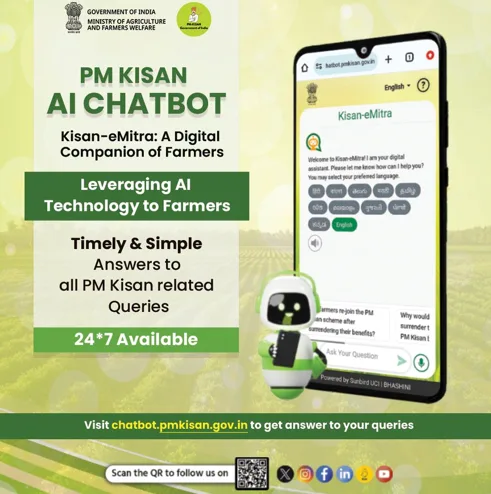
This number showcases value not as an experimental tool but as a working support mechanism integrated into India’s agricultural service architecture. On ground, Kisan e-Mitra is an effort to perform better outreach and reduce friction in accessing government benefits. A large number of farmers suffer due to a lack of schemes rather than not knowing about them or understanding the documentation clarity for those. Offering real time answers from how to enroll into a scheme to compensation entitlement under crop insurance Kisan e-Mitra. It has cut down dependency on intermediaries to help farmers and inform decisions with no delays. Another strong point lies in it is its adaptability. As it evolves, the chatbot is being trained to answer questions on more and more government initiatives, which would imply that farmers are getting comprehensive support from a single channel.
In rural areas, where digital literacy may range from nil to negligible, this voice model app ensures that farmers uncomfortable even with smartphones can get information just by speaking. If Kisan e-Mitra goes well in time, integrating with more databases and layers of services including advisories on agriculture, addressing grievances and navigating government programs, it can become an AI-powered “first responder” for farmers.
National Pest Surveillance System: Early Detection for Climate Resilient Farming
Climate change has escalated pest pressure throughout Indian agriculture, making early detection and rapid responses is more critical than ever. The Government of India initiative National Pest Surveillance System, which is built using AI and machine learning tools, offers a structured and field centric approach to this challenge. By enabling farmers and extension workers to identify pest infestations through simple photographs, this system helps to mitigate crop losses that might otherwise go unnoticed until it is too late. The platform supports 66 crops and over 432 pests in current scenario, and it is one of the most comprehensive digital pest monitoring efforts in the developing world. Over 10,000 labours are using this system in routine fieldwork.
The importance of this model is its linkage between farmers and extension services. A photo taken at the field site enables an AI model to analyze crop patterns, determine if there is an infestation and if so, what is the type and severity, then deliver an early warning. Where the risk is high, extension workers are alerted for the immediate deployment of advisories or interventions, making the system more responsive without having to rely exclusively on manual scouting or delayed reporting. This would lead to a reduction in unwarranted pesticide application. Instead of blanket spraying based on suspicion of pest infestation, farmers are able to undertake action upon actual detection. Thus, cost savings and overuse of chemicals can be avoided, which are harmful to soil health and human well being. Integration with pest surveillance and satellite based analytics further strengthens the accuracy. From field photography, it combines with weather and vegetation data to detect even patterns likely to lead to a looming risk. This is consistent with the broader national effort to develop climate resilient agriculture by improving monitoring and making decisions based on data.
Integrating AI with Field Extension and Satellite Monitoring
AI is proving most effective in Indian agriculture where it works alongside human expertise rather than trying to replace it. The AI-assisted systems for pest surveillance and advisory dissemination are part of a larger digital ecosystem that includes satellite based crop monitoring, field image analytics and crop weather matching. These tools contribute to reliable crop-area estimation, better procurement planning and improved crop insurance verification. The use of AI-driven analytics integrating field photographs with satellite based crop mapping has strengthened the monitoring of crops sown during different seasons.
This system reduces discrepancies between reported and actual sown areas, helping to smoothen the process of compensation claims in crop insurance and bring transparency in agricultural planning. The integration of AI with field extension overcomes one more bottleneck in Indian agriculture with the low ratio of agricultural extension workers to farmers.
AI tools help in expanding the coverage of extension work through their ability to analyze images automatically, generate alerts and spread advisories through platforms like M-Kisan. In this hybrid model the machine analyses and the extension worker get interpretation that helps in accuracy without misplacing contextual understanding of local conditions. Other aspect is that it is data driven governance. With a steady flow of field and satellite data, policymakers can track indicators such as pest outbreaks, rainfall variability and crop stress in near real time. In upcoming time, this will contribute to a better policy formulation, targeted interventions and region specific resource allocation. These are important structural steps towards creating an agricultural ecosystem not just productive but also climate resilient.
AI empowered climate ready farming system
The integration of AI into Indian agriculture is thus very practical, incremental and farmer centered. Solutions like Kisan e-Mitra and the National Pest Surveillance System demonstrate that the power of AI is maximized when it is applied to tangible challenges that farmers face every day scheme benefit navigation, pest identification, planning sowing dates and managing risk in an increasingly unpredictable climate. These systems avoid technological overkill and focus on accessibility, multilingual support and usability in field conditions. That millions of farmers have already engaged with the AI-enabled advisories reflects deepening acceptance of digital tools when they bring clarity and immediate utility. As India continues to invest in data infrastructure, extension capacity and farmer focused digital innovations, AI will increasingly take on the role of a supportive layer beneath the agricultural sector strengthening decisions without overwhelming users. The direction is clear, a future where Indian farmers operate with better information, lower uncertainty and timely support. t future, platforms like Kisan e-Mitra and the National Pest Surveillance System will remain foundational pillars of Indian effort to modernize agriculture without leaving behind its small and marginalised farmers.










Comments