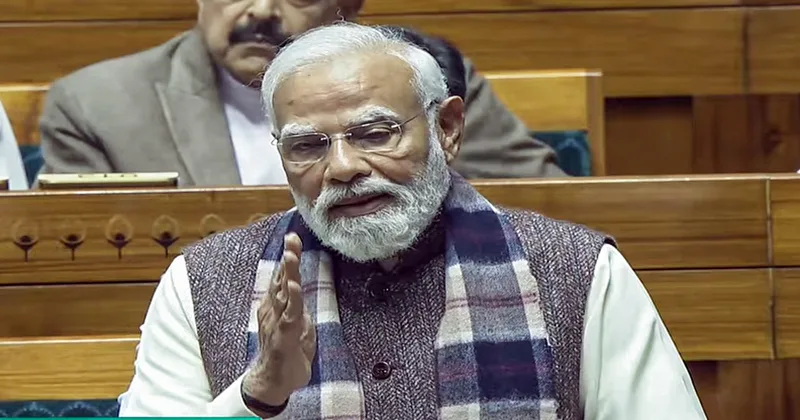
New Delhi, Dec 08 (ANI): Prime Minister Narendra Modi speaks in Lok Sabha during the winter session of Parliament, in New Delhi on Monday. (Sansad TV/ANI Video Grab)
NEW DELHI: Prime Minister Narendra Modi on December 16 addressed the Lok Sabha during the debate commemorating 150 years of Vande Mataram, asserting that the historic composition was much more than a rallying slogan for political independence. He called it a “sacred war cry” that inspired generations of Indians to free Bharatmata from the grip of colonial rule and reclaim the nation’s civilizational pride.
Modi said Vande Mataram emerged at a crucial moment when British rulers were attempting to shape Indian cultural and social life by promoting symbols of imperial supremacy. “At a time when they were trying to impose ‘God Save the Queen’ on Indian households, Bankim Chandra Chattopadhyay gave India a hymn that challenged this colonial arrogance,” the Prime Minister stated.
Tracing the roots of India’s spiritual relationship with the land, he said the song drew from a millennia-old tradition that revered the motherland. “Since the Vedic times, we have considered this land as the mother. Even Bhagwan Ram expressed the same sentiment after leaving Lanka,” he noted, adding that Vande Mataram embodied this profound connection.
PM Modi said Vande Mataram emerged at a time of immense political turmoil, when the memory of the 1857 revolt still shook the British Empire. “Vande Mataram was born in 1875,” he reminded the House, crediting Bankim Chandra Chattopadhyay for crafting a song that came to symbolise India’s struggle for selfhood.
“At a time when colonial rulers were aggressively promoting God Save the Queen as the anthem Indians must bow to, Bankim Chandra ne inth ka jawab pathar se diya,” he said. “He wrote a song to unite us, to awaken us, to remind us of who we were as a civilisation for over a thousand years.”
By 1882, when Bankim Chandra published his seminal novel Anandamath, Vande Mataram had already been woven into its narrative. The PM said its inclusion transformed the song into the clarion call of nationalism, rallying people across the subcontinent.
PM Modi underscored the colonial fear of Vande Mataram, particularly among British administrators in Bengal. “The British believed if Bengal could be broken, India could be broken,” he said. “Instead, Vande Mataram became the proclamation of Bengal’s unity.”
He recalled how the 1905 partition of Bengal triggered massive public uprisings, with the song acting as the emotional and cultural glue binding people together. “The British divided Bengal, but Vande Mataram stood like a rock and inspired unity,” he said.
The PM noted that the British eventually imposed strict laws banning the poem, prohibiting its printing, circulation, singing, or even utterance. Despite these restrictions, its message spread through acts of civil defiance—women removing gold bangles in protest, children drawing courage from the chant, and families standing firm against colonial intimidation.
He also spoke of the song’s international reach, recalling how recordings of Vande Mataram made their way abroad. “At London’s India House, Veer Savarkar used to sing Vande Mataram time and again,” he said, calling it a testament to the song’s unifying power among Indian revolutionaries overseas.
Beyond Politics: A Civilisational Mantra
Calling Vande Mataram the “modern incarnation of India,” PM Modi said the song transcends political categories. “It is not just a political song. It is the sankalp of every individual of this country,” he said.
According to him, the song rekindled India’s civilisational confidence at a time when colonial powers sought to divide communities and fragment Indian society. “Bankim Da wrote it when the British were trying to divide us. And yet this song united us,” he said. “It energised generations. It got us Independence.”
Modi emphasised that the song did not simply demand the expulsion of the British but articulated a broader vision for a free and self-confident nation. “The British looked down upon us, branding Indians as inferior, weak and lazy. Vande Mataram challenged that mindset. It revealed the strength within India and reminded millions that the struggle was not for a piece of land, but for the revival of a glorious past,” he said.

Leave a Comment