





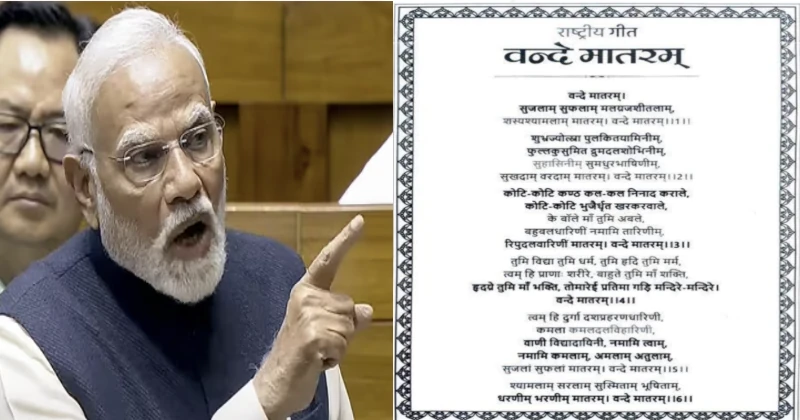
The Lok Sabha commenced a special discussion on the 150th anniversary of India’s national song, Vande Mataram, stating its unparalleled role in uniting Indians against colonial rule. Prime Minister Narendra Modi, opening the debate, emphasised the song’s enduring legacy as a rallying cry for freedom and patriotism while calling out the “appeasement mindset” that sought to dilute its essence.
The one-day discussion in the Lower House, earmarked for 10 hours, will be followed by a parallel session in the Rajya Sabha, led by Home Minister Amit Shah. The debate is expected to highlight both well-known and lesser-known facets of the song, tracing its origin, historical significance, and controversies surrounding its abridgment in the 20th century.
LIVE | PM Narendra Modi speaks in Lok Sabha on Vande Mataram.
📺 Watch here 🔗: https://t.co/p5Ddc6sa3F#VandeMataram150 #VandeMataram pic.twitter.com/zbcFmAHqe8
— Organiser Weekly (@eOrganiser) December 8, 2025
Penned by Bankim Chandra Chattopadhyay in 1875, Vande Mataram played a central role in uniting Hindus and Muslims in the struggle against British colonialism. The song gained widespread popularity during the 1905 anti-Partition movement in Bengal, where it became the rallying slogan of national resistance.
However, the song’s full version faced political truncation decades later. Historical records reveal that Jawaharlal Nehru, bowing to the demands of the Muslim League and Muhammad Ali Jinnah in 1937, shortened Vande Mataram, removing several stanzas a move opposed by contemporaries like Subhas Chandra Bose. Critics argue that this decision was a political compromise that diluted the song’s civilizational and unifying essence.
Even Rabindranath Tagore, when reciting the complete Vande Mataram in the December 1886 Congress session, did so in front of a Muslim president, Rahimtulla M. Sayani, reflecting the song’s inclusive appeal before political expediency intervened.
PM Modi, in his address, called this historical appeasement by the Congress as the hallmark of a “Muslim League-Maoist Congress mindset,” highlighting repeated attempts to sideline India’s civilizational symbols and national sentiment. He cited examples, including Rahul Gandhi allegedly instructing KC Venugopal to interrupt the recitation of Vande Mataram at a public rally—a move critics say reflects continued discomfort with India’s national song.
Tomorrow is a historic day.
Our Parliament will have a special discussion on 150 years of Vande Mataram in Lok Sabha.
As the nation will discuss on 150 years of Vande Mataram, let us not forget some historical facts:
– Jawaharlal Nehru truncated the entire Vande Mataram for… pic.twitter.com/72maKjbkSC
— Pradeep Bhandari(प्रदीप भंडारी)🇮🇳 (@pradip103) December 7, 2025
The Lok Sabha session began at 11 a.m. with the Question Hour, followed by the laying of papers by multiple ministers, including Gajendra Singh Shekhawat (Culture), Jayant Chaudhary (Education), Pankaj Chaudhary (Finance), Shobha Karandlaje (Labour & Employment), Kirti Vardhan Singh (Environment), and Harsh Malhotra (Corporate Affairs).
Key reports presented include the Tenth Report of the Standing Committee on Energy, the 371st Report of the Standing Committee on Education, Women, Children, Youth and Sports, and final action statements by the Committee on Estimates covering flagship schemes such as PMGSY, Green Highways under NHDP, Amrit Bharat Station Scheme, and PM MITRA Textile Parks.
The Lok Sabha discussion is expected to last for 10 hours, with the BJP-led NDA allotted three hours to present its perspective on the historical and cultural significance of Vande Mataram. The Rajya Sabha will continue the discussion on December 9.
The 150th anniversary of Vande Mataram offers a moment of reflection on India’s journey from colonial subjugation to independent nationhood, and the enduring relevance of cultural symbols in shaping national consciousness.










Comments