





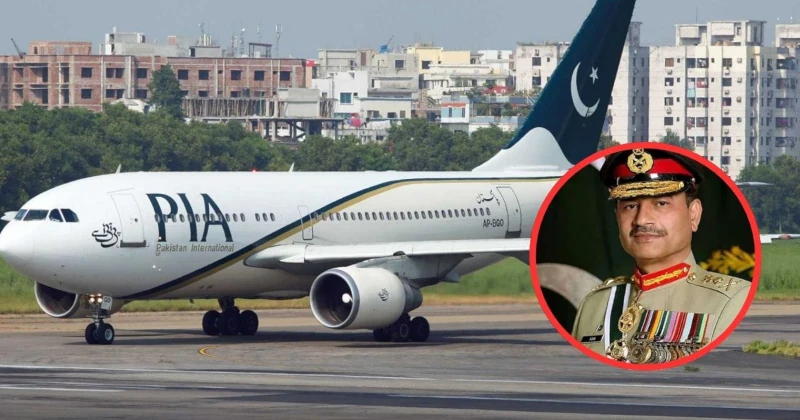
Pakistan, which has been relying heavily on financial assistance from the International Monetary Fund (IMF) to meet its routine expenditures, has finally begun the process of selling its national airline in compliance with IMF conditions. Pakistani Prime Minister Shehbaz Sharif announced that the tender process for Pakistan International Airlines (PIA) will take place on December 23. Pakistan recently secured a $7 billion IMF bailout package (approximately ₹63,000 crore). Disbursement of this loan is tied to strict economic and structural reform conditions imposed by the IMF. One of the key conditions is the privatisation of loss-making state-owned enterprises, particularly the national airline.
The IMF has already released $1 billion as part of the agreement. Another $1.2 billion tranche is expected to be considered at the IMF meeting scheduled for December 8. According to Pakistani officials, the IMF insisted on an immediate and irreversible decision regarding the sale of PIA before future disbursements could be approved. In response, the government moved swiftly to initiate the tender process. Pakistani daily Dawn reported that the tender proceedings will be telecast live across media platforms. The privatisation of PIA marks the first sale of a major public sector enterprise in nearly two decades in Pakistan.
From Calcutta to Karachi: A pre-partition legacy
Pakistan International Airlines did not begin as a state-owned entity. The airline was founded on October 29, 1946, in Calcutta, as a private venture named Orient Airways. It was established by Mirza Ahmad Ispahani along with prominent business tycoon Adamjee Haji Dawood. Following the Partition of India in 1947, the airline’s entire operation was transferred to Pakistan. Recognising its strategic importance, the Pakistani government nationalised Orient Airways in 1955 and renamed it Pakistan International Airlines.
PIA’s fortunes began to deteriorate as global competition intensified, particularly from Gulf carriers with superior funding, fleets, and service models. The airline struggled to modernise and adapt. Over the years, PIA became synonymous with corruption, administrative mismanagement, political interference, overstaffing, and repeated safety lapses. Frequent aircraft accidents, operational inefficiencies, and mass employee attrition further weakened the carrier. By 2020, PIA’s reputation suffered a devastating blow when it was revealed that over 30 per cent of its pilots held fake licenses. More than 260 pilots were suspended following the revelation. In response, the European Union banned PIA flights, severely limiting its international operations. Currently, the airline is burdened with debt exceeding PKR 825 billion, making it financially unsustainable without state support.
Military-linked entity emerges as leading contender
The government plans to sell 51 to 100 per cent ownership of PIA through the tender process. However, participation has been restricted to Pakistani citizens and domestic companies, excluding foreign buyers. Officials aim to raise PKR 86 billion from the sale. Of this amount, 15 per cent will go to the government, while the remaining funds will be directed toward stabilising the airline’s operations and balance sheet.
Four entities have submitted bids to acquire Pakistan International Airlines. Among them is Fauji Fertilizer Company Limited, a major conglomerate run under the Fauji Foundation, which is controlled by the Pakistan Army. The other bidders include the Lucky Cement Consortium, Arif Habib Corporation Consortium, and Air Blue Limited. The Fauji Foundation is one of Pakistan’s largest corporate networks, operating across sectors such as fertilisers, food, energy, banking, and healthcare. While Army Chief General Asim Munir does not hold a formal executive role in the foundation, the military exercises decisive influence over it. As Army Chief, Asim Munir appoints the Quartermaster General, who sits on the Fauji Foundation’s central board. In effect, this gives the military indirect but substantial control over the organisation.
The prospective takeover of PIA by a military-linked enterprise highlights the dominant role of the armed forces in Pakistan’s economy and governance, reinforcing perceptions that real power in Pakistan lies beyond civilian institutions. Whether privatisation will genuinely revive PIA, or merely transfer control from the state to the military establishment, remains a critical question for Pakistan’s future.













Comments