





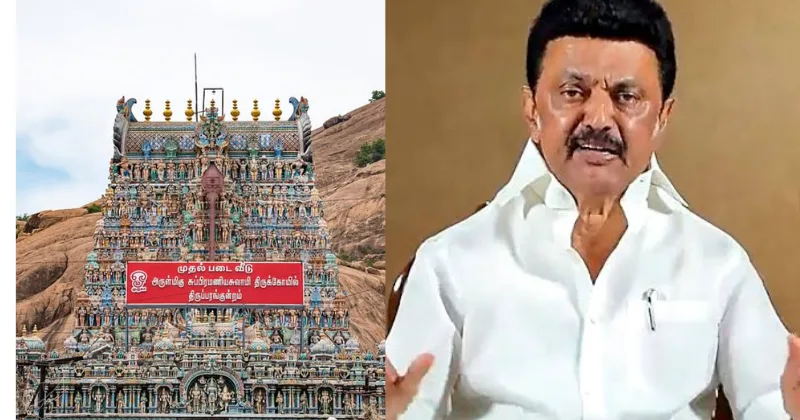
The DMK has shown no hesitation in antagonising the majority Hindu community in its bid to secure Muslim support, a trend critics say is once again visible in its push against three successive judicial orders. After these rulings went against it and contempt proceedings were initiated against senior officers, the Tamil Nadu government rushed to the Supreme Court seeking an urgent hearing on Thirupparankundram deepathoon issue. The apex court, however, declined to take up the matter immediately, assuring only that the petition would be numbered and listed in due course. The DMK’s influential lobby, backed by high-profile lawyers, failed to secure the relief it sought.
The swift manner in which the DMK goverment has approached court after court to deny Hindus their religious rights has drawn sharp criticism, with detractors calling the government “Hindu-phobic” and anti-Sanatana. They allege that temple funds are being diverted to pay highly expensive lawyers not to safeguard Hindu interests or temple rights, but to oppose them. When the Supreme Court bench led by CJI Surya Kant sat on December 5, Tamil Nadu’s counsel made an oral request for urgent listing. The petition, filed late on December 4, sought to challenge the Madras High Court’s order that spilled over into the Supreme Court. Counsel for District Magistrate K. J. Praveenkumar and Madurai Commissioner of Police J. Loganathan pressed for immediate listing.
Representing the caveat petitioners, advocate P. V. Yogeswaran accused DMK government of “playing drama” before the courts. He said the state was merely trying to signal to the High Court that it had approached the Supreme Court, while simultaneously defying repeated High Court directions. “On one hand, the Tamil Nadu government continues to disobey the Madras High Court; on the other, it is creating drama by filing an appeal to discourage contempt proceedings for blatant, brazen, and deliberate defiance,” he said.
He further argued that DMK government’s actions seemed aimed at preventing the High Court from proceeding with contempt charges against the officers for “wilful” disobedience and manipulation of court orders. The state defended its refusal to comply with orders allowing lighting of the deepathoon (ancient stone lamp pillar), contending that it held exclusive authority over temple rituals and customs.
The DMK government lead by CM Stalin maintained that the High Court could not invoke contempt jurisdiction to question rituals, which fall solely under the Tamil Nadu HR&CE Act, 1959.
On the same day, Justices G. Jayachandran and K. K. Ramakrishnan of the Madurai Bench posted for December 12 the appeals filed by the Madurai District Magistrate and the Executive Officer of the Subramanya Swamy Temple, Thirupparankundram. They argued that for over 150 years, the Maha deepam had been lit only at the Uchipillaiyar Temple mantap, and that no temple record, register, HR&CE file or agama reference supported claims of a traditional deepathoon site. They also said the hilltop was a sensitive zone and that the single judge had failed to consider this material.
Meanwhile, Justice G. R. Swaminathan of the Madurai Bench took note that both the state and the temple administration had filed appeals before the division bench, and that the State had also filed a special leave petition in the Supreme Court against dismissal of its Letters Patent Appeal. As both courts were seized of the matter, the judge adjourned the contempt petition to December 9. He directed the Deputy Solicitor General to obtain and submit a CISF report on implementing earlier orders.
Critics argue that the DMK’s stand claiming that allowing Hindus to perform an ancient ritual at a heritage site would threaten “communal harmony” and endanger a “600-year-old mosque” amounts to “weaponised secularism”, allegedly privileging Muslim sentiments over Hindu rights despite what they say are clear judicial rulings. They describe the unfolding events as unprecedented in independent India: a state government allegedly violating multiple High Court orders to prevent Hindus from performing their own traditional practices.
The HR & CE Department reportedly submitted several letters from priests claiming the ritual could only be performed on Karthigai Deepam. Shortly after these letters circulated on social media, one of the signatories stated publicly that he had not made such a declaration, accusing the department of misusing his name, an act critics described as “perjury”. He claimed details were provided to him by officials and criticised the administration for exploiting his position. Opponents allege this reflects the DMK’s “vote-bank politics”, accusing the party of “murdering democracy at the Deepathoon”.
Chief Minister M. K. Stalin, HR&CE Minister P. K. Sekarbabu, and allies including the Left and VCK continued to justify the government’s stance as necessary to “protect communal harmony”. They blamed “external Hindu outfits” for seeking to “disrupt unity” and “stoke tensions”. Stalin reacted to criticism by saying Madurai sought development politics, metro rail, AIIMS, industries, and employment. However, detractors responded that the DMK was playing communal politics while failing on development indicators, pointing to flooding in Chennai and infrastructure failures across the state.
HR & CE Minister Sekarbabu said Thirupparankundram had always lived in harmony and that there was no law-and-order threat when Muslims marched for animal sacrifice or when an MP ate biryani atop the hill and declared it a Waqf property. Critics called it hypocrisy that obeying High Court orders was portrayed as a threat to tranquillity.
They argue that the issue demonstrates how a Muslim minority-appeasing DMK government can flout laws, invent new claims, and tweak court orders to suppress the religious rights of the Hindu majority. DMK leaders have also accused judges of being aligned with RSS ideology and attempted to frame the dispute along caste lines.
For the DMK, critics say, court rulings are celebrated when favourable but attacked when unfavourable. They call for the Supreme Court to clarify whether Indian federalism allows state governments to systematically violate High Court rulings on religious freedoms.
Hindu Munnani has called for statewide protests on December 7 against what it calls the DMK’s double standards on the Deepam issue.
கோவை கோட்டத்தில் ஆர்ப்பாட்டம் நடைபெறும் இடங்கள்..
திருப்பரங்குன்றம் நீதிமன்ற தீர்ப்பை மீறி முருக பக்தர்களை அவமதித்த தமிழக அரசைக் கண்டித்து மாநிலம் தழுவிய மாபெரும் ஆர்ப்பாட்டம்..
முருக பக்தர்களே திரளென கலந்து கொள்வோம்!!
#thiruparankundram | #karthigaideepam | #TNGovt |… pic.twitter.com/O7eSGcI87Y— Hindu Munnani (@hindumunnani_tn) December 6, 2025
BJP leader K. Annamalai claimed over 158 temples were demolished many without court orders while no mosque or church was removed despite judicial directives. He provided lists to the media as evidence of alleged minority appeasement.
In today’s press meeting, we strongly condemned the DMK Government’s wilful defiance of the court’s clear directive permitting Hindu devotees to light the sacred Karthigai Deepam on the Deepa Thoon (stone pillar) atop the Thiruparankundram hill.
The chronology of events,… pic.twitter.com/o5UH0DFxDp
— K.Annamalai (@annamalai_k) December 5, 2025
The controversy echoed in Parliament, where MoS L. Murugan delivered a sharp response to DMK MPs. Remarks by T. R. Baalu casting aspersions on a judge and linking him to an organisation were expunged after objections from BJP members.





Comments