





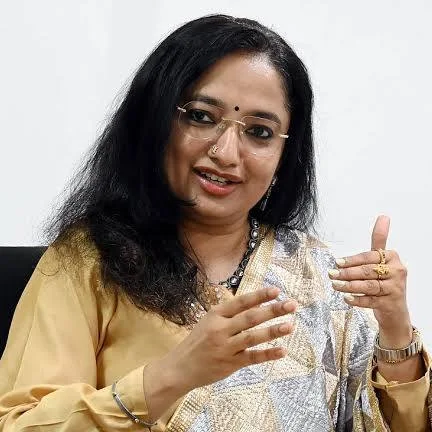
Thiruvananthapuram: Senior IAS officer Divya S. Iyer, Managing Director of Vizhinjam International Seaport and Project Director of the Kerala Solid Waste Management Project (KSWMP), has stirred a major controversy by stating that ‘Jihad’ means a tension-free life and not a holy war to destroy others. The remark, made during the release of the ninth volume of the Malayalam book “Quran Akam Porul – Manavikakhyanam” (Quran – Inside Meanings Humanitarian Interpretation), has triggered sharp reactions across Kerala.
During the event, Iyer said ‘Jihad’ is not meant for destroying others or joining an extreme path, but for leading a war-free life. Her interpretation has been criticised widely, with many accusing her of romanticising and whitewashing the concept of ‘Jihad’, a term that sections of the global Islamic community associate with militant violence. Social media debates intensified as critics pointed out that Islamic scholars across regions have historically interpreted ‘Jihad’ in militant terms, and Islamic terrorist groups have invoked the concept while carrying out terror attacks.
Critics note that Bharat has suffered thousands of casualties due to jihad-driven terrorism, citing the recent Red Fort suicide attack by Dr Umar Nabi and the massacre of tourists at Pahalgam as stark reminders of extremist violence. They also argue that attempts to redefine or soften the meaning of ‘Jihad’ are misleading and stem from lack of proper knowledge, especially when the term has been invoked repeatedly by global extremist groups, Islamic Scholars and even political leaders.
Observers compared Iyer’s remarks to the trend of urban Maoists poetically glorifying ‘Jihad’, adding that such a statement from a senior civil servant is far more concerning. Despite the growing backlash, the IAS officer has not issued a response or clarification.
This is not the first time Divya S. Iyer has drawn political attention. In April, she publicly praised CPM leader K.K. Ragesh upon his election as Kannur district secretary, a gesture that attracted criticism from opposition parties. Chief Minister Pinarayi Vijayan defended her, dismissing the criticism as misogynistic and arguing that her political views should not be assumed based on her marriage. Iyer is married to K.S. Sabarinath, former Youth Congress leader and ex-MLA, and the son of late Congress veteran G. Karthikeyan.
In June, Iyer again became a talking point after she visited and hugged CPM leader K. Radhakrishnan upon his resignation as minister following his election to the Lok Sabha, later sharing the image on social media.
Political observers believe her latest comments may also be viewed in the context of the recent proximity between Congress and SDPI, the political wing of the now-outlawed Popular Front of India (PFI). Although Congress publicly rejected SDPI’s declared support in the 2024 Lok Sabha elections, analysts considered it a public relations exercise. SDPI’s victory rally in Palakkad after Youth Congress leader Rahul Mankoottathil won the 2024 bypoll further fuelled speculation.
The controversy has also revived debate on selective outrage and double standards. Observers point out that when Islamic texts are questioned, critics are branded “Islamophobic”, yet criticism or mockery of Hindu scriptures or the Bible is often deemed acceptable. They argue that such inconsistencies distort public understanding, especially when influential figures present personal interpretations.
Critics assert that the responsibility lies with Islamic scholars and religious authorities to clearly define and adhere to the accepted meaning of terms like ‘Jihad’. Without consistent interpretation, they warn, the concept becomes open to subjective, self-serving reinterpretations, potentially misleading the public and undermining the real-world consequences associated with extremist violence.








Comments