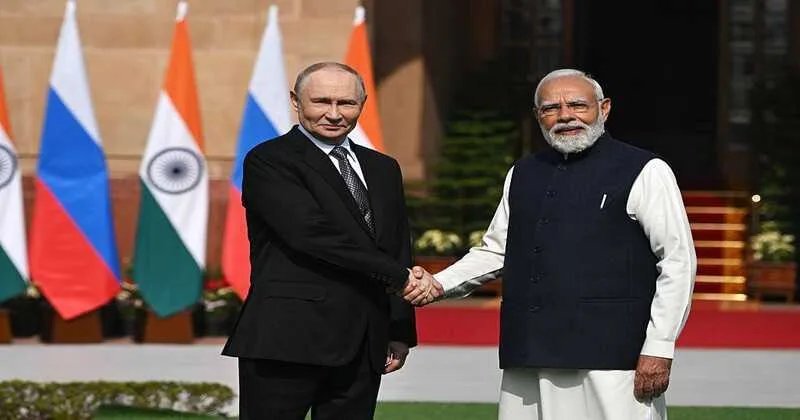
Russian President Vladimir Putin and India's Prime Minister Narendra Modi
India and Russia have agreed to institutionalise regular bilateral consultations on Arctic-related matters while reviewing progress in their expanding cooperation on the Northern Sea Route, according to a joint statement issued after the India–Russia summit held in New Delhi on December 5.
The commitment reflects growing alignment between the two countries on polar research, maritime corridors, and strategic resource access in the Arctic region. Both sides noted that ongoing collaboration on the Northern Sea Route had advanced steadily, particularly in areas related to trade connectivity, navigation, and logistical feasibility as climate-induced ice melt reshapes Arctic shipping routes. India’s engagement with the Arctic long predates its independence. In 1920, the British Government signed the Svalbard Treaty, which recognised Norwegian sovereignty over the Svalbard archipelago while granting equal non-military commercial and scientific rights to nationals of 48 signatory countries. The treaty permits activities such as mining, fishing, hunting, and research, while explicitly barring military installations and fortifications.
India formally entered Arctic scientific research in the 2000s, when it launched its first expedition to the region and established Himadri, its permanent research station in Svalbard. Since then, Indian scientists have focused on glaciology, monitoring Arctic glacier mass balance and comparing those findings with Himalayan glacier systems. Research efforts have also extended to Arctic oceanography, atmospheric sciences, pollution studies, and microbiology. More than 25 Indian universities and research institutions currently participate in Arctic research programmes. Since 2007, Indian researchers have published around 100 peer-reviewed scientific papers examining various Arctic processes and their global implications. India is one of 13 observer states in the Arctic Council, alongside countries such as France, Germany, Japan, China, South Korea, and the United Kingdom. As an observer, India contributes to scientific discussions and environmental assessments while remaining outside the Council’s decision-making framework.
In 2014 and 2016, India commissioned its first multi-sensor moored observatory in Kongsfjorden and established the northernmost atmospheric laboratory at Gruvebadet in Ny-Ålesund. By 2022, India had successfully completed thirteen Arctic expeditions. Accelerated polar ice melt due to global warming is expected to produce significant geological changes, potentially opening new shipping corridors and making mineral and metal extraction more viable in the coming decades.
Second nuclear plant site
Beyond Arctic cooperation, India and Russia agreed to deepen collaboration in the nuclear energy sector. The joint statement noted continued cooperation on fuel supply, fuel cycle services, and long-term operational support for the Kudankulam nuclear power plant. Two 1,000 MW units are currently operational at the site, while four additional units of the same capacity are under construction. The full 6,000 MW capacity of the Kudankulam project is expected to be realised by 2027. The two governments also decided to pursue further discussions on the establishment of a second nuclear power plant in India, with New Delhi indicating its intention to allocate an additional site in line with previously concluded agreements. Technical and commercial talks on Russia’s VVER nuclear reactor technology are to be expedited, covering design collaboration, research, and potential joint development of future nuclear projects.
The summit also endorsed the expanding partnership between the Indian Space Research Organisation and Russia’s Roscosmos. Cooperation will continue in peaceful space activities, including human spaceflight programmes, satellite navigation systems, planetary exploration initiatives, and rocket engine development.

Leave a Comment