






In last ten years, the tourism sector in India has witnessed one of the most structured and government driven phases of development ever. What differentiates this era from previous, is the attempts at developing tourism in India with the integration of three major national schemes such as PRASHAD, Swadesh Darshan and Swadesh Darshan 2.0. Each of these has been designed with clear financial allocations, well defined objectives and measurable outcomes. These represent a total sanctioned investment of Rs 1,726.74 crore under PRASHAD, Rs 5,290.30 crore under Swadesh Darshan and Rs 2,208.27 crore under Swadesh Darshan 2.0, with a total of Rs 9,225.31 crore allocated toward tourism infrastructure across the country. This massive national effort, dispersed over 183 projects serves how coordinated efforts with align budgets, implementation capacity and state partnerships to create tourism assets for the long term.
Building Pilgrimage Infrastructure: The PRASHAD Initiative
The PRASHAD scheme was started in 2015 as the first major initiative to develop pilgrimage sites in India with modern amenities while retaining the original religious and spiritual character at these pilgrimage sites. The scheme has sanctioned 54 projects across 28 States and Union Territories with a total sanctioned cost of Rs 1,726.74 crore out of which 32 projects have already been physically completed. This completion rate is almost 60 per cent, it is remarkable because most heritage locations require very sensitive interventions, rehabilitation of old structures and often cooperation with religious institutions.
The development model adopted by PRASHAD basically focuses on integrated infrastructure creation. Tourist arrival plazas, parking zones, facilitation centres, waiting halls and cloakrooms are the basic constituents of visitor interface. These initiatives are supported by solid waste management systems, bio toilets, drinking water facilities, improved drainage networks, dustbins, waste management facilities and detailed landscaping. Features related to accessibility such as ramps, railings, wheelchair provisions and lifts reflect an inclusive philosophy of design.
Road widening, development and the introduction of e-vehicles ensures better mobility. This structured approach to development is reflected across several states. Andhra Pradesh has undertaken major upgrading of temple and towns such as Rs 27.77 crore for Amaravati, Rs 43.08 crore for Srisailam and Rs 54.04 crore for the Simhachalam temple. Gujarat’s investments were Rs 45.36 crore for Somnath and Rs 10.46 crore for Dwarka. In Jammu & Kashmir, Rs 40.46 crore was sanctioned for improvement of facilities at the Hazratbal Shrine. Uttar Pradesh witnessed considerable development in Varanasi, with Rs 18.73 crore given for Phase I and Rs 44.60 crore for Phase II, besides an additional ₹9.02 crore to develop river cruise tourism along the Ganga. Uttarakhand’s sacred destination of Kedarnath and Badrinath were strengthened through sanctioned costs of Rs 34.77 crore and Rs 56.15 crore, respectively.
The 2021 IIM Rohtak done an evaluation which has emphasized that the PRASHAD projects substantially enhanced visitor satisfaction and aesthetic quality at pilgrimage sites. The study report shares the enhanced visitor experience and ease of movement due to PRASHAD facilities in place thus affirming its effectiveness.
Swadesh Darshan: Thematic Circuits as National Connectors
While PRASHAD introduced an element of convergence, Swadesh Darshan introduced for the first time a structured thematic approach to tourism planning. Swadesh Darshan counts as the efficient and successfully implemented tourism schemes in India. With 76 projects sanctioned at an aggregate cost of Rs 5,290.30 crore and 75 of them are physically completed.
The thematic circuit approach forms the core strength of Swadesh Darshan. In place of isolated interventions, the scheme amalgamates destinations into integrated circuits like Coastal, Heritage, Spiritual, Eco, Buddhist, Himalayan and Tribal areas amongst others. These circuits often traverse from different states and cluster destinations that naturally complement each other.
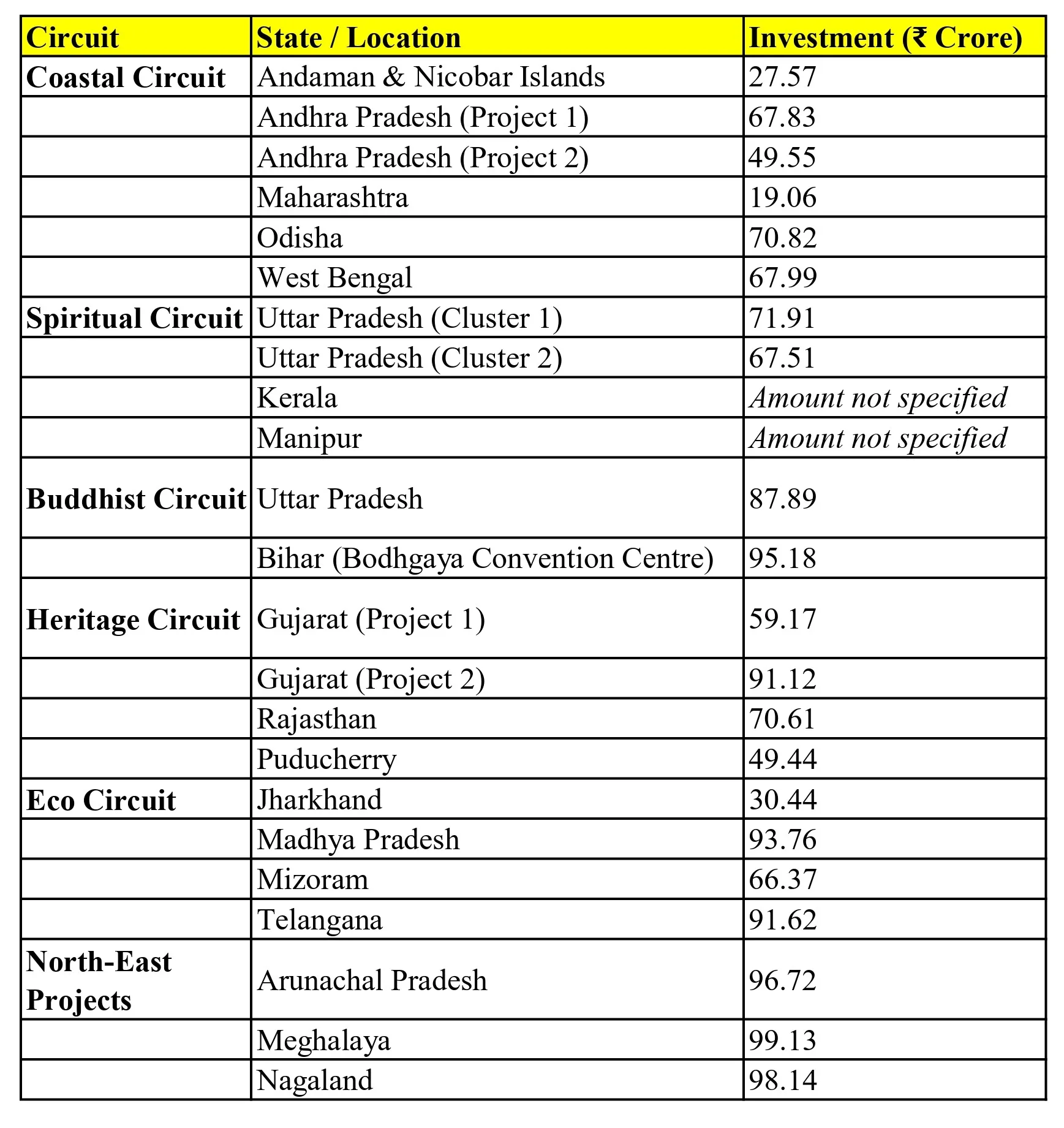
The circuit-based tourism strategy of India reflects a concerted effort at consolidating regional economies, with a whole preservation of cultural and natural resources. The Coastal Circuit has focused its priorities on developing the Andaman & Nicobar Islands and prime eastern states like Andhra Pradesh and Odisha, aimed at improving coastal infrastructure and tourist amenities. In accumulative state both Spiritual and Buddhist Circuits are actively supporting pilgrimage tourism, with major allocations being given to Uttar Pradesh, Bihar, Kerala and Manipur in an effort to upgrade religious sites and improve overall tourist experience.
The Heritage and Eco Circuits epitomize the balancing of conservation and sustainability. While investments in Gujarat, Rajasthan and Puducherry focus on the restitution and promotion of cultural landmarks, funding in Madhya Pradesh, Telangana and Mizoram aims at scaling up eco-friendly tourism models. The North-East continues to be a priority, with states like Arunachal Pradesh and Meghalaya being given major thrust, underlining the emerging potential for eco cultural tourism in the region and its gradual integration with India’s larger tourism circuit.
Shift to Destination-Centric Development
Swadesh Darshan scheme was getting saturated in its circuit-based implementation, the Ministry brought a strategic shift towards destination-based planning under Swadesh Darshan 2.0. SD 2.0 is standing on the pillars of sustainability, community participation and experience oriented tourism. The scheme has sanctioned 53 projects worth Rs 2,208.27 crore with Rs 187.32 crore already authorised. SD 2.0 is different from earlier circuit-based model, it identifies individual destinations and builds them around immersive visitor experiences.
Projects under SD 2.0 represent a diversified portfolio across the country. Andhra Pradesh has been sanctioned Rs 97.52 crore for the development of the Suryalanka Beach Experience and Rs 29.88 crore for the Borra Caves Experience in Araku. The Buddhist Meditation Centre at Bodh Gaya received Rs 165.44 crore in Bihar, while the Bhoramdeo Corridor project is sanctioned at Rs 145.99 crore in Chhattisgarh. Kerala Alappuzha Water Wonderland project received ₹93.18 crore, with improvements at Malampuzha Garden and Leisure Park sanctioned at Rs 75.87 crore. Rajasthan received Rs 87.87 crore for the development of Khatu Shyam Ji Temple. Mizoram Conference Centre accounted for Rs 99.71 crore. Uttar Pradesh received Rs 14.52 crore for Azad Park and the “Dekho Prayagraj Trail” experience and Rs 17.80 crore for the Vedic wellness experience at Naimisaranya. Uttarakhand received Rs 17.86 crore for the Rural Tourism Cluster at Gunji.
SD 2.0 thus marks the shifting of Indian tourism policy from infrastructure based to experience-based design, in line with global trends where satisfaction of tourists depends on quality, sustainability and curated local engagement.
Skill Development: Enhancing Human Resources in Tourism
The capital-intensive projects and the Capacity Building for Service Providers initiative of the Ministry is targeted at developing human resources in the tourism sector. The programme offers education, training and certification of tourism service providers with particular emphasis on youth and women. It also ensures that the expanding tourism infrastructure is supported by professional service delivery, creating employment opportunities in urban and rural regions and strengthening India’s tourism workforce.
Ministry’s policy underline that proposals invited from State Governments and Union Territories are processed on a continuous basis. This flexible mechanism allows States to orient their tourism planning in tune with emerging needs, ensures judicious utilization of central support and encourages innovation by the States within the national framework. Funding approvals depend upon adherence to guidelines, project viability and availability of funds. This process ensures accountability while offering States the freedom to expand their tourism development agenda within a coordinated national strategy.
National Tourism Architecture Built on Data, Delivery and Design
Its implementation reflects a balanced spread in major tourism rich states, whether Uttar Pradesh or Andhra Pradesh. In Uttar Pradesh six major projects under PRASHAD were sanctioned for two phases of Varanasi development, river cruise tourism and enhancements at Vrindavan and Govardhan. Under Swadesh Darshan, the state executed eight projects covering Buddhist, Ramayana, Spiritual and Heritage Circuits. Under SD 2.0 Prayagraj and Naimisaranya received focused experience based projects. In Andhra Pradesh, four PRASHAD projects, three Swadesh Darshan circuit projects and two SD 2.0 projects were sanctioned thus reflecting balanced federal investment in spiritual and cultural tourism assets.
Today Indian tourism development story unfolds on the back of integrated planning, sustained investments and long term strategic vision. The aggregated sanctioned value of more than Rs 9,225 crore for 183+ projects is unprecedented in scale compared to earlier decades. With 75 Swadesh Darshan projects completed, 32 PRASHAD projects delivered and 53 SD 2.0 projects underway, Indian tourism infrastructure today rests on a bedrock of structured development, financial discipline and targeted execution. These schemes collectively create better visitor experiences, contribute toward cultural preservation, foster local economic opportunities and position India as a competitive global tourism destination.















Comments