Women as Protagonists of Ram Janmabhoomi Movement
December 7, 2025
  • Read Ecopy
  • Circulation
  • Advertise
  • Careers
  • About Us
  • Contact Us
Android AppiPhone AppArattai
Organiser
  • ‌
  • Bharat
    • Assam
    • Bihar
    • Chhattisgarh
    • Jharkhand
    • Maharashtra
    • View All States
  • World
    • Asia
    • Europe
    • North America
    • South America
    • Africa
    • Australia
  • Editorial
  • International
  • Opinion
  • RSS @ 100
  • More
    • Op Sindoor
    • Analysis
    • Sports
    • Defence
    • Politics
    • Business
    • Economy
    • Culture
    • Special Report
    • Sci & Tech
    • Entertainment
    • G20
    • Azadi Ka Amrit Mahotsav
    • Vocal4Local
    • Web Stories
    • Education
    • Employment
    • Books
    • Interviews
    • Travel
    • Law
    • Health
    • Obituary
  • Subscribe
    • Subscribe Print Edition
    • Subscribe Ecopy
    • Read Ecopy
  • ‌
  • Bharat
    • Assam
    • Bihar
    • Chhattisgarh
    • Jharkhand
    • Maharashtra
    • View All States
  • World
    • Asia
    • Europe
    • North America
    • South America
    • Africa
    • Australia
  • Editorial
  • International
  • Opinion
  • RSS @ 100
  • More
    • Op Sindoor
    • Analysis
    • Sports
    • Defence
    • Politics
    • Business
    • Economy
    • Culture
    • Special Report
    • Sci & Tech
    • Entertainment
    • G20
    • Azadi Ka Amrit Mahotsav
    • Vocal4Local
    • Web Stories
    • Education
    • Employment
    • Books
    • Interviews
    • Travel
    • Law
    • Health
    • Obituary
  • Subscribe
    • Subscribe Print Edition
    • Subscribe Ecopy
    • Read Ecopy
Organiser
  • Home
  • Bharat
  • World
  • Operation Sindoor
  • Editorial
  • Analysis
  • Opinion
  • Culture
  • Defence
  • International Edition
  • RSS @ 100
  • Magazine
  • Read Ecopy
Home Bharat

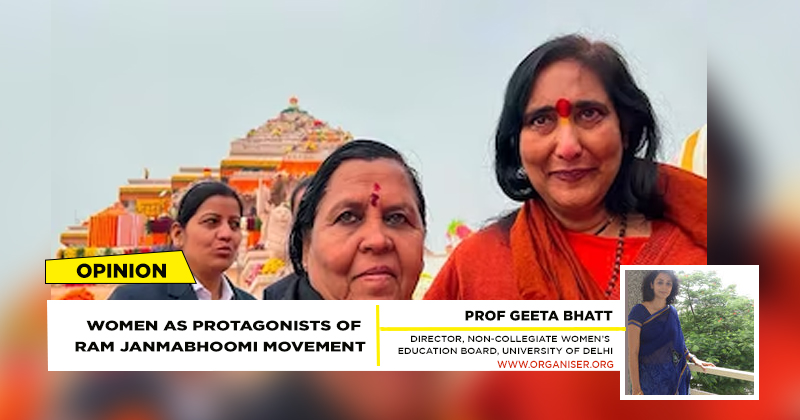
Women as Protagonists of Ram Janmabhoomi Movement

The Ram Janmabhoomi Movement has become a catalyst for redefining and expanding the roles of women in Indian society, leaving an enduring impact on cultural narratives

Prof Geeta BhattProf Geeta Bhatt
Dec 6, 2025, 09:30 am IST
in Bharat, Opinion, Culture
Follow on Google News
FacebookTwitterWhatsAppTelegramEmail

In the post-independence timeline of the nation, the Ram Janmabhoomi (birthplace) Movement will be remembered as the largest socio-cultural movement touching the masses. It is a 500-year-old struggle that has culminated into justice and vindication of our heritage and ethos. History will remember the day of ‘Pran Pratishtha’ of Bhagwan Ram as the day we reinstated our cultural pride and self-respect. It is in this social, cultural and political context, that the movement has become the collective call of aspirations, inspiring men and women alike. The participation of women in the Ram Janmabhoomi Movement played an unprecedented role in stirring the consciousness of the society.

The clarion call to join the Ram Rath Yatra in 1990 resulted in women’s participation from all walks of life. It was not just a symbolic representation. Centuries of invasion have limited the role of women to home and hearth in the last 1000 years. During the independence movement, Mahatma Gandhi had mobilised women in large numbers to participate in the cause of the national freedom struggle and post-independence, women take charge as planners and as executors in the Ram Janmabhoomi Movement, their voices reverberating in public spaces and in the privacy of homes. The Ram Janmabhoomi Movement gave women a platform to express their emotions and to exhibit leadership. It altered the social assumptions on the role of women in the society.

When Shalini Dabir, a 96-year-old lady from Maharashtra received the invitation to attend the ‘Pran Pratishtha ‘at Ayodhya on January 22, she recollected the memories of her walking for 60 km during the Ram Janmabhoomi Movement in the year 1990 when all modes of transport to Ayodhya had been suspended. Shalini, then at the age of 63 recalls that she along with many other women from Dadar in Mumbai, were jailed inside a school as all the jails in the vicinity of Ayodhya were packed with Karsevaks. Bindu, a local from Ayodhya bore witness to women doing multiple tasks – holding gatherings for bhajans, communicating between groups who were shielding themselves as well as rescuing others from the bullets being fired on them and giving shelter to the wounded. Bindu says that she left her 20-day old son in someone’s care to join the procession that was heading towards the Ram Janmabhoomi site. Hansmukhi Joshi, a former councillor from Madhya Pradesh recalled that she was with a group of women heading towards Ayodhya when they were stopped at Gwalior by the police threatening them with dire consequences. The women refused to return back to their homes and were then taken to another town Jhansi and were detained there for days. She reminisces that many locals used to visit them to show solidarity with the movement. In Aligarh, Poonam Bajaj went door to door to mobilise women to go to Ayodhya in 1991. She along with a group of women travelled surreptitiously as there was heavy police deployment to deter people from going to Ayodhya. There are innumerable incidents where women from all across the country plunged into the movement.

Women amplified the cause of the Ram Janmabhoomi Movement and led from the front, inspiring men and women alike. Raj Mata Vijaye Raje Scindia, hailing from the royal family of Rajasthan was a popular leader who had been imprisoned during the Emergency. The proposal for the construction of the Ram Mandir in Ayodhya was introduced in the National Executive meeting of the Bhartiya Janata party held at Palampur in 1989 by none other than Vijaye Raje which became the foundation of the phenomenal mobilisation for the Ram Janmabhoomi Movement. She was present in Ayodhya along with the Karsevaks and addressed the public from Ram Katha Kunj on 6 December in 1992. Vijaye Raje accompanied Lal Krishan Advani in the ‘Ram Rath Yatra’ undertaken in 1990 covering 10,000km journey across ten states. Sadhvi Rithambara and Uma Bharti emerged as the ascetics with powerful oratory skills in the Ram Janmabhoomi Movement. Their speeches were replayed in audio cassettes in large gatherings called to motivate the masses. Sadhvi Rithambara’s spiritual discourse and bhajans were pivotal in strengthening the ideological ground of the Karsevaks. Presence of Sadhvis like Pragya Singh Thakur, Sadhvi Prachi, Sadhvi Saraswati, Aastha Ma, Sadhvi Kamal and others led to a paradigm shift in the perception of women in socio-cultural mobilisation.

At this juncture, one needs to pause and pay homage to the 27 women and 20 children who had travelled to Ayodhya in 2002 to participate in the Purnahuti Mahayagna at the Sri Ram Janmabhoomi and were burnt in a train near a town called Godhra near Ahmedabad, while returning from Karseva. For decades, no one knew the names of these women and children who became a part of the long list of martyrs who sacrificed their lives for the struggle to reclaim the Ram Janmabhoomi. The sacrifices and struggles undertaken by women gave shape to the Movement which has now culminated into witnessing the long-awaited celebrations across the country. The Ram Janmabhoomi Movement for Ram Mandir in Ayodhya can be hailed as the crusade where women’s agency was integrated with the cultural and historical pride of the nation.
Topics: Ram MandirRam Janmabhoomi movementAyodhya Ram MandirKarsevaksPran PratishthaAyodhya
Share16TweetSendShareSend
✮ Subscribe Organiser YouTube Channel. ✮
✮ Join Organiser's WhatsApp channel for Nationalist views beyond the news. ✮
Previous News

Karnataka: Belagavi woman commits suicide after harassment, death threats over forced conversion; Muktumsab booked

Next News

Ex Pentagon official Michael Rubin links Trump foreign policy failures to stronger India Russia alignment

Related News

Kalyan Singh

December 6, 1992: Kalyan Singh’s unwavering resolve reshaped Ayodhya’s Ram Lala narrative

Ram Mandir in Ayodhya

UP: Ayodhya set for global-scale cultural upgrade as cabinet approves Tata Sons’ 52-acre Ram Mandir Museum

Defence Minister Rajnath Singh(File Photo)

‘Nehru wanted Babri Masjid built with public funds, Patel opposed it’: Rajnath Singh at Unity March in Gujarat

Ram Mandir Dhwajarohan: Flag of resolve and realisation

Uttar Pradesh CM Yogi Adityanath

Uttar Pradesh: CM Adityanath’s call to protect Sanatan Dharma; Hoist Sanatan flag, unite against anti-dharma forces

Dharma Dhwaj in Ayodhya: Reverence, resilence, restoration, righteousness

Load More

Comments

The comments posted here/below/in the given space are not on behalf of Organiser. The person posting the comment will be in sole ownership of its responsibility. According to the central government's IT rules, obscene or offensive statement made against a person, religion, community or nation is a punishable offense, and legal action would be taken against people who indulge in such activities.

Latest News

Representative Image

Conflict escalates between Pakistan and Afghanistan: Four Afghan civilians killed, four injured near Spin Boldak border

Tamil Nadu: DMK govt accused of ‘weaponised secularism’ as Deepathoon row intensifies; Hindu Munnani calls protest

External Affairs Minister Dr. S. Jaishankar(File Photo)

India-Russia ties not a catalyst to calibrate relations with US: EAM Jaishankar while citing strategic autonomy

Former Congress MLA Rahul Mankoottathil

Kerala: Congress suspends MLA Rahul Mankoottathil after bail rejection in sexual abuse case

ED has summoned DCM DK Shivakumar in the National Herald Case

Karnataka: ED summons DK Shivakumar & DK Suresh over National Herald donations, seeks detailed financial records

3D Concrete Printer for the Trishakti Corps of the Indian Army

Trishakti Corps of the Indian Army operationalises on-site 3D concrete printing technology in forward areas

Consistent government efforts and strategy has brought India to the verge of being a naxal-free nation

India’s march towards a naxal-free future

Uttar Pradesh CM Yogi Adityanath

Uttar Pradesh: CM Yogi Adityanath led govt promotes Tamil, Telugu, Kannada & Malayalam in vocational education

(Left) PM Narendra Modi (Right) Russian President Vladimir Putin

Putin in India: Civilizational camaraderie and future of Indo–Russia relations

Representative Image

India rebuilt its tourism landscape through PRASHAD and Swadesh Darshan Schemes after 2015

Load More
  • Privacy
  • Terms
  • Cookie Policy
  • Refund and Cancellation
  • Delivery and Shipping

© Bharat Prakashan (Delhi) Limited.
Tech-enabled by Ananthapuri Technologies

  • Home
  • Search Organiser
  • Bharat
    • Assam
    • Bihar
    • Chhattisgarh
    • Jharkhand
    • Maharashtra
    • View All States
  • World
    • Asia
    • Africa
    • North America
    • South America
    • Europe
    • Australia
  • Editorial
  • Operation Sindoor
  • Opinion
  • Analysis
  • Defence
  • Culture
  • Sports
  • Business
  • RSS @ 100
  • Entertainment
  • More ..
    • Sci & Tech
    • Vocal4Local
    • Special Report
    • Education
    • Employment
    • Books
    • Interviews
    • Travel
    • Health
    • Politics
    • Law
    • Economy
    • Obituary
  • Subscribe Magazine
  • Read Ecopy
  • Advertise
  • Circulation
  • Careers
  • About Us
  • Contact Us
  • Policies & Terms
    • Privacy Policy
    • Cookie Policy
    • Refund and Cancellation
    • Terms of Use

© Bharat Prakashan (Delhi) Limited.
Tech-enabled by Ananthapuri Technologies