





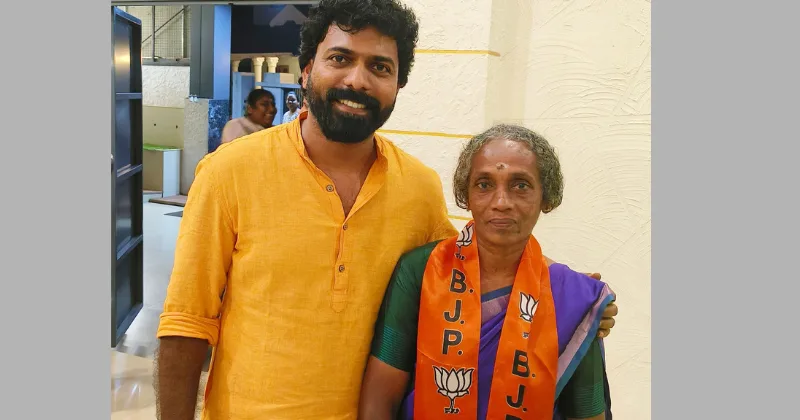
In Malappuram’s Valancherry Municipality, an extraordinary chapter unfolds as Janaki, the widow of slain BJP worker Valancherry Thami, steps into the local body elections thirty years after her husband’s brutal murder.
In 1995, on the eve of Onam, Thami went to the Valancherry market to buy vegetables. He never returned. He was abducted, hacked and stabbed to death by operatives of the banned extremist outfit Al-Umma, a radical Islamic group responsible for a series of targeted killings across Kerala and Tamil Nadu during the 1990s.
Bharatiya Janata Yuva Morcha (BJYM) national secretary P. Shyamraj met her during a BJP Sthanarthi Sangamam (Contestants’ Meeting), turning the spotlight once again on a killing that exposed Kerala’s deep-rooted radical Islamic ecosystem.
Janaki is not merely a candidate; she stands as a living reminder of how radical Islamic violence has persisted in the state. She now contests from Division 26 of the upgraded Valancherry Municipality.
Observers note that the Kerala BJP, without luxuries or dynastic privileges, draws its strength from the blood of martyrs and from the tears, sacrifice and courage of their families. While mainstream Communist and Islamic political parties in the state rely heavily on minority vote-bank politics, the BJP is shaped by sacrifice, struggle and clarity of intention.
Hindu organisations, particularly the RSS and its inspired bodies, lost numerous workers in the 1990s to Islamic terrorism. With the CPM-led Left Democratic Front (LDF) and the Congress-led United Democratic Front (UDF) constantly competing for minority vote banks, fundamentalist Islamic groups came to view Kerala as a safe haven for their nerve centres and training activities.
Janaki represents a strand of Kerala’s political resistance rarely documented in mainstream narratives. She is not a dynast or a career politician, but a woman who carries the memory of political martyrdom into public life.
Thami’s murder was not an isolated act of violence but part of a larger pattern of radical Islamist consolidation in pockets of Kerala. Investigative reports over the years have repeatedly highlighted the transformation of districts such as Malappuram, Kondotty and Vallikkunnu into safe zones for radical preachers and sleeper networks.
Kerala’s Islamic radical ecosystem has thrived due to a political culture that routinely avoids confronting extremist elements for fear of alienating a consolidated minority vote bloc. Thami’s killing was one of several warnings that the political establishment chose to overlook.
The state’s security landscape continues to be strained by the presence of radical Islamic organisations such banned PFI and ISIS-linked modules, all of which have exploited vulnerable districts for recruitment, indoctrination and targeted violence.
















Comments