





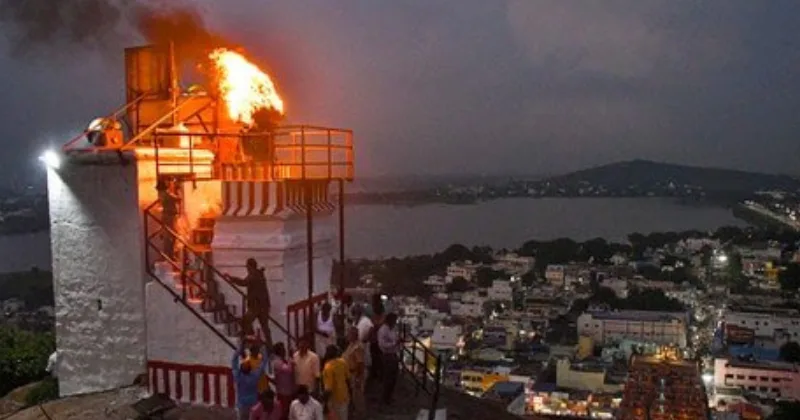
On December 3, 2025, on the slopes of Thirupparankundram hill near Madurai, the constitutional fundamentals of secular governance, judicial supremacy, and religious equality were tested in real time. The issue at hand was not the creation of a new religious claim but the court-ordered restoration of an old Hindu ritual: the lighting of the Karthigai Deepam at the ancient Deepathoon (The sacred place in a Temple where the Resident Deity is worshipped in the light form, by lighting Diya) stone pillar. What followed was not merely an administrative lapse but a chain of executive actions that the Madurai Bench of the Madras High Court itself characterised as willful disobedience of judicial authority.
On December 1, 2025, Justice G.R. Swaminathan ordered the temple administration to light the Karthigai Deepam at Deepathoon in addition to the usual locations. The Court relied on historical records and earlier peace committee resolutions of 1994 and 2005, both of which recorded that the nearby Sikkandar Dargah had expressed no objection, provided a buffer distance was maintained. The Court also made a crucial legal finding: lighting the Deepam at Deepathoon would not affect the Dargah’s rights, whereas denying it could permanently jeopardise the temple’s own customary rights. The police were explicitly directed to ensure that this judicial mandate was not obstructed.
What followed on December 3 was the direct opposite of compliance. The Temple Executive Officer made no arrangements to implement the order. A writ appeal was filed in defective format and abruptly withdrawn. The Single Judge, confronted with this conduct, recorded that the appeal attempt appeared to be a mere ruse to delay obedience. Importantly, the State government itself had not filed any appeal against the December 1 order, which had ordered the temple administration to light the lamp in the Deepathoon on December 3. By six in the evening, when the Deepam should have been lit, it had not been done.
At that point, the Court recorded in unambiguous terms that contempt had already occurred and that the Court’s order had been breached. This was not a tentative observation but a direct judicial finding. In a rare constitutional step, the Court authorised the writ petitioner himself, along with ten others, to climb the hill and light the Deepam, and directed the deployment of CISF personnel to protect them. This extraordinary substitution of citizens and central forces was justified by the Court on the ground that the state police and district administration had collapsed in their duty to enforce the Court’s command.
Instead of facilitating even this symbolic enforcement of judicial authority, the District Collector issued a prohibitory order under Section 163 of the Bharatiya Nagarik Suraksha Sanhita. The stated rationale was the possibility of law-and-order disturbance due to Hindu groups gathering near the temple. When the matter reached the Division Bench the next day in appeal, the original government file on the prohibitory order was summoned. The Bench recorded disquieting facts: the file consisted largely of loose sheets; the prohibitory order itself specifically exempted religious ceremonies; and yet it was used to block precisely the religious activity that the High Court had permitted. The Bench went so far as to observe that either the order had been passed before the judicial direction or the records had been manipulated after the Court called for them.
The appeal, filed by the District Collector and the Commissioner of Police, was dismissed in full on December 4. The Division Bench held that the contempt order did not exceed judicial authority, that changing the person responsible for lighting the lamp was not a modification of the original writ order, and that seeking CISF assistance was legally justified in circumstances where the state police had refused to act. The appeal itself was described as a pre-emptive move to escape contempt scrutiny rather than a bona fide legal challenge.
Most significantly, the Division Bench recorded that the state machinery had failed in its constitutional duty to protect fundamental religious rights. The Court rooted the issue squarely in Articles 25, 26, and 226 of the Constitution. This was not framed as an inter-community dispute but as an executive failure to enforce a neutral judicial directive protecting a Hindu religious practice that had already been cleared of any legal conflict with the nearby Dargah, an Islamic site.
The appointed executive cannot distance itself from these findings. Under India’s constitutional structure, District Collectors and Police Commissioners operate under the authority of the state government. In this case, both officers invoked prohibitory power after a clear court order, both blocked a court-authorised religious act, both were parties to the failed appeal, and both now stand under the shadow of contempt jurisdiction. The responsibility therefore extends beyond individual officers to the political executive currently led by the Dravida Munnetra Kazhagam.
The Thirupparankundram episode cannot be reduced to a routine law-and-order issue. The courts themselves rejected that framing. No irreversible act was ordered. No demolition was directed. No competing prayer rights were extinguished. A lamp was to be lit at an ancient stone pillar as part of a traditional festival. Yet a full apparatus of prohibitory power was deployed against that limited act, in direct contradiction to a subsisting High Court order.
What stands damaged is not merely the religious sentiment of devotees but public confidence in neutral governance. When a High Court is forced to deploy CISF because state police refuse to enforce its mandate, and when an executive prohibitory order is used to override a judicial command in practice if not in law, the idea of even-handed secular administration takes a direct blow.
The Thirupparankundram judgments will endure not as a theological milestone but as a constitutional caution. They place on record that judicial authority was defied, that executive power was used in a legally suspect manner, and that fundamental religious rights required direct court intervention to remain enforceable. Whether this episode will remain an aberration or evolve into a pattern of selective secularism will be determined not by future speeches, but by the conduct of the elected DMK government when similar tests inevitably arise again.
It would be pertinent here to analyse what drives the present TN Government run by the DMK party in these blatant anti Hindu activities.
The Dravida Munnetra Kazhagam has, from its ideological origins, positioned itself in sustained opposition to what it defines as “Hindu orthodoxy”, drawing from a legacy of self-respect rationalism, anti-Brahmin movements, and atheistic politics. Over decades, this ideological posture has repeatedly translated into public campaigns against temples, rituals, and priesthood practices, while leaving other non-Hindu religious institutions linked to Church and Mosque were largely outside the scope of equivalent scrutiny. This asymmetry has been a persistent criticism levelled at the party even when it functioned purely as an opposition force, long before it became an administrative authority.
After assuming political power, this ideological bias has increasingly entered the administrative domain through the State machinery. Policies involving aggressive HR&CE control, selective scrutiny of Hindu customs under the banner of reform, delayed responses to temple rights, and frequent framing of Hindu religious assertion as a “law and order” problem have strengthened the perception that the government applies secularism unevenly. The Thirupparankundram episode sharply amplified this view, as the state administration was judicially found to have failed in enforcing a High Court order protecting a Hindu religious practice, instead invoking prohibitory powers against its execution.
What distinguishes the present phase is that this perception is no longer confined to political rhetoric but is now reflected in formal judicial findings. Courts have recorded executive defiance, selective restriction, and failure to protect constitutionally guaranteed Hindu religious rights. As a result, what was once debated as ideological hostility now increasingly appears, in the public mind, as a pattern of governance where Hindu religious interests face structural disadvantage under DMK rule, even when backed by explicit constitutional and judicial protection.
The Thirupparankundram incident shows how DMK party that takes no pride in Tamil Nadu’s own heritage and views traditions through a colonial lens can use state power in ways that Hindu customs. Its leaders have openly spoken about ending Sanatana Dharma, and this action fits that agenda. What is now clear is that the long-running social-justice narrative propogated by DMK was well used to mask what increasingly resembles a religious anti-Hindu war presented as politics. This episode is making people rethink their political choices and how to protect both true social justice and the religious sentiments and rituals that belong to this land.










Comments