





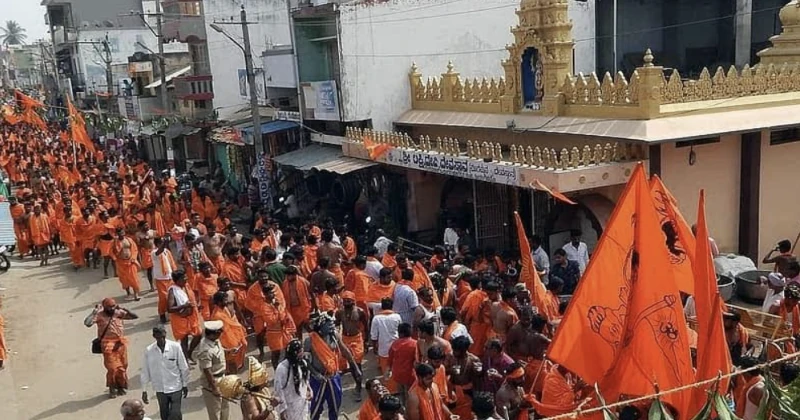
BENGALURU: Srirangapatna, the historic town of Karnataka, became a centre of religious and cultural fervour as the Hindu Jagran Vedike organised the Sankirtana Yatra of the Mudala Dargava Hanuman Maladharis. Devotees filled the streets, chanting Jai Shri Ram and Jai Hanuman, creating an atmosphere charged with devotion, historical consciousness, and a firm assertion of religious identity. The procession, which concluded at the Sri Ranganathaswamy Mandir, sent a resounding message as it passed the Jamia Masjid: “We will build a mandir only.”
The yatra was flagged off by astrologer V. Bhanuprakash Sharma, with participants moving along major thoroughfares under tight security to ensure the event remained peaceful. Lohitraj Urs, the divisional coordinator of the Hindu Jagran Vedike, addressed the gathering, emphasising the historical injustice inflicted on the Hindu community during Tipu Sultan’s reign. “It is true that there was a Hanuman mandir at the site of Jamia Masjid. We will rebuild the mandir and enshrine Hanuman once again,” Urs declared, drawing strong applause and reaffirming the commitment of devotees to reclaim their religious heritage.
Historical records underscore the alleged fundamentalist policies and religious misrule of Tipu Sultan. In 1786, within just five years of consolidating his power as the most influential chief of the Mysore territories, Tipu Sultan constructed the Jamia Masjid at the site of a small Hanuman mandir. The 1935 report of the Archaeological Survey of India (ASI) notes that, influenced by a prophecy from a fakir during his youth, Tipu compelled Hindus to remove the deity and erected the mosque atop the original mandir. While modest in structure, the original Hanuman shrine held local religious significance. Tipu’s actions reflect a pattern of intolerance and coercion, as Hindu religious sites were forcibly replaced by Islamic structures, altering the cultural and religious fabric of the region.
The Jamia Masjid itself is architecturally significant. Its hall with numerous foil arches, the western mihrab, and the twin majestic minārs adorned with floral bands, cornices, and ornamental parapets make it a prominent historical monument. It was one of only two structures in Srirangapatna preserved by the British after their defeat of Tipu Sultan in 1799—the other being his summer palace, the Daria Daulat Bagh. Despite its architectural importance, the mosque also symbolises the legacy of religious coercion and the oppressive policies of Tipu Sultan’s administration.
The Sankirtana Yatra on December 3 reaffirmed the historical memory and religious sentiment of Srirangapatna’s Hindu community. Devotees and Hindu workers expressed their determination to reconstruct the Anjaneya mandir, viewing the effort not merely as a religious act but as a reclamation of cultural and historical identity. The event highlighted how devotion, historical consciousness, and community activism intersect to challenge the legacy of intolerance and assert cultural pride.










Comments