To understand the magnitude of Devavrat Mahesh Rekhe’s achievement, one must first appreciate the extraordinary discipline required to undertake the Dandakrama Parayanam. In the 21st century, where distractions dominate the daily life of most teenagers, Devavrat chose instead to immerse himself in a world of rigorous chanting, ascetic discipline, and spiritual concentration. The feat he has accomplished is so demanding that only a handful of instances exist in documented history, and even those occurred generations ago. Yet this 19-year-old has managed to bring a nearly extinct oral tradition back into the national conversation, with scholars describing his performance as a revival of a “lost civilisational skill.”
At the core of his accomplishment lies the Dandakrama Parayanam of the Shukla Yajurveda, considered one of the most complex and least practised recitation forms in India’s Vedic corpus. Devavrat completed this monumental exercise during a 50-day period in Varanasi, maintaining perfect rhythm, precision, and spiritual adherence without a single break in the sequence. His perseverance has drawn admiration from cultural institutions, religious establishments, and political leaders, including Prime Minister Narendra Modi and Uttar Pradesh Chief Minister Yogi Adityanath. Many scholars and Indologists, both in India and abroad, have noted that such an achievement is rare even among veteran practitioners, let alone a teenager.
Childhood Immersed in Vedic Tradition
Devavrat’s story begins in a deeply traditional Vedic family in Maharashtra, where chanting and scripture study were woven into the rhythm of daily life. His father, Vedabrahmasri Mahesh Chandrakant Rekhe, is a respected scholar in his own right and serves as the chief examiner for the Shukla Yajurveda Madhyandina branch examinations conducted by the Veda Poshaka Sabha of the Sringeri Sharada Peetham. His mother, who prefers to remain away from the public eye, played an equally important role, creating an atmosphere marked by discipline, devotion, and spiritual harmony.
Devavrat began memorising mantras at the age of seven. As he progressed, his teachers and his father noticed traits extremely rare even among Vedic students, remarkable concentration, flawless phonetic pronunciation, and an ability to retain complex sequences over long periods. By the time he turned 17, he had already mastered several advanced styles of recitation. Yet the Dandakrama, considered the summit of Vedic oral mastery, remained an aspiration. The difficulty of this recitation, its declining number of practitioners, and the immense discipline it demands meant that very few had even attempted it. But Devavrat, guided by his father and his teachers, decided to pursue it with exceptional dedication.
Historic Achievement in the Heart of Kashi
From October 2 to November 30, Devavrat undertook the Dandakrama Parayanam at the Vallabharam Shaligram Sangveda Vidyalaya near Ramghat in Varanasi, one of the holiest centres of Vedic learning. The environment demanded complete austerity. Each day involved uninterrupted chanting of meticulously structured mantra sequences that adhere to strict phonetic architecture and rhythm. The discipline required not just physical resilience, but mental acuity and spiritual steadiness.
Scholars of the Sringeri Math note that only three successful attempts of the Dandakrama Parayanam have been recorded in documented history. It is regarded as the pinnacle of the Vikriti recitation tradition, a sophisticated category of chanting that alters standard mantra sequences into intricate sonic patterns. Experts often call Dandakrama a “sound architecture” because of its mathematical structure, the unbroken tonal pathways it demands, and the precision with which syllables must be placed. A single mispronunciation, a misplaced pause, or a momentary lapse breaks the sanctity of the recitation. By all accounts of those who supervised him, Devavrat did not falter even once in the 50-day period.
“This is Guru Kripa”
For the family, the journey was one of immense spiritual gravity. Devavrat’s father described the intense period with visible emotion, saying the accomplishment was not merely the result of human effort but a blessing of the Guru Parampara. He recalled witnessing his son remain unwavering in focus, breath, and clarity for 50 days. The family prayed each day for his physical health and mental steadfastness, aware that the discipline demanded more than academic commitment, it required surrender and devotion.
What turned a quiet spiritual feat into a national moment was a message from Prime Minister Narendra Modi, who represents Varanasi in Parliament. Congratulating the teenager, Modi described Devavrat’s achievement as a “gift to future generations” and praised him as a true embodiment of India’s timeless Guru-Shishya Parampara. His message highlighted how significant it was that the revival of such a rare tradition took place in Kashi, a city revered for its millennia-long association with Vedic scholarship.
Following the Prime Minister’s public acknowledgment, major media houses carried detailed reports about the young scholar. Many described him as “the boy who revived a lost Vedic art” and “a modern custodian of India’s ancient oral legacy.” Indologists from universities in Germany and the United States also responded online, expressing awe that such mastery had been achieved in today’s age, where oral traditions are rapidly vanishing.
Honoured at Sringeri Sharada Peetham
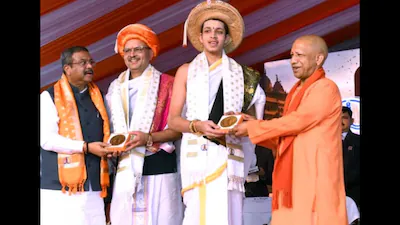
The recognition did not stop there. The Jagadguru Shankaracharyas of the Dakshinamnaya Sri Sringeri Sharada Peetham honoured Devavrat in a special ceremony acknowledging the monumental nature of his accomplishment. He received a gold bracelet worth Rs 5 lakh and a cash prize of Rs 1,11,116, along with a certificate confirming the purity and precision of his Parayanam. During the felicitation, a message of blessing from Jagadguru Sri Sri Bharati Tirtha Mahasannidhanam was read out by Asthana Vidwan Dr. Tangirala Shivakumar Sharma, praising the teenager for reviving one of the rarest jewels of India’s Vedic heritage.
Historians quoted in media say that the Dandakrama Parayanam had almost disappeared over the last 200 years due to the absence of trained teachers, the extreme difficulty of the style, the pressures of modern-day life, and the decline of traditional gurukul systems. Devavrat’s achievement has therefore been considered not merely an individual triumph but a cultural milestone. Scholars believe his example may inspire young students to pursue advanced Vedic learning and help reinstate powerful oral traditions that are precariously close to extinction. Dr. Sharma of the Sringeri Peetham remarked that even if a single student accomplishes this recitation once in a decade, it will be enough to keep the tradition alive.
Despite the widespread recognition and media attention, Devavrat remains grounded. His family says he has already returned to his routine studies and chants, reminding those around him that the work of mastering the Vedas never truly ends. His father says Devavrat knows that this is merely the beginning and that the Vedas demand a lifelong commitment. His future plans include training younger students and participating in advanced recitation programmes across traditional Peethams.
Devavrat’s achievement holds broader cultural significance for India. UNESCO has recognised Vedic chanting as a “Masterpiece of the Oral and Intangible Heritage of Humanity,” and scholars believe feats like his reinforce the importance of India’s oral civilisation. Institutions such as Sringeri Math and Varanasi’s Vedic schools see his journey as evidence that traditional gurukulas can still nurture exceptional talent even in an era defined by technology. His story also serves as an inspiring example for Indian youth, offering a reminder that ancient knowledge systems still hold value and relevance.
For Kashi, a city synonymous with timeless scholarship, Devavrat’s 50-day spiritual journey adds another luminous chapter to its history. For India at large, his accomplishment is a testament to continuity, a sign that even in a fast-moving, digitally drowned world, the oldest traditions can remain alive through the devotion of the youngest practitioners.
In 19-year-old Vedamurti Devavrat Mahesh Rekhe, India has found not just a prodigy, but a revivalist and a guardian of a 5,000-year-old oral tradition. Above all, he stands as proof that even in the youngest voices, the oldest truths can still find their most devoted custodians.