





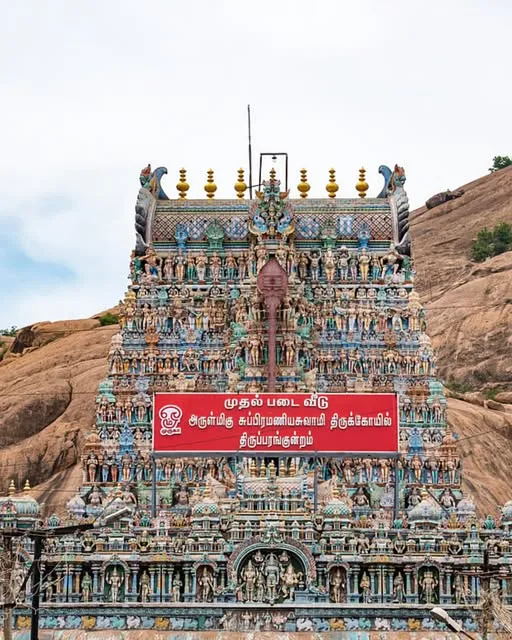
The Madurai Bench of the Madras High Court on Thursday, 4 December, dismissed the petition filed by the State government challenging the contempt of court proceedings with regard to court-ordered lamp lighting at Tiruppanarankundram. It also revoked the Section 144 prohibitory orders issued by the Madurai City Police Commissioner. It is learnt the DMK government may be using temple funds to go for an appeal in the Apex Court.
Saying that the government officials had filed the present appeal only to escape punishment in contempt proceedings, a Division Bench of Justices G. Jayachandran and K.K. Ramakrishnan said, “there is nothing wrong on the part of the Single Judge in having directed CISF to accompany the petitioner for lighting the lamp on the Deepathoon.”
The Bench said, “This Court finds that the order in contempt was not one altering the earlier order of the Court. When the Court found its earlier order was not complied with, the Court directed the devotees to light the lamp… the order only changed the person who was to perform the function as per its order. The appeal, filed with an ulterior motive, is dismissed.”
The DMK government filed an urgent appeal before a Division Bench challenging the contempt of court proceedings initiated against the temple EO and District Collector for non-compliance with the Court’s directions on lighting the lamp atop the stone lighting pillar.
The Court was hearing the appellants, viz. the District Collector, Madurai, and the Commissioner of Police, Madurai City, who filed a Letters Patent Appeal being aggrieved by the order passed by the Single Judge on 3 December.
Counsel appearing for the writ petitioner submitted that it is a clear case of the State administration wilfully disregarding the order passed by the High Court. The majesty of the Court is totally undermined by the conduct of the appellants. After due consideration, the right conferred on a citizen under Articles 25 and 26 of the Indian Constitution, as well as the judicial pronouncement in connection with the right of performing the ceremony of lighting the Deepam at the stone pillar (Deepa Thoon), which is at least 15 metres away from the Darga, has been protected by the learned Single Judge vide his order dated 01.12.2025. The temple is more than 1,200 years old and the custom of lighting the Deepam in the Deepa Thoon is as old as the temple. Just because the practice was discontinued for the past 100 years due to invasion of aliens cannot take away the prevailing right of the worshippers of Thiruparankundram hillock. “While the fundamental right of the citizen had been restored through judicial order, by making intemperate allegations against the learned Single Judge, the contemnors had filed the present appeal to get over their non-compliance of the order passed by the learned Single Judge.”
The judges said, “The learned Single Judge has not passed order immediately. He has taken the submission made by the learned Additional Advocate General on that day that time for lighting the Deepam is not yet came, therefore, he had passed over the matter till 06.05 p.m… The petitioner had been given permission to light the Deepam and CISF personnels were requested to give protection.”
Justifying the deployment of CISF, the Court said, “Single Judge having found that the State machinery wilfully decided not to implement the direction citing pendency of the unnumbered appeal, called upon the assistance of CISF for enforcing the directions. The situation has arisen in which the State Police unable to carry the constitution mandate. There is no illegality in taking the assistance of central force for the said purpose, if the circumstances warrant… We failed to understand that when there is specific order by the High Court to permit the petitioner and others, 10 in numbers, to light the Deepam at the Deepa Thoon, how this prohibitory order can be put against them and whether the executive order passed under Section 163 of BNSS will prevail over the judicial order passed under Article 226 of the Constitution of India is to be decided. We wish this will be decided at the appropriate time.”
The Court said, “It is well designed act of the appellant, who has admittedly not complied the order of the learned Single Judge, dated 03.12.2025, had approached this Court to pre-empt contempt action. It is for the learned Single Judge to test whether their non-compliance of the order dated 03.12.2025 is wilful or not… In earlier order dated 01.12.2025, the responsibility to carry out work was entrusted to the fourth respondent (EO). Later, having found that the fourth respondent failed to discharge his responsibility, the said responsibility has been given to the writ petitioners. This is neither altering the order nor modifying the order, but only changing the person who was supposed to discharge the responsibility of lighting lamp. Therefore, we find this appeal filed with ulterior motive to pre-empt contempt action is liable to be dismissed. With the above observations, this Letters Patent Appeal stands dismissed.”
Meanwhile, BJP leader K. Annamalai came down heavily on the DMK govt. in a post on X, saying by deploying hundreds of police personnel and physically preventing devotees from performing the religious ritual, the DMK regime had exposed the full extent of its appeasement politics. “DMK must answer why Sanatan Dharma is singled out, time and again. Do court orders mean nothing to this govt?”
The DMK Govt’s hostility toward Sanatan Dharma is no longer a matter of interpretation; it is a fact. The Hindu Religious & Charitable Endowment Department (which is supposed to serve Hindu devotees) appealed against a court order blocking the lighting of the sacred Karthigai… pic.twitter.com/EoXkSTt9Hi
— K.Annamalai (@annamalai_k) December 3, 2025
Meanwhile, Single Judge G.R. Swaminathan has revoked the Section 144 orders and directed police to give protection to light the lamp at the stone pillar and file a compliance report on the morning of 5 December. Earlier, the District Collector Praveen Kumar, CoP Loganathan, and temple EO Yagna Narayan appeared through video conference.












Comments