





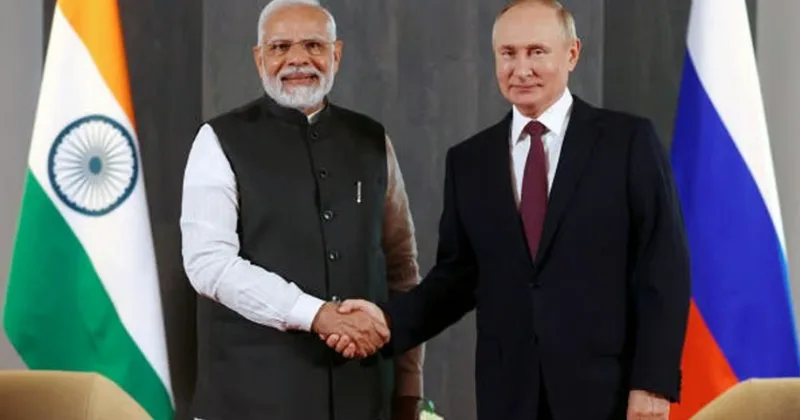
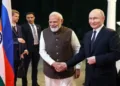
Russian President Vladimir Putin’s visit to New Delhi on 4-5 December 2025 holds immense importance for India, Russia, and the world. It is his first visit to India in last four years, and the first since start of the conflict in Ukraine, which gives the meeting additional relevance. The summit comes at the juncture of 25th anniversary of the India–Russia Strategic Partnership Agreement, signed in 2000 by Putin and the then Prime Minister Atal Bihari Vajpayee. Over the years, the two countries have built a stable partnership in defence, security, energy, space, trade, science, technology, education, and culture. Russia continues to be a reliable ally for India, especially for the defence supplies and crude oil. In the times of increasing global uncertainty and India’s push for strategic autonomy, the current visit is being closely watched
A Changing World Order and India’s Strategic Space
In January 2024, G. John Ikenberry wrote an influential essay, “Three Worlds: the West, East and South and the Competition to Shape Global Order” for International Affairs. He argued that the world is no longer defined by simple bipolarity or unipolar dominance; instead, it has reorganised into three blocs, the Global West led by the United States and Europe, the Global East shaped by China and Russia, and the Global South represented by key non-Western states such as India. The Global South has emerged as a “collective, system-wide power” that can no longer be ignored.
Against this backdrop of fragmented alignments, new power centres, and rising geopolitical competition, India finds itself navigating a complex international landscape. The West is reconsidering its strategic postures, China is asserting its own rules of engagement, and Russia is locked in the military conflict and western sanctions. India, now deeply integrated into the global economy and dependent on stable security partnerships, must constantly recalibrate its foreign policy. It is in this evolving context that Putin’s visit to India acquires unusual significance, offering New Delhi a moment to Re-Assess, Re-Evaluate and Re-Assert its external engagement, particularly with a long-standing partner like Russia.
Reaffirming a Stable and Reliable Partnership
India–Russia ties have historically thrived on predictability and mutual trust. Russia has been one of India’s most stable partners across decades. Russia has been supplying defence technologies, supporting India in multilateral forums, and maintaining political reliability even during moments of international turbulence. While India’s ties with the United States have strengthened over the past decade, they have now run into a ‘Trump bump’—a moment of uncertainty and recalibration in Washington that India cannot ignore. This has compelled the Indian strategic establishment to avoid overdependence on any single bloc.
In this volatile environment, a reliable partner becomes invaluable. Putin’s upcoming visit, his first in four years, and the size of his accompanying delegation, comprising Defence Minister Andrei Belousov and high-level delegates from business and industry, signal Moscow’s intention to deepen cooperation. This signifies that Russia sees India as a crucial diplomatic and economic interlocutor at a time when much of the world is attempting to isolate Moscow.
India’s Independent Foreign Policy on Display
The most important message of this visit is that India continues to pursue an independent foreign policy, one anchored in national interest rather than global pressure. India has expressed concerns over the Putin’s Ukraine war, diversified its energy sources, and reduced its reliance on discounted Russian crude. Yet India has not joined Western sanctions, has not severed political ties with Moscow, and is hosting President Putin at a time when most major capitals are unwilling to do so. President Trump’s move to punish India with tariffs for its continuing trade with Russia has not hampered the bilateral relations as India remains steadfast in its partnership with Moscow.
This signals three things of Prime Minister Modi’s foreign policy: first, India charts its own course in international affairs; second, it values continuity and refuses to oscillate with every geopolitical shock; and third, it honours long-term friendships even when they become inconvenient for others. In a world where narratives and “realities” shift every nano-second, India’s steadiness becomes a strategic message in itself. Welcoming Putin—even while criticising aspects of Russian policy—reflects India’s nuanced diplomacy: principled but autonomous, values-driven yet interest-focused.
Defence, Energy and New Areas of Cooperation
Defence cooperation remains the backbone of India–Russia relations, and this visit is expected to reinforce that foundation. Discussions will likely include completing the delivery of S-400 air defence systems, exploring pathways for India’s participation in the Sukhoi-57 (Su-57) fifth-generation fighter programme, and expanding collaboration in small modular nuclear reactors (SMRs). India aims not only to procure but to co-develop and co-produce systems in line with Prime Minister Modi’s Aatmanirbhar Bharat vision. Energy cooperation, though under strain, continues to be a sensitive but manageable space. India’s crude imports from Russia are set to hit a three-year low, largely because of tightening sanctions and logistical bottlenecks, even as New Delhi increases purchases of US oil and gas. This shift is driven by practical constraints rather than political distancing. Beyond defence and energy, the visit is expected to unlock progress in agriculture, shipping, and civilian nuclear energy. India and Russia are discussing the acceleration of the Chennai–Vladivostok Maritime Corridor, collaboration on the Northern Sea Route, and new reactors beyond Kudankulam. A major highlight of the economic agenda will be the initiation of talks on a Free Trade Agreement with the Eurasian Economic Union (EAEU)—a move agreed upon in August and poised to reshape Eurasian commerce.
How the World Will Interpret the Visit
This visit is likely to invite mixed but measured reactions from across the world. In Washington, there will be cautious observation rather than overt criticism. Recent U.S.–Russia backchannel discussions about potential de-escalation in Ukraine may ease concerns about India’s engagement with Moscow. Yet Indian officials are worries that any new defence or energy deals could provoke a reaction from Trump including continuation of the 50% tariffs. Europe may express discomfort but recognises India’s indispensable role in global supply chains and its right to strategic autonomy. Across the Global South, however, India’s decision to maintain open channels with Moscow are viewed positively, as an assertion of the very autonomy that defines Southern diplomacy in Ikenberry’s “Three Worlds” framework. By hosting Putin, India demonstrates leadership within this emerging bloc, signalling that the Global South cannot be coerced into alignment but will act as an independent pole of power.
A Visit That Reinforces India’s Strategic Identity
Putin’s State Visit is far more than a ceremonial exchange. It is a moment of geopolitical clarity! Through this visit, India reiterates that stable partnerships matter, independent decisions matter, and long-standing friendships matter. As the world restructures itself into competing blocs, India refuses to be pulled entirely into any one camp. It welcomes cooperation with the West, deepens ties with the East, and asserts leadership within the global South. Putin’s visit reaffirms that Prime Minister Modi’s foreign policy remains guided by continuity, autonomy and national interest. In a fragmented world order, the India–Russia partnership stands as a strategic anchor. It is a reminder that India is not merely a passenger in global affairs, but a force shaping the trajectory of the international system.








Comments