Delhi Blast: Pakistan signals new phase of Jihad against Bharat
December 5, 2025
  • Read Ecopy
  • Circulation
  • Advertise
  • Careers
  • About Us
  • Contact Us
Android AppiPhone AppArattai
Organiser
  • ‌
  • Bharat
    • Assam
    • Bihar
    • Chhattisgarh
    • Jharkhand
    • Maharashtra
    • View All States
  • World
    • Asia
    • Europe
    • North America
    • South America
    • Africa
    • Australia
  • Editorial
  • International
  • Opinion
  • RSS @ 100
  • More
    • Op Sindoor
    • Analysis
    • Sports
    • Defence
    • Politics
    • Business
    • Economy
    • Culture
    • Special Report
    • Sci & Tech
    • Entertainment
    • G20
    • Azadi Ka Amrit Mahotsav
    • Vocal4Local
    • Web Stories
    • Education
    • Employment
    • Books
    • Interviews
    • Travel
    • Law
    • Health
    • Obituary
  • Subscribe
    • Subscribe Print Edition
    • Subscribe Ecopy
    • Read Ecopy
  • ‌
  • Bharat
    • Assam
    • Bihar
    • Chhattisgarh
    • Jharkhand
    • Maharashtra
    • View All States
  • World
    • Asia
    • Europe
    • North America
    • South America
    • Africa
    • Australia
  • Editorial
  • International
  • Opinion
  • RSS @ 100
  • More
    • Op Sindoor
    • Analysis
    • Sports
    • Defence
    • Politics
    • Business
    • Economy
    • Culture
    • Special Report
    • Sci & Tech
    • Entertainment
    • G20
    • Azadi Ka Amrit Mahotsav
    • Vocal4Local
    • Web Stories
    • Education
    • Employment
    • Books
    • Interviews
    • Travel
    • Law
    • Health
    • Obituary
  • Subscribe
    • Subscribe Print Edition
    • Subscribe Ecopy
    • Read Ecopy
Organiser
  • Home
  • Bharat
  • World
  • Operation Sindoor
  • Editorial
  • Analysis
  • Opinion
  • Culture
  • Defence
  • International Edition
  • RSS @ 100
  • Magazine
  • Read Ecopy
Home Bharat

Delhi Red Fort Blast: Pakistan signals new phase of Jihad against Bharat

The deadly Red Fort blast on November 10—India’s first major terror strike in the heart of the national capital in a decade—has signalled a disturbing evolution in Pakistan-backed jihadist strategy. What makes this strike particularly alarming is the pattern shift it reveals: the audacity to hit India’s core, the silence of terror outfits in claiming responsibility, and the emergence of highly radicalised, professionally qualified operatives—a stark departure from past modules led by Indian Mujahideen or banned outfit like SIMI

Srijan SharmaSrijan Sharma
Dec 4, 2025, 08:00 pm IST
in Bharat, World, Delhi, Haryana
Follow on Google News
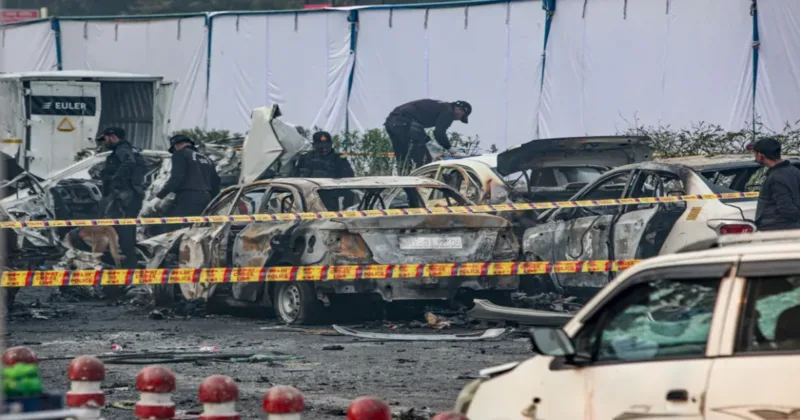
Site of the Delhi Blast that took place on November 10, 2025

Site of the Delhi Blast that took place on November 10, 2025

FacebookTwitterWhatsAppTelegramEmail

On November 10, after a decade, India experienced its first terror attack on its heartland, starting from the capital, which killed 13 and injured more than 20.  The largest bomb strike in India since the 2006 Mumbai train bombings has nearly blurred the red lines of terror against India. The bomb blast at the Red Fort must be seen as a serious warning or sign of upcoming dangers for India, as it indicates multiple significant patterns shifts in the terror cycle against India and possibly a new beginning of Jihad against India.

The Shift 

There are three shifts worth noting after the horrific terror incident in Delhi. First, terror gloves are off now, which shows the audacity to strike India in its heartland—a dangerous stance that was prominent from the early to mid-2000s, diminished after 2014, and shifted focus to Kashmir. Second, the tone and nature of terror modules have also undergone a major change. Earlier, the pattern was direct, with terror outfits and their splinter groups directly recruiting and carrying out attacks with full responsibility. Third: complexity and silence—until now, no terror outfit has claimed responsibility for the Red Fort terror attack, which is a troubling shift—indicating an increasing depth of subversive terrorism aimed at staging both direct and indirect attacks through multiple methods—sabotage, institutional infiltration, front groups, kidnappings, assassinations, etc.

The shift may resemble what LeT supported, Indian Mujahedin, and SIMI, where radicalisation focused on youth and students who formed the core of IM and SIMI. Both terrorist groups targeted urban areas and used high-impact serial blasts to create shock. The SIMI group had about 90 percent of its members as students with bachelor’s degrees, supporting Osama Bin Laden’s goals through radical social activities—such as violence and protests. The main factor that drove SIMI, an organisation historically established for religious education and reform, toward more terror and extremist activities was fractured communal lines and some external inspiration from the 1979 Iranian revolution, rejecting secularism and democracy.

Also Read: Make in India gets pharma push: PLI schemes and industrial parks drive domestic manufacturing expansion

However, after the government banned SIMI, it received support from external terror groups such as LeT and the Bangladesh-based Harkat Ul Jihad, which later contributed to the formation of the Indian Mujahideen in 2003, two years after the ban on SIMI. This led to a phase of indirect attack methods, where the main outfit enables strikes by indirectly facilitating bombings. The infamous ISI’s Karachi Project involved LeT and other terror groups training Indian youth to carry out terror attacks in India. The modus operandi was to train these youths through brainwashing and operational training with IEDs, then facilitate their movement to major cities and wait for instructions to carry out bomb strikes. Interestingly, they were taught how to construct IEDs using locally available materials to avoid leaving a clear trail of Pakistani involvement, giving Pakistan a chance at plausible deniability and creating a band of radicalised Indian youths, especially Muslims. This indirect method—the Karachi Project—became a nightmare for India from 2005 to 2010, leading to bombings in Jaipur, Pune, and Ahmedabad.

The case of Sayed Zabiuddin Ansari a.k.a. Abu Hamza, who was Indian-born in Maharashtra, played a role in planning the 26/11 attacks, especially teaching Hindi to terrorists and giving them instructions through VoIP. Another interesting case is Yasin Bhatkal, who was born in Karnataka and later became a prominent figure and co-founder of Indian Mujahideen. Bhatkal played a key role in carrying out a series of bombings, including the 2011 Mumbai Bomb Blasts, 2012 Pune, and 2013 Hyderabad blasts.

This indirect method involved spotters who identify uneducated youth and some educated individuals, exploiting communal fault lines to brainwash them, which mainly involves blue-collar workers. The cases of Bhatkal and Ansari are examples of blue-collar individuals, as both of them did not complete their education.

The Dangerous Shift: White Collar Terror

Perhaps for the first time in India’s terror landscape, a complete group of white-collar recruits with full professional degrees and skillsets has carried out a bomb strike. The emergence of white-collar terror could signal another shift from Pakistan’s ISI. This shift involves a hybrid of indirect and inspired methods, where online propaganda and training by terror outfits like Jaish and LeT motivate self-radicalized individuals to carry out attacks, especially lone-wolf attacks.

The case of four doctors, one of whom carried out a bomb strike near the Red Fort, indicates a pattern more aligned with inspired terror, but it also includes some indirect elements, such as establishing contact with certain outfits, Kashmiri terror modules’ top commanders, and facilitating support from outside if some reports are to be believed. However, what is concerning is the strike pattern, which leans more towards Inspired methods. If this inspired method develops further, it could trigger a wave of lone wolf attacks. An example is the 2016 Nice attack. Though the perpetrator, Mohamed Lahouaiej-Bouhlel, acted on his own, ISIS later claimed responsibility for his actions.

Conversely, there is the April 7, 2017, truck attack in Stockholm, Sweden, where a similar vehicle ramming incident occurred. In this case, ISIS did not claim responsibility for the self-radicalised man’s attack. The organisation was under intense pressure at that time, and US-led coalition forces had significantly damaged its presence and capabilities; by the end of the year, ISIS was defeated in Iraq.

Pakistan’s New Terror Plan

Pakistan’s ISI may have transformed their informal Karachi Project into a more advanced and intricate operation, potentially denying involvement and remaining concealed during terror attacks in India through this new initiative. The hybrid approach of indirect and inspired tactics could enhance terror groups’ capacity for subversive activities by targeting more professional and skilled operatives to maintain cover and infiltrate institutions. Most concerningly, it provides a range of strike options, from bombings to lone wolf attacks. The modus operandi would be simple—execute a strike, avoid claiming responsibility, and spark a wave of radicalism in India, rekindling the nightmare that IM once caused, but this time with minimal human or direct terror network involvement, thus sidestepping India’s large-scale retaliatory measures. While much remains to be understood and determined about this potential shift and new terror module, India must consider strategies beyond kinetic operations and focus on non-kinetic counter-terrorism methods to prevent, counter, and address the conditions enabling terrorism.

Topics: Delhi BlastWhite Collar TerrorDelhi Blast CasePakistanJIhad
ShareTweetSendShareSend
✮ Subscribe Organiser YouTube Channel. ✮
✮ Join Organiser's WhatsApp channel for Nationalist views beyond the news. ✮
Previous News

Russia is India’s strategic partner in technology, defence: Rajnath Singh amid bilateral meet with Russian Def Minister

Next News

Former Mizoram Governor Swaraj Kaushal passes away; PM Modi expresses condolences

Related News

Retired Subedar held for leaking Army details to Pak handlers posing as Indians

Gujarat ATS dismantles spy network involving Ex-Army personnel and woman for sharing information with Pakistan

Pakistan's Prime Minister Shehbaz Sharif Afganistan's Foreign Minister Amir Muttaqi and India's Foreign Minister S Jaishankar

Afghanistan rebukes Pakistan, defends right to build stronger ties with India

Former nursing staff reveal preparation of fake patient files at University (Image via Bhaskar)

Delhi Blast Case: Ex employee at Al Falah University alleges fake patient files & discrimination against Hindus

Pakistan's Chief of Army Staff Asim Munir, Aleema Khan and ex-Pak PM Imran Khan

Aleema Khan, sister of Imran Khan, accuses Asim Munir of Islamist hardline driving Pakistan toward conflict with India

From Maqbool Sherwani to Maqbool Butt: Jammu Kashmir dwindles Between Nationalism and Separatism

Former Pakistani Prime Minister Imran Khan (Left) and Field Marshal Asim Munir (Right)

Pakistan: Imran Khan claims severe mental torture in jail, blames Asim Munir for harsh treatment

Load More

Comments

The comments posted here/below/in the given space are not on behalf of Organiser. The person posting the comment will be in sole ownership of its responsibility. According to the central government's IT rules, obscene or offensive statement made against a person, religion, community or nation is a punishable offense, and legal action would be taken against people who indulge in such activities.

Latest News

Chhattisgarh CM Vishnu Deo Sai at Panchjanya Conclave, Nava Raipur, Image Courtesy - Chhattisgarh govt

Panchjanya Conclave: Chhattisgarh CM Sai shares views on development projects in Maoist hotbed, women empowerment

Union Finance Minister Nirmala Sitharaman

‘TMC is holding Bengal back’: Sitharaman slams Mamata govt over industrial & healthcare setbacks

Karnataka: Muslim youth Mohammed Usman accused of sexual assault, blackmail & forced conversion in Bengaluru

Social Justice Is a cover; Anti-Sanatana dharma is the DMK’s real face at Thirupparankundram

Karnataka: Hindus demand reclaiming of Anjaneya Mandir at the site of Jamia Masjid; Setting wrongs of Tipu Sultan right

Assam govt proscribes all forms of Jihadi literatures in state; Islamic terror groups trying to recruit Muslim youth

Retired Subedar held for leaking Army details to Pak handlers posing as Indians

Gujarat ATS dismantles spy network involving Ex-Army personnel and woman for sharing information with Pakistan

Economic freefall of West Bengal: Mamata’s “Paribartan” turns to crisis; 207 Companies gone in six months

Prime Minister Narendra Modi and Russian President Vladimir Putin

India on the side of “peace” in Russia-Ukraine conflict, PM Modi asserts for swift peaceful solution

Russian Economic Development Minister Maxim Reshetnikov and Commerce and Industry Minister Piyush Goyal

Piyush Goyal holds talks with Russian counterpart, discusses cooperation in textiles, automobiles and agriculture

Load More
  • Privacy
  • Terms
  • Cookie Policy
  • Refund and Cancellation
  • Delivery and Shipping

© Bharat Prakashan (Delhi) Limited.
Tech-enabled by Ananthapuri Technologies

  • Home
  • Search Organiser
  • Bharat
    • Assam
    • Bihar
    • Chhattisgarh
    • Jharkhand
    • Maharashtra
    • View All States
  • World
    • Asia
    • Africa
    • North America
    • South America
    • Europe
    • Australia
  • Editorial
  • Operation Sindoor
  • Opinion
  • Analysis
  • Defence
  • Culture
  • Sports
  • Business
  • RSS @ 100
  • Entertainment
  • More ..
    • Sci & Tech
    • Vocal4Local
    • Special Report
    • Education
    • Employment
    • Books
    • Interviews
    • Travel
    • Health
    • Politics
    • Law
    • Economy
    • Obituary
  • Subscribe Magazine
  • Read Ecopy
  • Advertise
  • Circulation
  • Careers
  • About Us
  • Contact Us
  • Policies & Terms
    • Privacy Policy
    • Cookie Policy
    • Refund and Cancellation
    • Terms of Use

© Bharat Prakashan (Delhi) Limited.
Tech-enabled by Ananthapuri Technologies