





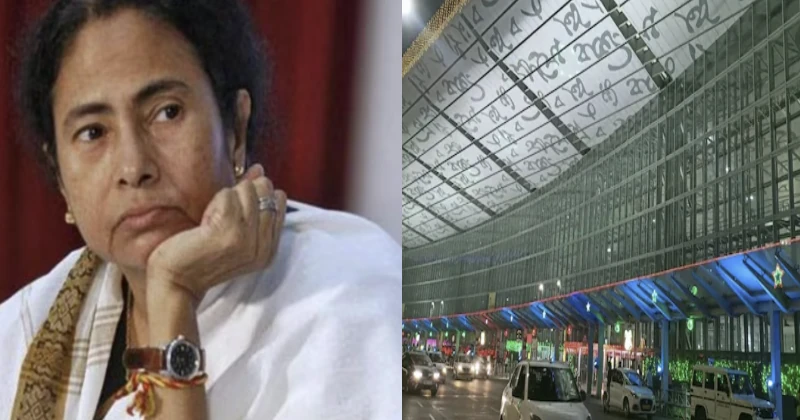
Kolkata: Kolkata’s Netaji Subhas Chandra Bose International Airport has once again found itself at the center of controversy and this time, it involves a century-old mosque located dangerously close to the airport’s secondary runway. The Bankra mosque, built in the 1890s, predates the airport itself and has become a symbol of conflict between heritage, religion, and modern aviation safety.
The issue resurfaced in December 2025 after West Bengal BJP chief Samik Bhattacharya raised the matter in the Rajya Sabha. The Ministry of Civil Aviation (MoCA) admitted that the mosque obstructs the secondary runway, forcing an 88-metre displacement of the northern threshold, reducing usable runway length and affecting emergency aircraft operations. The revelation has ignited a debate over passenger safety, airport expansion, and alleged “appeasement politics” by the Mamata Banerjee-led TMC government.
The Kolkata Airport obstruction is not an accident, it’s the direct result of Mamata Banerjee’s shameless appeasement politics.
A mosque standing inside the operational area has forced an 88-metre runway displacement, compromising national security and endangering passengers and… pic.twitter.com/gi9w8m0YZd
— BJP West Bengal (@BJP4Bengal) December 3, 2025
The Bankra mosque was built in the late 19th century in what was then a small village near Dum Dum, on the northern outskirts of Calcutta. At the time, the area was sparsely populated, and the mosque served the local Muslim community.
In 1924, the British established an aerodrome near Dum Dum Cantonment, laying the foundation for the modern airport. The village surrounding the mosque continued to exist even as the airfield expanded. By the 1950s and 1960s, growing air traffic necessitated expansion of the airport. Villages to the north and west of the primary runway were cleared, and residents were relocated across Jessore Road to what is now Madhyamgram. However, the mosque was left untouched, reportedly due to an understanding reached during land acquisition that preserved this historic religious site.
Over the decades, the mosque remained in place even as the airport grew into a major international hub. While the surrounding area was integrated into airport infrastructure, the mosque became an anomaly inside a high-security operational zone.
The MoCA’s admission confirmed that the mosque sits directly in the approach path of the secondary runway 19R-01L, forcing the displacement of the northern threshold by 88 metres. While the secondary runway is primarily used when the primary runway is under maintenance, the displacement limits runway usability in emergencies, reducing operational efficiency and potentially compromising passenger safety.
The mosque also prevents critical infrastructure developments, including:
- Runway extension to accommodate larger aircraft.
- Construction of connecting taxiways, which could reduce aircraft taxiing time.
- Full operational utilisation of the secondary runway, limiting airport efficiency during peak hours.
In 2023, the AAI instituted a bus service to ferry worshippers into the mosque inside the operational zone, creating further complications as the pathway overlaps with taxiways used by aircraft. On busy days, the mosque sees 200–250 visitors, with higher footfall during Fridays and the holy month of Ramadan.
Despite decades of safety concerns, attempts to relocate the mosque have repeatedly failed due to opposition from the mosque’s managing committee and political inaction:
- 2003: Union Civil Aviation Minister Shahnawaz Hussain and West Bengal CM Buddhadeb Bhattacharjee met to resolve the issue. Instead of relocating the mosque, authorities opted to divert the runway after the mosque committee refused to move.
- 2019: The AAI proposed building a tunnel from Jessore Road to the mosque to free the land above for a taxiway. Security-clearance hurdles stalled the plan.
- 2020s: Multiple proposals from the AAI and requests from political leaders to shift the mosque were met with resistance, leaving the mosque operationally problematic.
BJP leaders, including Suvendu Adhikari, have repeatedly highlighted the safety risks, arguing that allowing civilian access to a secured airport zone is a serious security lapse.
The BJP has accused Mamata Banerjee and her government of sacrificing passenger safety and operational efficiency in the name of appeasement politics. Amit Malviya, head of the BJP IT Cell, tweeted:
“Passenger safety cannot be sacrificed by appeasement politics. The mosque obstructs safe aircraft operations, displaces the runway threshold by 88 metres, and affects emergency utilization. Mamata Banerjee must take responsibility.”
BJP Bengal State President Samik Bhattacharya raised a crucial question in the Rajya Sabha about the Mosque inside the operational area of Kolkata Airport and the government has now officially confirmed the obstruction.
The Ministry of Civil Aviation has admitted that:
◼️ A… pic.twitter.com/cGlBikMJs2
— Amit Malviya (@amitmalviya) December 3, 2025
Over decades, the TMC and previous Left Front governments have deliberately avoided relocating the mosque, allowing political considerations to override the practical needs of aviation safety and infrastructure modernisation.
Kolkata airport was once among India’s top three international hubs, handling flights from Europe, North America, East Asia, and Australia. Over time, it has slipped in rankings to sixth place in 2024–25, partly due to constraints posed by the mosque on runway expansion.
The mosque’s presence inside a high-security zone also raises serious national security concerns. Critics note that unrestricted access to a restricted area undermines security protocols, creating a potential vulnerability in one of India’s critical infrastructure zones.
Further, the demolition of old terminal buildings, essential for the new integrated terminal project, has been delayed, pending Bureau of Civil Aviation Security (BCAS) clearance. Until the mosque issue is resolved, long-term airport expansion remains constrained.
The Bankra mosque’s presence in the middle of a modern international airport creates a complex clash between heritage preservation and aviation safety. Decades of political indecision have led to a scenario where:
- A 19th-century mosque blocks the operational expansion of a 21st-century airport.
- Passenger safety and emergency operations are compromised due to runway displacement.
- Airport modernisation and growth plans are stalled, delaying infrastructure projects that could benefit millions of travelers.
BJP leaders insist that the TMC government must finally take responsibility, relocate the mosque, and prioritise passenger safety and airport development over political expediency.















Comments