





Madurai: The Madurai Bench of the Madras High Court on December 3 launched contempt proceedings against senior district authorities—including the Thiruparankundram temple Executive Officer (EO), the District Collector, and the Commissioner of Police—after they failed to carry out the court’s explicit order directing the lighting of the Deepam atop the Thiruparankundram hillock at the ancient Deepathoon stone pillar on Karthigai Deepam day.
In a strongly worded order that ran over 13 pages, Justice G.R. Swaminathan criticised what he described as a deliberate and coordinated attempt by the temple administration and district authorities to subvert a lawful judicial order. The judge noted that although the court’s directive was issued on December 1, with sufficient time for compliance, the officials chose instead to file a last-minute appeal—through a party that was not even aggrieved—using what the judge described as a “defective format,” resulting in the appeal not being listed for hearing.
“A ruse to disobey the order of the Court”
In the order, Justice Swaminathan remarked that the temple administration’s actions amounted to clear defiance.
“The Dargha, which alone can be said to be the aggrieved person, has not filed any appeal. The temple cannot be said to be aggrieved at all. Filing an appeal in defective format appears to be a ruse to disobey the order of this Court,” he observed.
மதுரை மக்களே… அடுத்த முறையும் மறக்காமல் பீமுக கூட்டணிக்கே ஓட்டு போடுங்கள்…. pic.twitter.com/o7HwUbooUV
— "ERIMALAI" RAJ ( Modi's Family ) (@ErimalaiRaj) December 2, 2025
The judge said the respondents had every opportunity to list their appeal before a Division Bench during normal court hours, but no such attempt was made. Instead, the EO stopped responding to phone calls, the court was told.
Chaos on the hill and in the town
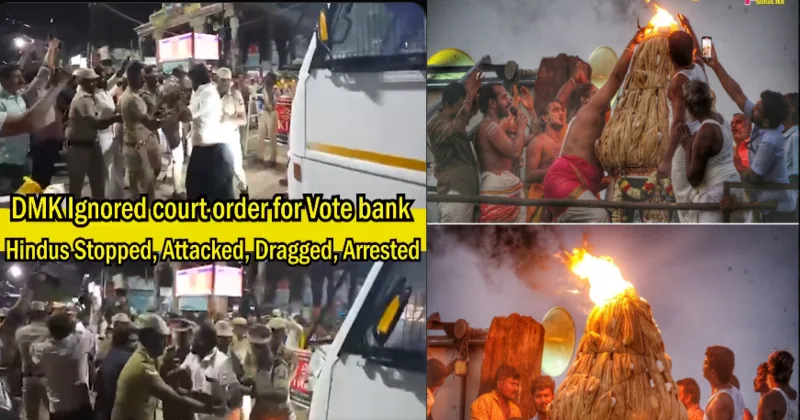
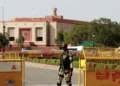
As the deadline drew near, the Deepam was lit at the Uchi Pillaiyar Temple at 6 p.m., but the Deepathoon remained unlit in direct violation of the High Court’s order. Barricades were erected around the stone pillar, and heavy police deployment prevented devotees from proceeding to the top of the hill.
This triggered anger among devotees. When the Deepam failed to appear at the usual time, crowds reportedly surged toward the pathway, leading to a brief altercation in which a head constable sustained injuries. Protesters soon blocked the main road near Thiruparankundram town entrance, demanding compliance with the court’s directive.
Madurai, Tamil Nadu: The Madurai Bench of the Madras High Court has ordered that, with the assistance of the CISF, the petitioners may go up the Thiruparankundram hill and light the lamp on the Deepam pillar located near Sikandar Dargah. In a short while, the petitioners will be… https://t.co/S5cs24O2hd
— ANI (@ANI) December 3, 2025
Adding to the already volatile situation, Muslim organisations announced plans to lay siege to the District Collector’s office on December 3, escalating tensions further.
Court says Executive defied orders “willfully”
Justice Swaminathan rejected the state’s contention that the contempt plea was premature.
“That contempt has been committed is beyond dispute. The order of this Court has been breached. The authorities have made it clear they would not implement the order of this Court,” he said.
The judge underscored a fundamental principle: “So long as my order is not stayed or set aside, it has to be complied with in letter and spirit. The Executive cannot remain in hibernation.” He added that defying a judicial order without facing any consequences would set a dangerous precedent and “sound the death knell of democracy.”
Left parties, critics and political undertones
The situation soon acquired a political dimension, with Left parties condemning the High Court order and accusing the judge of giving a communal colour to the issue. Critics of the state government argued that the administration’s actions reflected a pattern of appeasement politics and hostility toward Hindu religious practices under what is described as the “Dravidian Model” governance.
One critic alleged: “Time and again the DMK government has shown rabid Hindu phobia by taking anti-Hindu measures. These moves are meant to appease minorities and create panic among devotees.”
According to another observer, deploying police and heavy equipment like the Vajra vehicle created a sense of fear as though violence or a major security threat was imminent—despite the issue being a symbolic religious ritual.
CISF steps in: Court bypasses Tamil Nadu Police
In an unusual move, the court directed the Central Industrial Security Force (CISF) to enforce its order instead of the Tamil Nadu police.
Justice Swaminathan instructed a 48-member CISF contingent to accompany the petitioner, Rama Ravikumar, and up to ten devotees to the hilltop to light the Deepam themselves—a symbolic but significant gesture meant to uphold the authority of the judiciary.
“Contempt jurisdiction is not only about punishment but also about restoring the status quo,” the judge said.
“I am conscious this is only symbolic, but the importance of symbolism cannot be lost sight of.”
By Tuesday night, the CISF team escorted the petitioners to the hill, following strict security protocols.
Section 144 invoked, restrictions tightened
As tensions rose, the Madurai District Collector issued prohibitory orders under Section 163 of the Bharatiya Nyaya Sanhita (equivalent to Section 144 of CrPC) across the Thiruparankundram region. The order cited “emergent law and order concerns” and barred gatherings to prevent possible clashes between devotees, political groups, and counter-protesters.
Critics alleged that the state government was using the situation to craft a narrative of victimhood.
“DMK expects some violence, hoping it could lead to the dismissal of the government, which they will turn into a martyr-dom narrative,” a political analyst said.
Some also alleged that during recent electoral roll revision drives, detailed personal information—including bank details—was collected, hinting at potential misuse ahead of polls.
The court ordered compliance to be reported on December 4 at 1 p.m., indicating that further action — including punitive measures — could follow based on the state’s conduct.











Comments