





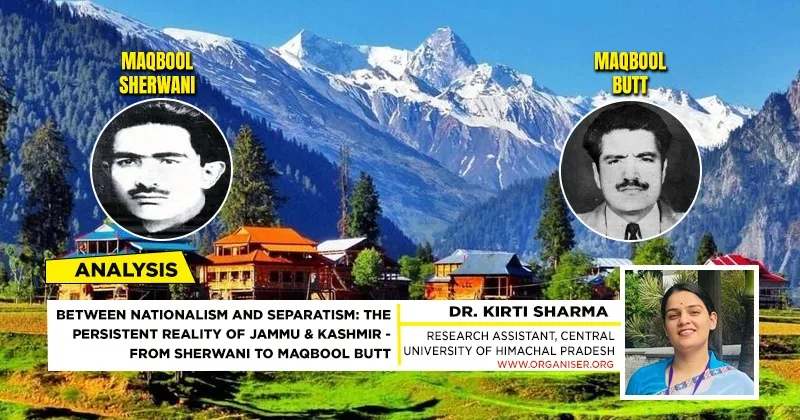
‘Kashmir’ is a word derived from the Sanskrit words ‘Kashyapa’ and ‘Mira’, signifying the sea, lake, or mountains associated with Sage Kashyapa. Many religions have flourished in Jammu and Kashmir (J&K), from Shaivism to Islam, and many rulers have ruled here, from the Mughals to the Dogras. The land has always provided its essence to every human that has lived on it, whether they ruled it or ruined it. Inhabitants of J&K have nurtured their native lands with their blood and sweat, sacrificing for the protection of the sacred land and its dwellers. At the same time, traitors have traded the land for their odious motives at the expense of innocent lives and the fortunes of its people. The indomitable spirits of its martyrs have fought against traitors for ages, despite their wicked motives for Kashmir.
During 1947, when Pakistan attacked Jammu and Kashmir on October 22, the whole state was in confusion with deaths, rapes, loot, arson and other kinds of barbarity expected from Pakistani attackers. The entire state was divided into two groups: those who accepted the attack and believed it was the day of judgment, or wanted to have a new moon in Kashmir, but did not want to fight because they could not betray their Muslim brothers from Pakistan. Others believed that they cannot let anyone capture their land by force and torture because they have nourished it, and wanted to fight back attackers. Among the few who chose to resist Pakistani attackers during the 1947 attack was Mohammed Maqbool Ahmad Sherwani from Baramulla, a 19-year-old boy who displayed remarkable strength and courage in confronting the Pakistani attack on J&K. Sherwani kept state before religion, and the opposite was the case with traitors of Kashmir.
Sherwani was recalled during such times as one who had attempted to disturb the public meeting that Mohammad Ali Jinnah addressed in 1944 on his way back from Kashmir. So, he was an eyesore to Pakistan. When Pakistan attacked Kashmir few Hindu families who escaped the wrath of Pakistani attackers from Muzaffarabad came to Sherwani and narrated the barbarity of the attackers on Hindus. Sherwani comforted families and helped them reach safer places. Sherwani gathered local people and trained them to counter Pakistani attackers. On his one call, villagers came forward to counter Pakistan. Meanwhile, when Sherwani was preparing for confrontation, Pakistani attackers captured Baramulla and killed eleven thousand Muslims there.
When Maqbool left Baramulla for Srinagar, at that time, the attackers were a little far from it, and he was sure that the Indian army would arrive at Srinagar to help the people at Baramulla. But they were late because of the formalities of accession. So, he moved again to Baramulla to collect a force like in Srinagar with every old and young, and women in it to help the people to fight against attackers. Sherwani even diverted the attackers from reaching Srinagar. He cultivated friendships with the attackers and showed them the route opposite to one reaching Srinagar. His strategic move helped Maharaja Hari Singh to buy time to proceed with accession to the Union of India. Pakistani officers want Kashmir to join Pakistan to form a central Muslim state, which will connect their brothers in the Middle East and revive the glory of ancient Islamic democracy in a world ridden with disbelief.
Somehow, Sherwani was captured by the eyes of the raiders, and they came to his home to arrest him. He escaped from the roof of his house but was captured by them because he fell into a drain. They smashed his head and beat him with the buts of rifles. They arrested him and took him to an old horse stable. The stable was congested with attackers and their bullets. When he was brought there, everyone gazed at him like he was a prisoner and everyone wanted to kill him like he was a traitor. Everyone called him a kafir. There was a leader of attackers called Zaman Khan, who locked Sherwani inside a dark room till Sardar Khurshid Anwar, the head of attackers from Pakistan, came to decide his fate.
Maqbool Sherwani: The embodiment of nationalism
In front of them, Sherwani was tortured brutally, but he didn’t say a word because he felt it was worthless to make them understand the importance of the Kashmiri land. Pakistani attackers wanted to know the purpose of Sherwani in the city and why he went to Srinagar some days back. Who were the people who were making plans to stop the Liberation Army of Pakistan from occupying Srinagar? Sherwani was accused of being pro-Bharat, who is helping India or guiding the Indian Forces. The attackers considered Sherwani to be a traitor because, being a Muslim, he was helping the Indian Army as well as planning with them to sell Kashmir into the hands of Jawaharlal Nehru through a “corrupt Hindu raja”. Because Sherwani misled the attackers to reach Srinagar, he became the biggest enemy of the brutal attackers.
Maqbool Sherwani can protect his life from those attackers by accepting their offer to him of joining the Pakistan Liberation Army, but Sherwani refused the proposal again and again, because he cannot betray his land. For him, the dignity and honour of the land were important. Sherwani said, “The land which gave birth to me (Kashmir), this land which is like a poem to me, how shall I explain my love for it to you traitors (Pakistani attackers), from out of its valleys there has risen for centuries the anguish of torture…and we were trying to emerge from the oppression to liberate our mother, because we know her each aching caress…. And you have come and fouled her and wounded her! How could any of us stand by and not protest against your cruelty…”
Sherwani want to die but does not want to recant and surrender his power of fighting for his land to such cowardly people. Kurshid didn’t declare the sentence of death to him, but Sherwani’s friend ordered Zaman Khan to shoot him to death. His body was lying on the heap of soil, and cruel Ahmed Shah ordered to Zaman Khan that lift his corpse and tie it to the pole behind him, and write the word kafir on his shirt with his blood. He said the whole population of Baramulla should know that treachery is punishable only with death.
Maqbool Butt: The pawn of Pakistan sponsored terrorism
The other face of Kashmir is of those who were a part of the anti-India covert movement in Jammu and Kashmir. One such traitor of the land was Mohammad Maqbool Butt. He was a close ally of the National Conference and Sheikh Abdullah. In his youth, he crossed the ceasefire line towards Pakistan. In collaboration with the National Liberation Front (NLF) headquartered in Muzaffarabad, Maqbool Butt led one group to initiate its first armed operation in J&K. He was tasked to recruit personnel and execute political tasks, including the setting up of covert cells in J&K. He travelled to major cities and towns, attempting to find recruits for them. The NLF group was soon tracked down by a police patrol, and Maqbool was captured. In 1968, a Srinagar Court sentenced him to death, but he escaped the prison complex and made his way back across the cease-fire line into the Pakistan-occupied Jammu and Kashmir.
On January 30, 1971, the Ganga Hijacking took place on the orders of Maqbool Butt. In 1976, he again crossed to the Kashmir valley but was captured and in 1978, the Supreme Court of India restored his death sentence.
Shockingly, on February 11, 1984, the date of Maqbool Butt’s hanging on the orders of the Supreme Court, is commemorated each year with strikes and protests by Kashmiri Muslims across the world. Even one of the prominent terrorist organisations described him as the first authentic martyr of the Kashmir independence movement because, being a Muslim, he was fighting against India for the Liberation of Kashmir; thus, he is honoured and remembered as a freedom fighter. Contrary to Maqbool Butt, Maqbool Sherwani is not widely revered by the majority of the population in J&K because, as he is perceived by many to have betrayed the land of Kashmir by assisting India. From the glorification of separatism in Kashmir to the protection of Kashmir’s land by a few, the mindset of Kashmiris has not changed much from 1947 to the 1990s.
India, that is Bharat, has faced the spectre of violence and invasions since the dawn of its civilisation. Yet, through every era of turmoil, the indomitable spirit of nationalism inherent in the people has safeguarded the nation from ruin and preserved its enduring essence. The erstwhile state of Jammu and Kashmir has always been an integral part of India. However, the Pakistan-sponsored terrorism, which became overt during the 1990s, has undermined peace, stability, and the cultural essence of the common masses in J&K. Various extrinsic and intrinsic factors within and outside the state supported the wave of terrorism during its peak.
However, the factors that motivated locals of J&K to join Pakistan in its sinister designs of disintegration of J&K from India have failed to maintain their charm for a long time, thus compelling the terrorists to surrender their weapons to the Indian Army/Jammu and Kashmir Police in J&K. These surrendered terrorists were part of terrorist organisations and were engaged in spreading terrorism in J&K once, but due to various reasons like discrimination and harassment, inhumane treatment in training camps, torture by fellow terrorists, undefined killings, loss of individual identity etc. they surrendered their weapons and started working with the Indian Armed Forces in combating terrorism as a counter-terrorist.
From Guns to Guilt
Many terrorists surrendered under the Rehabilitation Policy for terrorists, who later got absorbed into the Ikhwan Battalion or Ikhwani force, which came into existence in 2003 to fight terrorism. It was a legal framework to employ the surrendered. Those local terrorists of J&K, who were terrorists first and later surrendered their weapons to the Indian Army or J&K Police and started working with them in the anti-terrorist operations of the State, are commonly called Ikhwan in J&K. Ikhwan is an Arabic word that means brethren or brothers.
Today, the narratives of the Ikhwan are in total contrast to those of terrorists who were enthusiastic to join Pakistan to serve the so-called cause of Azadi. The youngsters who aspire to join Pakistan in the training camps have glorified terrorism in their narrations as well as writings, which defies the reality that the Ikhwans have faced in the Pakistani training camps. An account of a terrorist below depicts his desire to join Pakistan, which is as follows:
“Shaheed…tumse hee yeh aab, apne me lahu humara,
Hume Judah na dena, kasam hee tumko, hee sarfiroshan, hume jalaa na dena…
Hee deen ke dushman, humara dushman, har tu ko lauta naa dena dushman,
Lahuu me bhiga daar kinara judaa na kar dena…
Hee ular, Gulshan veerana vahan…hume chalna he baag (Azaad Kashmir) ko,
Humare maa ke girte ansu aur jism ko unse judah na kar dena…
Jeevan Gulshan, bhala mushake rehmat kaliyan rooz,
Hath pavv kaat dalo…karz apna bhula naa dena…
Massom apne lahu ko karke khuda ke vahan,
Hume bula naa dena
Rahh-e-mujahid me katt jaye tum dil se dua karna…
Islam ke khatir mit jaye, tum rab se iltejah karna…
Mat le talashi humare, hum kafir ke dushman he…
Humne sabko talash karna he…
Dushman par har waqt vaar karna he…
Apne kitne hi mujahid shahhed hue….
Talwar kafir ke sene par chala kar neend me,
humse juda kar dena…
Rahh-e din rahh me katt jaye…Jihad me…”
The preceding account makes it apparent that joining terrorism became a fascination among the youngsters living in Kashmir, who would sacrifice anything to join Jihad. The guns and power associated with them have a pervasive impact on youngsters, making them willing enthusiasts to travel to Pakistan for training in arms and ammunition. They were also encouraged by Jamaatis (extremist religious leaders) and separatists in the name of Islam to choose terrorism as a religious duty, as a pious deed. Death on the path of jihad was too glorified by terrorists; thus, to die while achieving goals dictated by Jammatis was seen as honourable in the society of Kashmir during the peak of terrorism. Terrorists did not see death in Kashmir as a loss; rather, it turned out to be an epitome of sacrifice, thereby mentioning ‘shaheed’ to themselves and their contemporaries. The above lines clearly signify their desire to reach ‘Baag’ for training in camps, which were dull and await them to begin their movement of terror in Kashmir.
On the other side, by analysing the narratives of the Ikhwan after their surrender in their own verbatim, it became evident that living in the camps of Pakistan was challenging for the youngsters of Jammu and Kashmir, who thought that after joining terrorism, luxuries would be available to them and life would be easy. Despite various reasons that motivated men to join terrorism, youngsters at one point became disillusioned with the promises of Pakistan and thus surrendered their weapons.
The narrations of the Ikhwans are as follows:
“Pakistan humare liye kuch acha nahi chahta tha, yeh khud ke liye chahta tha, kashmiriyon ko maut deke, unka katal karke, yeh khud ka fayada chahta he…. lekin yeh bat hum zoor se Pakistan me nahi bata sakte the…Agar hum bolte to hume jailo me band karwa dete ya marwa dete. Yeh ab jo hum samaj gye Pakistan me, unki manshaa, par hum yeh apni zaban se nahi nikal sakte the ki app Pakistani ke log hum kashmiriyon ke khilaf ho, ya app hume galat rasta dikha rahe ho”.
“Pakistan juth he, vo sapne bilkul juth thee, agar kise ke sath kabi bhi 20-30 salo me ek bar Pakistan ne sahi kiya hota to hum bolte theek he, lekin afsoos ki sab juth nikla hum ab rab aur army ke saye me bethe he.
The inhumane reality of recruits in Pakistan terror camps
The narratives, as mentioned above, clearly revealed a sense of betrayal and a fearful environment experienced by the Ikhwan in the training camps. When men undergo training in terrorist camps in Pakistan, they eventually feel betrayed by the policies of Pakistan, which were more Pakistan-centric and less Kashmir-centric. Those who failed to take on the burden of training in the camps felt isolated and helpless under the restrictions of the camps. The religious indoctrination by the religious teachers in the camps has made men ready to die or kill others for the Jihad. Men have become propagators of violence at the dictates of Pakistan. But on realising the futility of dying for the missions of Pakistan has somehow enlightened the local terrorists of Kashmir to surrender their guns and ideology. But it was never easy for the trained men to surrender what once pushed them to leave India towards Pakistan. The deconstruction of the reality in front of them has forced them to shift their choices from Pakistan to India. Thus, trained men surrender their weapons to the Indian Armed Forces to save the rest of their lives.
The very terrorism that led men in Kashmir to betray India, the same terrorism and its organisations, are not allowing their trained men to live the rest of their lives in peace in J&K after their surrender. The journey of terrorists from being terrorists to Ikhwan is evidence of the fact that terrorism and its organisations have made their own people their targets. When such distracted men (terrorists) want to amend their past mistakes, terrorism does not allow them to do so. It pressured them to stick to their old ideals and commitment rather than securing their lives under the Indian Forces.
The account of terrorists before their movement to Pakistan for training reveals the existence of an illusory, idealised world in their minds, one shaped largely by fascination and external allure rather than by reality. However, the stark conditions and harsh realities of the training camps stood in sharp contrast to these imagined notions. This disillusionment ultimately contributed to the collapse of their fundamentalist or extremist motivations. Furthermore, the emergence of dual personalities, i.e of terrorists and Ikhwan among them, has been caught between their fabricated ideals and the truth of their experiences, which has resulted in their inability to find acceptance within the contemporary society of Kashmir.
Conclusion
Witnessing the history of J&K, it is clear that terrorism has not been uprooted there since 1947. From Maqbool Sherwani to Maqbool Butt and Terrorist to Ikhwan, Kashmir has witnessed traitors and loyalists throughout the successive wave of terrorism and Pakistan aggression in J&K. The separatist and anti-Indian movement that was rooted in Kashmir decades ago continues to retain a dominant presence in J&K even today. The surrender of weapons by the terrorists has also failed to change much of the ideas and hearts of the separatists living in Kashmir; thus, they continue to espouse the separatist emotion to remain alive in J&K by conducting multiple terror attacks at different intervals of time in history. Thus, Jammu and Kashmir suffered from the strategies of Pakistan that have bled India through thousands of wounds.













Comments