





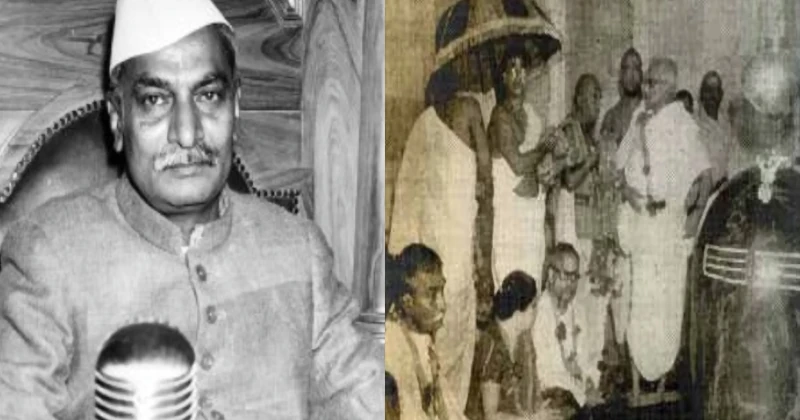
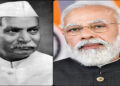
On December 3, Prime Minister Narendra Modi paid tribute to Dr Rajendra Prasad on his 141st birth anniversary, millions were reminded not only of the life of India’s first President but of a forgotten moment when he spoke to the heart of a newly independent nation. That moment came in 1951, at the western edge of India, on the shores where the Somnath mandir rises again like a phoenix from the ashes of history.
Tributes to Dr. Rajendra Prasad Ji on his birth anniversary. From being an active participant in India’s freedom struggle, presiding over the Constituent Assembly to becoming our first President, he served our nation with unmatched dignity, dedication and clarity of purpose. His… pic.twitter.com/oeOdtiZOVP
— Narendra Modi (@narendramodi) December 3, 2025
Today, when India reflects on Dr Rajendra Prasad’s legacy, his Somnath speech stands out as one of the most powerful civilisational addresses ever delivered by an Indian leader one that described the soul of India in words both simple and profound.
Born in 1884 in the agrarian district of Siwan in Bihar, Rajendra Prasad was a prodigious student who topped all examinations, earned a doctorate in law, and built a flourishing legal career. His intellect and precision had made him one of the most sought-after lawyers in the region.
But the turning point arrived when he met Mahatma Gandhi.
In 1921, drawn by Gandhi’s call for the Non-Cooperation Movement, Prasad walked away from his legal practice. He left behind wealth and comfort to join India’s struggle for freedom, traveling across villages, organising relief during natural disasters, and becoming a bridge between leaders and the masses.
After independence, as President of the Constituent Assembly and later as the first President of India, he shaped the moral tone of the young Republic always modest, always rooted, always dignified.
To understand the weight of Dr Prasad’s speech at Somnath, one must understand the mandir itself.
Somnath is not merely stone and architecture it is an epic saga carved in time. Revered as the first among the twelve Jyotirlingas, it was once a mandir whose golden spire kissed the sky and whose courtyards echoed with pilgrims from across Bharatvarsha. Chroniclers wrote of its grandeur, its wealth, its devotion.
And for the same reasons, waves of invaders from the 11th to the 18th century targeted it repeatedly. Mahmud of Ghazni razed it. Other conquerors attempted to obliterate it. Aurangzeb demolished it again in 1706.
Yet, each time, the mandir rose again rebuilt by devotees whose spirits could not be broken.
This cycle of destruction and reconstruction gave Somnath a symbolic meaning far greater than its physical form. It became a civilisational heartbeat a reminder that stones may fall but faith does not fracture.
After Independence and the integration of Junagadh into the Indian Union, Sardar Vallabhbhai Patel was determined that Somnath must be rebuilt not by state funds, but by the people themselves.
When he took the idea to Mahatma Gandhi, Gandhi gave his blessings with one condition, “Let the people rebuild it with their own hands, their own devotion.”
Patel accepted. But he passed away before the mandir could be completed. The mantle of fulfilling this dream fell on K. M. Munshi, and the honour of inaugurating the restored shrine fell on Dr. Rajendra Prasad.
Prime Minister Jawaharlal Nehru had expressed discomfort about the President attending a religious ceremony. But Dr Prasad held a different understanding of secularism one rooted in respect, not rejection.
He believed that a leader could honour his civilisational heritage without violating the secular fabric of the Constitution. So he went. Not as a head of state imposing a faith, but as a son of India paying tribute to its ancient spirit.
On May 11 1951, before thousands of devotees and seers, as the Arabian Sea winds swept across the courtyard, Dr. Rajendra Prasad rose to speak. What followed was not political rhetoric it was a timeless reflection on Indian civilisation.
Standing before the newly consecrated mandir, Dr. Prasad described Somnath as a metaphor for India’s indestructible cultural soul. “The external symbols of a national faith may be destroyed, but nothing can destroy the fountains of that faith.”
He spoke of how generations rebuilt the mandir not out of defiance but devotion because the mandir lived in their hearts even when its walls lay in ruins.
He then moved beyond the mandir to speak of India’s spiritual philosophy one that embraced diversity long before the world even understood the word “pluralism.” On spiritual unity, “Though He is one, the wise describe Him in many ways.”
On religious coexistence, he said “Intolerance has always led to destruction. The lesson of history is clear bitterness between faiths only diminishes humanity.”
On his own practice, he revealed that though he was a practicing Sanatani Hindu, he visited dargahs, churches, mosques, and gurdwaras with the same respect. His message was unmistakable:
- India’s civilisation is ancient, but its outlook is inclusive.
- Secularism is not denial; it is equal honour.
- Faith should unite, never divide.
Dr Prasad emphasised that rebuilding a mandir was only symbolic the real task was rebuilding the nation.
He reminded the audience that ancient India was once a global economic and cultural powerhouse, exporting goods and attracting scholars like Al Biruni. “The reconstruction of Somnath will be complete only when the mandir of our people’s prosperity is restored.” Somnath, he said, must inspire India to reclaim not its past structures but its past greatness.
Dr Rajendra Prasad spent his final years quietly at Sadaqat Ashram in Patna and passed away on February 28, 1963. But his message from Somnath remains one of the most eloquent articulations of India’s civilisational spirit.










Comments