





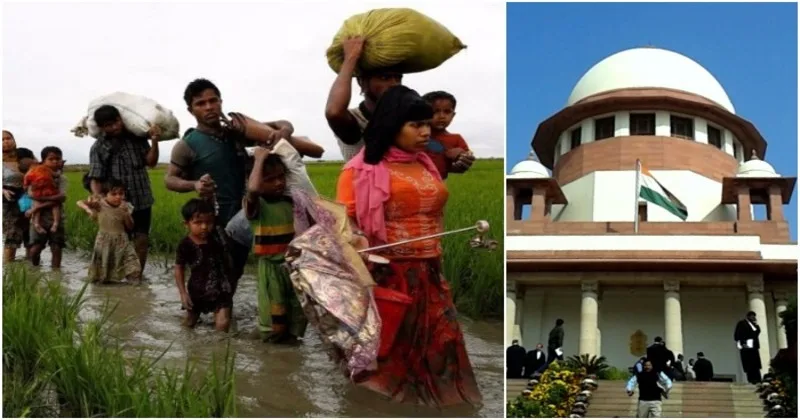
The Supreme Court on December 2 delivered a sharp response while hearing a habeas corpus petition alleging that Rohingya refugees in India were “going missing.” The bench questioned whether the judiciary was expected to extend extraordinary safeguards to individuals who, according to the government, had entered the country unlawfully. A three-judge bench led by Chief Justice Surya Kant noted that Rohingya refugees often cross into India through covert routes and subsequently claim entitlements such as food, shelter, and state support. The Chief Justice remarked that individuals entering through clandestine passages cannot expect preferential legal treatment, and posed a pointed question on whether basic entitlements for Indian citizens, particularly vulnerable children, should be compromised to accommodate illegal entrants. The bench emphasised that stretching the law beyond reasonable limits for those who had violated immigration norms was neither practical nor justified.
The Court also underscored the national-security dimension of the issue, especially in the northeastern region where borders are porous and vulnerable. The bench observed that the northeastern frontier remains highly sensitive and argued that unchecked infiltration poses significant security challenges. It questioned whether it was the judiciary’s responsibility to shield those who evade lawful entry procedures and highlighted that illegal cross-border movement has long been a strategic concern for security agencies. During the hearing, Solicitor General Tushar Mehta challenged the credibility and standing of the petitioner. He argued that the plea had been filed by an individual with no direct connection to the Rohingya community and urged the Court to avoid allowing unverified public-interest petitions to influence sensitive immigration matters. After hearing preliminary submissions, the bench adjourned the proceedings and scheduled the matter for further consideration on December 16. At the core is the question of whether this Muslim minority from Myanmar should be granted refuge or deported on grounds of illegal entry. India is not a signatory to the 1951 UN Refugee Convention, and the central government categorises Rohingyas as illegal immigrants rather than refugees. Officials maintain that the community’s presence involves security risks.
Intelligence assessments have repeatedly flagged concerns about human-trafficking networks, the widespread use of counterfeit identity papers, and alleged links between certain individuals and extremist groups. These inputs have strengthened the government’s claim that regularising Rohingya settlements without strict scrutiny could have long-term security implications. The humanitarian narrative pushed by rights groups is misguided and ignores the ground reality. They maintain that portraying the Rohingya as victims deserving international protection overlooks the fact that they have entered India illegally and continue to exploit loopholes in the system. According to this view, invoking constitutional guarantees meant for lawful residents to shield foreign nationals who have broken immigration rules is a distortion of the law. Opponents insist that granting humanitarian relief to those who arrived through unauthorised channels undermines national security, burdens public resources, and places unwarranted obligations on the Indian state.
Most Rohingyas enter India through easily navigable stretches of the India–Bangladesh border, often transported by traffickers using riverine channels and forest corridors in West Bengal, Assam, and Tripura. Others have slipped in through Jammu and certain northeastern pockets, bypassing formal immigration checks. Without valid papers, many settle in informal clusters across Delhi, Jammu, Hyderabad, Mewat and parts of Rajasthan. Fake Aadhaar numbers and voter IDs obtained through local networks allow access to basic services, a practice the government cites as evidence of systemic illegality and a reason for resisting demands for unrestricted rights or long-term settlement.















Comments