





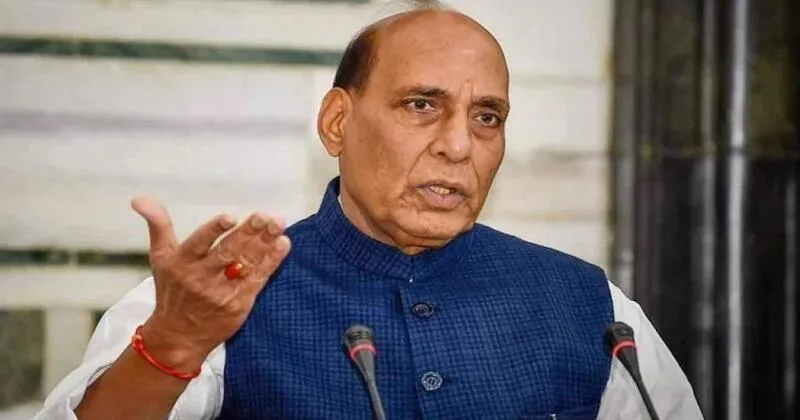
Defence Minister Rajnath Singh on December 2, said that India’s first Prime Minister, Jawaharlal Nehru, had once proposed using public funds to build the Babri Masjid in Ayodhya, a proposal he said was opposed by Sardar Vallabhbhai Patel. Singh made the remarks while addressing a gathering in Sadhli village near Vadodara during the ‘Unity March,’ organised as part of the ongoing celebrations for Patel’s 150th birth anniversary.
Calling Patel “a true secular leader,” Singh asserted that the Iron Man of India upheld inclusivity without any form of appeasement. “Pandit Jawaharlal Nehru wanted to build the Babri Masjid using public funds. If anyone opposed this proposal, it was Sardar Vallabhbhai Patel, born to a Gujarati mother. He didn’t allow the Babri Masjid to be built using government money,” Singh claimed, triggering applause from the audience.
Drawing parallels between Ayodhya and Somnath, Singh underlined Patel’s consistent principles on state neutrality in religious matters. “Not a single penny of government money was used for the restoration of the Somnath Temple. The funds came wholly from public donations. Similarly, no government rupee has been used to construct the Ram Temple in Ayodhya,” he said.
“This is real secularism,” the Minister declared.
Singh credited Patel for setting a precedent of maintaining a clear boundary between the state and religious endeavours, while still supporting cultural revival through voluntary public participation.
Shifting to Patel’s political career, Singh recounted how the leader willingly stepped aside from becoming the Congress President in 1946.
“Patel had the ability and popular support to become India’s first Prime Minister. But when Mahatma Gandhi asked him to withdraw his nomination, he did so for the sake of unity and discipline in the party,” Singh said.
He emphasised that Patel’s humility and commitment to national interests stood in stark contrast to leaders who sought high office. “For him, the promise he made to Mahatma Gandhi was more important than any position,” the Minister remarked.
Rajnath Singh criticised what he called a “systematic effort” to sideline Patel’s contributions after Independence. According to him, some political groups sought to overshadow the role Patel played in unifying princely states and shaping the nation.
He particularly highlighted the fate of funds collected after Patel’s death for his memorial. “Nehru suggested the money be used to build roads and wells instead of a memorial. This was a farce. It is the government’s duty to build infrastructure, not the responsibility of a memorial fund,” Singh alleged.
Singh further accused Nehru of awarding himself the Bharat Ratna while Patel remained unrecognised. “It was only under Prime Minister Narendra Modi that Patel finally received his due through the creation of the Statue of Unity,” he said, referring to the world’s tallest statue which stands as a monumental tribute to Patel in Kevadia, Gujarat.
The Defence Minister reiterated that Sardar Patel’s principles of national integration, secular governance, and public participation continue to serve as guiding pillars for the present-day government. He praised PM Modi for restoring Patel’s “rightful place” in India’s historical narrative.
Singh concluded his address by urging the youth to study Patel’s life and adopt his values of integrity, sacrifice, and national unity.





Comments