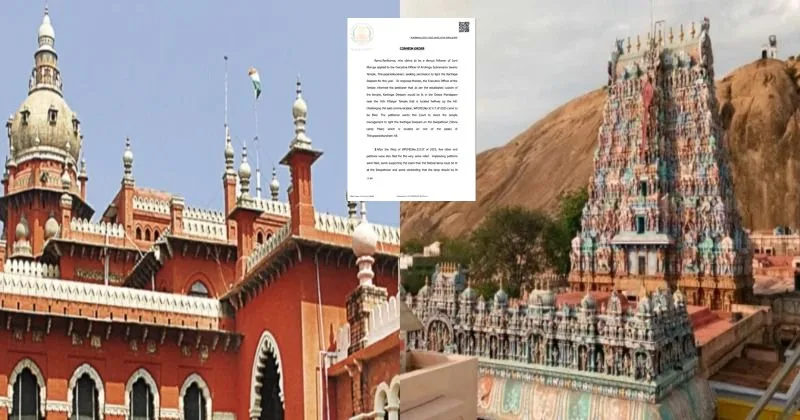
CHENNAI: In a major victory for Hindu devotees and heritage activists, the Madurai Bench of the Madras High Court has ordered the restoration of the centuries-old tradition of lighting the Karthigai Deepam atop the Thiruparankundram hillock—one of the six abodes (Arupadai Veedu) of Bhagwan Murugan. The verdict, delivered on December 1 by Justice G.R. Swaminathan, directs the Subramaniya Swamy Temple management under the HR&CE Department to light the ceremonial lamp at the ancient stone pillar known as Deepathoon, in addition to the usual designated locations within the temple precincts. The temple has been asked to comply from this year onwards.
The long-pending controversy surrounding the hilltop ritual resurfaced after certain Muslim groups claimed the hill belonged to the Waqf Board, asserting that the traditional lighting of the lamp could create communal tensions. Devotees, citing historical precedence and earlier judicial rulings, argued that the practice predates all modern disputes and reflects the uninterrupted Hindu character of the hill since antiquity. The matter had escalated in recent years, with authorities frequently invoking prohibitory orders or police action to prevent Hindus from performing the ritual.
Frustrated by repeated denials and restrictions by the state administration, devotees and temple activists filed a batch of petitions seeking the court’s intervention. While some petitioners demanded the lighting of the Deepam at the hilltop pillar, others sought permission to perform the ritual at the Uchi Pillaiyar (Vinayagar) Temple located at the peak.
Delivering his 49-page judgment—reserved on November 28—Justice Swaminathan issued a clear and categorical directive: the HR&CE-managed Subramaniya Swamy Temple must light the Karthigai Deepam at Deepathoon, restoring what he described as a “well-established, customary tradition supported by overwhelming literary and historical evidence.”
The respondents in the case were numerous:
- District Collector, Madurai
- Commissioner of Police, Madurai City
- Joint Commissioner, HR&CE Department
- Executive Officer, Subramaniya Swamy Temple
- Representatives of Sikandar Badhusha Dargah
- Superintending Archaeologist, ASI, Trichy Circle
- Commissioner, HR&CE Chennai
- Tamil Nadu Waqf Board, represented by its CEO
Justice Swaminathan’s judgment is meticulous in its exploration of both literary and legal history. Drawing from Sangam literature, the judge noted that Thiruparankundram Hill has been associated with Bhagwan Murugan “since time immemorial.” He quoted poems from Aga Nanooru, specifically Songs 59 and 149, composed well over 1,800 years ago, which refer to the hill as “Murugan’s hill.” Commentator Solomon Pappaiah’s interpretations were also cited, affirming the hill’s longstanding identification with Murugan worship.
The judge further delved into archaeological records, citing a 1909 Government Order that described the entire hillock as a sacred Linga worshipped by Hindus. He observed that the hill itself has long been regarded as an extension of the temple, and that the Subramaniya Swamy Temple carved out of the rock is integral to this religious landscape.
The High Court’s order heavily references O.S. No. 4 of 1920, a civil suit filed over a century ago, in which disputes between the temple management and trustees of the Dargah were thoroughly adjudicated. The Trial Judge of that era had noted that:
- The hill had been sacred to Hindus “from prehistoric times,”
- Its holiness was recorded in Tamil works predating the birth of the Prophet,
- The hill was an endowed property of the temple,
- The devasthanam had undisputed possession of the hillock,
- The Privy Council upheld the judgment, cementing the legal position.
Justice Swaminathan underscored that this century-old judgment continues to hold legal authority and remains unchallenged in fact.
In a culturally resonant observation, the High Court cited Tamil sayings such as “Kundrin mel itta vilakkai pola” (like a lamp lit atop the hill), noting that the tradition of lighting lamps during the Tamil month of Karthigai is embedded deeply in Tamil culture.
The judge emphasised that lighting Deepams atop hillocks is an intrinsic part of Tamil Shaivite and Murugan traditions—and that the Deepathoon pillar exists specifically for this purpose.
Court Rejects Waqf Arguments, Says No Impact on Dargah
Muslim groups and the Dargah management argued that lighting the lamp near their structure could spark communal unrest. They also claimed historical rights over the hilltop.
It noted that the lamp pillar is over 50 metres away from the Dargah, located at a safe distance where rituals cannot affect the structure in any way. The judge stated: “By lighting the lamp at Deepathoon which is meant for that purpose, the structure of the Dargah is not in any way affected.”
Justice Swaminathan observed that the Dargah management had, in fact, signed a peace committee resolution in 2005 expressing no objection to lighting the lamp at Deepathoon.
He also made it clear that the Places of Worship Act, 1991 does not apply to this case, because the act of lighting the lamp does not alter, convert, or encroach upon any place of worship.
Police Ordered to Ensure Peaceful Enforcement
To prevent disruption, the High Court issued a firm directive to the police: “The Commissioner of Police, Madurai City, shall ensure that no one comes in the way of enforcement of this order.”
Prominent temple activist T.R. Ramesh hailed the judgment as a landmark moment. Sharing his response on X (Twitter), he wrote:
EXCELLENT NEWS from Madurai !
Hon’ble Madras High Court has allowed restoration of the tradition of lighting of the Karthigai Deepam atop Tirupparankundram Hill – which primary belongs to Sri Subramania Swamy Temple, Tirupparankundram
TN GOvt and @tnhrcedept were not for… pic.twitter.com/ctGYW3aHWB
— trramesh (@trramesh) December 1, 2025
He termed the verdict “the restoration of a sacred tradition that rightfully belongs to the Subramaniya Swamy Temple.”
However, the ruling also triggered political reactions. CPI(M) MP Su. Venkatesan, who represents Madurai, criticised the order and warned that it could provoke unrest in the region. Critics accused him of undermining the judiciary and pandering to extremist sentiments.
They questioned his priorities, pointing out his minimal involvement in pressing civic issues within Madurai while choosing to comment aggressively on religious matters.
His remarks were widely circulated alongside an image link shared by critics:
Several local voices condemned his reaction as irresponsible and inflammatory.
Hindu groups have long alleged that successive Dravidian governments—both DMK and AIADMK—restricted temple rituals at the hilltop to appease minority groups and protect electoral interests. Devotees were frequently detained, and Section 144 was invoked to prevent gatherings at the site.
The High Court’s judgment, therefore, is seen not merely as a legal victory but as the restoration of a suppressed tradition.
In conclusion, the High Court declared: “If the lamp is not lit at Deepathoon, the rights of the temple may be jeopardized.”
It directed that the Deepam be lit every year henceforth, beginning immediately.
Heritage activists, Murugan devotees, and Tamil cultural scholars have welcomed the ruling as a significant step in reclaiming the spiritual and cultural identity of one of Tamil Nadu’s holiest sites.