





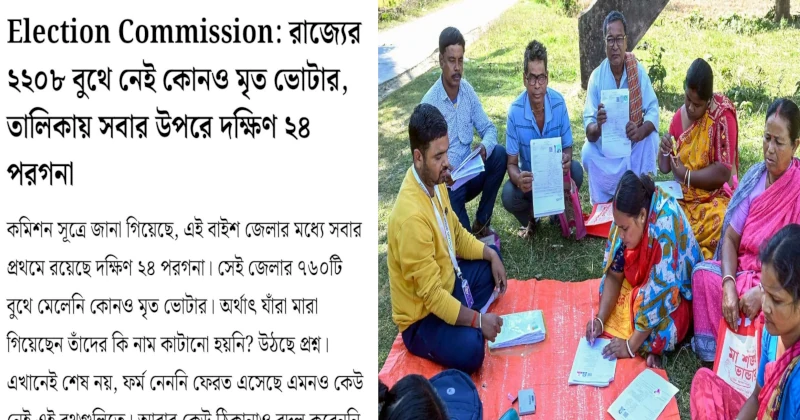
West Bengal’s Special Intensive Revision (SIR) exercise has exploded into a full-blown controversy after the Election Commission (EC) flagged 2,208 polling booths where 100 per cent SIR forms were distributed, collected, and digitised with zero ‘uncollectable’ forms.
The Commission has called this pattern “highly impossible” and ordered an emergency statewide investigation, triggering severe outbreak.
According to startling media reports, in West Bengal, the Election Commission has received 100% Enumeration Form fill-up from 2,208 booths so far, out of several thousand booths. This implies that not a single voter in these booths has died or moved elsewhere in the last 23… pic.twitter.com/Y7pG5VLvug
— Amit Malviya (@amitmalviya) December 1, 2025
The EC’s data-driven monitoring system identified 7,844 booths across West Bengal where digitisation of enumeration forms had been completed. Among these, the Commission flagged 2,208 booths for showing zero uncollectable forms meaning no voter was listed as:
- Deceased,
- Duplicate,
- Permanently shifted, or
- Untraceable.
A senior EC official described this trend as “very unnatural and statistically implausible”, noting that such perfect results are unheard of even in small urban pockets, let alone across thousands of booths spread over the state’s diverse rural and semi-urban landscapes.
“In no society can thousands of voters remain unchanged for decades there will always be deaths, migration, or outdated entries. The absence of even a single uncollectable form raises questions about whether the exercise was done honestly,” an EC official said.
The Commission has instructed Electoral Registration Officers (EROs) and District Election Officers (DEOs) who are also district magistrates to submit signed explanatory reports by 10 a.m. on December 2.
The district with the highest number of suspicious booths is South 24 Parganas, recording 760 booths with “perfect” outcomes. The region is politically sensitive, known as a stronghold of the ruling TMC and the base of its national general secretary Abhishek Banerjee.
This is not the first time the district has attracted attention during the voter roll revision. Earlier reports had suggested that local administrative officers were allegedly instructed to ensure “100 per cent form collection”, a directive that critics say left BLOs under pressure to avoid reporting irregularities.
The distribution of flagged booths across major districts is as follows:
- South 24 Parganas – 760
- Purulia – 228
- Murshidabad – 226
- Malda – 216
- Nadia – 130
- Bankura – 101
- Howrah – 94
- North 24 Parganas – 82
- Hooghly – 54
- Kolkata North – 1
- Kolkata South – 0
The sheer volume and concentration of such booths in politically sensitive districts has strengthened concerns about possible administrative interference.
The EC’s move comes amid rising complaints from multiple political parties and civil society groups. The BJP has alleged that some Block Development Officers accused of being politically aligned were pressuring Booth Level Officers to:
- Share OTPs required to submit SIR forms,
- Allow insertion of new names without in-person verification,
- Retain names of dead voters,
- Retain entries of voters who have permanently shifted,
- And allegedly include names of illegal Bangladeshi immigrants.
These allegations are currently under examination, but the EC’s latest findings lend weight to concerns that the enumeration process may have been compromised in certain pockets of the state.
Opposition parties including the CPI(M) and Congress also met with the EC-appointed Special Roll Observer Subrata Gupta on Monday, submitting documents and allegations claiming large-scale discrepancies in the ongoing SIR process. In addition to the booths with zero discrepancies, the Election Commission has flagged thousands more that show unrealistically low numbers of uncollectable forms:
- 542 booths reported only one uncollectable form
- 420 booths reported two
- 372 booths reported three
- 374 booths reported four
- 481 booths reported five
Combined with the 2,208 booths that reported none, the pattern suggests a widespread administrative phenomenon rather than isolated clerical error. Experts believe that such “perfect” outcomes typically arise from:
- Administrative Pressure: Local officers fearing political backlash may have avoided reporting genuine uncollectable forms.
- Artificial Compliance: Staff may have rushed the process to meet unofficial targets of “100 per cent form collection”.
- Manipulation of roll data: By avoiding uncollectable entries, outdated or questionable names remain on the rolls an issue with electoral implications.
- Intimidation or fear among BLOs: In some areas, BLOs are contract staff who may face pressure from local political actors.
Special roll observer Subrata Gupta has begun:
- Public grievance hearings
- Closed-door meetings with political delegations
- Scrutiny of administrative lapses
- Verification of alleged tampering and misuse of BLO credentials
Sources confirm that Gupta may also recommend internal disciplinary action against officials found to have furnished incorrect or forced data. The EC is preparing to send field teams to some of the most suspicious booths, especially in South 24 Parganas, Murshidabad, and Malda.










Comments