





Divisive tendencies and the colonial mindset have been the biggest obstacles in the path of Ek Bharat, Shreshth Bharat. A deeper examination reveals that these two tendencies lie at the root of most of the nation’s problems. While divisive tendencies made continuous attempts to weaken the nation and fragment it into pieces, the colonial mindset never allowed the country to connect with the original source or fountainhead of its strength. Without connecting to one’s roots, one can neither chart the steps of progress nor establish an authentic identity. It requires no separate elaboration that the fundamental essence of Bharat lies in its expansive conception of Dharma and in its eternal (Sanātana) culture.
System Survived Despite Independence
It was hoped that after the hard-won Independence, the great nation of Bharat would carve out its own path in accordance with its culture, heritage, traditions, and lofty ideals—from governance and administration to the diverse domains of life. It was expected that the country, while remaining rooted in its cultural foundations, would establish its own exemplary models of education, healthcare, research, science, innovation, good governance, and development. Unfortunately, power was transferred in 1947, but the character and structure of the system did not change. Bharat did attain political freedom, yet it has not been fully successful—even to this day—in creating, developing, and establishing a system based on its own Self (Swa & Swatwa). As a result, from education to art, literature, and cinema; from governance to law and jurisprudence; and from architecture, science, and medicine to tourism—the influence and dominance of foreign systems, foreign perspectives, and foreign frameworks continue unabated. Without transforming the colonial system, its methods, and its mentality, even imagining a strong foundation for a developed Bharat is impossible.
Beacon of Hope
After 2014, a strong aspiration, a well-thought-out direction, and several interventionist initiatives to transform the governance system—its structure, its methods, and its mindset—are certainly visible, and some efforts have indeed been made at the policy level. Yet the mentality sown, nurtured, and propagated by Macaulay has penetrated so deeply into the so-called intellectual class of Bharat that it rises like an impregnable fortress in the path of every positive reform. It is no coincidence that the Prime Minister’s call to liberate the nation from the slavery-ridden mindset created by Macaulay’s education system by 2035 is being subjected to irrational, unfair and narrowly framed interpretations by this very class.
Prime Minister Narendra Modi has urged every Bharatiya to take a 10-year pledge to reverse Macaulay’s ‘enslaved education system’ before the 200th anniversary of his infamous English Education Act of 1835
Is there any doubt that our economic, educational, social, literary and cultural institutions continue to determine, assess, and evaluate everything on the basis of Western standards? Far from rewarding or encouraging Bharat and Bharatiyata, there is hardly a Bharatiya who has not, at some point or another, suffered unequal treatment, neglect, or even humiliation from our own institutions merely for taking pride in their own language, attire, cultural symbols, identity markers, or history. Not only in private, corporate, and commercial or fountainhead of its strength. Without connecting to one’s roots, one can neither chart the steps of progress nor establish an authentic identity. It requires no separate elaboration that the fundamental essence of Bharat lies in its expansive conception of Dharma and in its eternal (Sanātana) culture. It was hoped that after the hard-won Independence, the great nation of Bharat would carve out its own path in accordance with its culture, heritage, traditions, and lofty ideals—from governance and administration to the diverse domains of life. It was expected that the country, while remaining rooted in its cultural foundations, would establish its own exemplary models of education, healthcare, research, science, innovation, good governance, and development. Unfortunately, power was transferred in 1947, but the character and structure of the system did not change. Bharat did attain political freedom, yet it has not been fully successful in creating, developing, and establishing a system based on its own self (Swa & Swatwa). As a result, from education to art, literature, and cinema; from governance to law and jurisprudence; and from architecture, science, and medicine to tourism—the influence and dominance of foreign systems, foreign perspectives, and foreign frameworks continue unabated.
Positive Change in Policy
After 2014, a strong aspiration, a well-thought-out direction, and several interventionist initiatives to transform the governance system—its structure, its methods, and its mindset—are certainly visible, and some efforts have indeed been made at the policy level. Yet the mentality sown, nurtured, and propagated by Macaulay has penetrated so deeply into the so-called intellectual class of Bharat that it rises like an impregnable fortress and an unyielding wall in the path of every positive and epochal reform. It is no coincidence that the Prime Minister’s call to liberate the nation from the slavery-ridden mindset created by Macaulay’s education system by 2035 is being subjected to irrational, unfair, and narrowly framed interpretations by this very class. Is it not true that even in the eighth decade of Independence, we have been almost unsuccessful in creating and firmly establishing a Bharatiya model of architecture, art, education, literature, aesthetics, and culture? Is there any doubt that our economic, educational, social, literary, and cultural institutions continue to determine, assess, and evaluate everything on the basis of Western standards? Far from rewarding or encouraging Bharat and Bharatiyata, there is hardly a Bharatiya who has not, at some point or another, suffered unequal treatment, neglect, or even humiliation from our own institutions merely for taking pride in their own language, attire, cultural symbols, identity markers, or history.
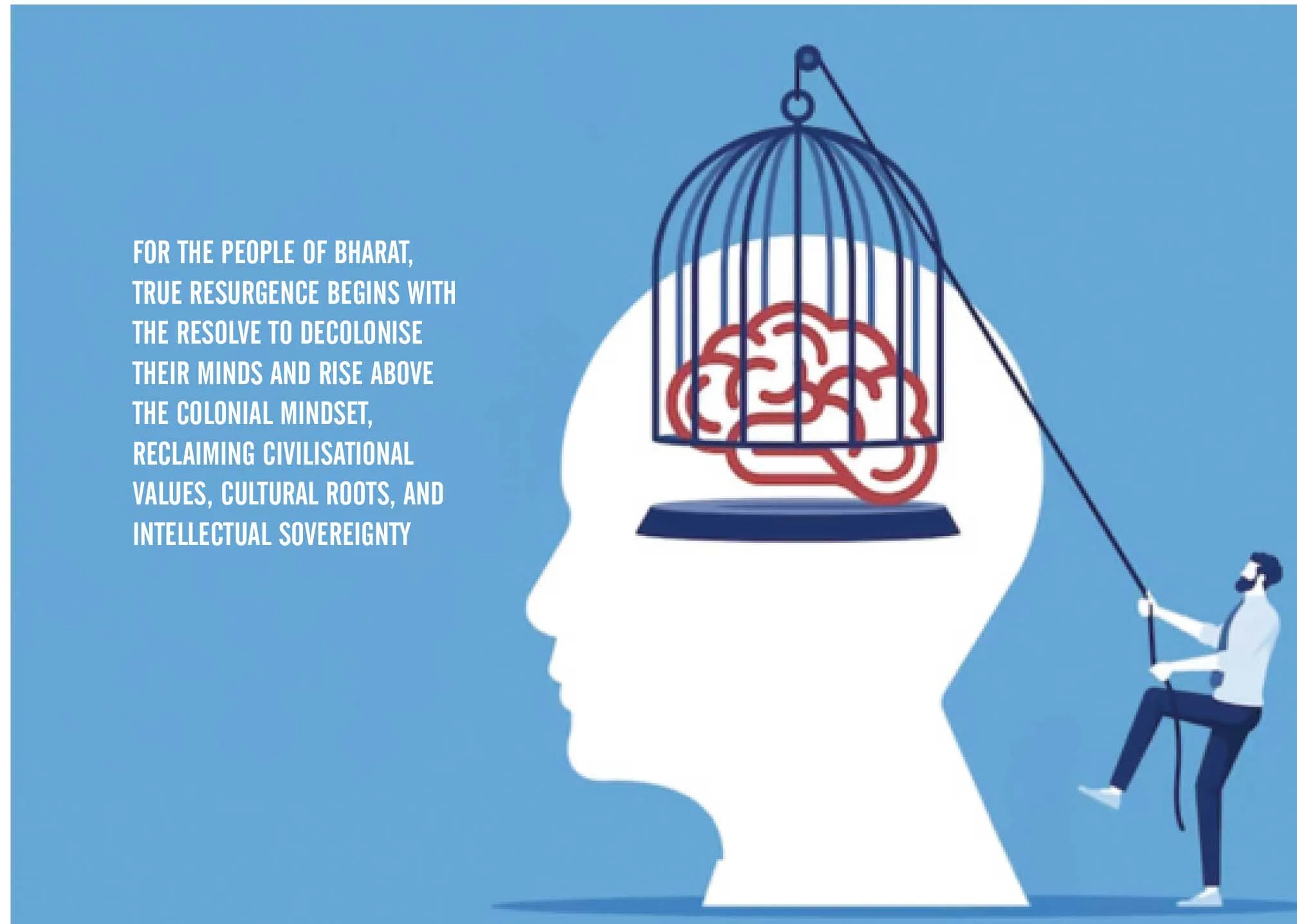
Our food habits, lifestyle, modes of living, and entire framework of conduct and behaviour are far more natural and environment-friendly than those of the West. Yet we remain confined to the Western benchmarks laid down in the United Nations’ Sustainable Development Goals. If this is not a colonial mindset, what is?
Rectify Historical Inaccuracies
Is it not also a manifestation of the same colonial mentality that if the invasions by Turks, Mughals, and Afghans are labelled as “Islamic invasions,” why are the invasions by the British and Europeans not taught as “Christian invasions”? Is it not true that the educational system and intellectual discourse of the past eight decades bear responsibility for this? Through what channels were generations made to feel inferior about their own language, attire, food, music, and cultural sensibilities? Who, through honey-coated words, instilled into successive generations of youth the belief that whatever belongs to the West is superior, modern, logical, scientific, and worthy of reverence—while whatever belongs to Bharat is regressive? Is it not our greatest irony that the very falsehood once proclaimed arrogantly by the East India Company that they had come not to plunder Bharat, but to “civilise” us is now proudly repeated by the so-called intellectuals of independent Bharat?
The claim that Bharat could not have progressed without the British and the English language is nothing but falsehood. The assertion that Bharat became a political entity only after the arrival of the British and it was fragmented into pieces before that was a myth.
To understand the educational traditions of Bharat prior to British rule, we need to examine the surveys conducted by William Adam, between 1830 and 1835 on the educational system of Bengal and Bihar. According to his report, there was not a single village in this region that did not have at least one small or large school. On an average, there was one school for every 400 students. Numerous contemporary British administrators and Christian missionaries have acknowledged in their writings that the educational system of Bharat at that time was far more advanced than that of England.
Falsehood Propagated by Leftists
The greatest falsehood propagated by the followers of Marx and Macaulay is that, in the earlier society, education was the exclusive preserve of Brahmins and a few select castes. In response to PM Modi’s call for freeing Bharat from colonial and slavish mindsets by 2035, this very falsehood is once again being repeated by Leftists. The truth, however, is entirely the opposite. Due to colonial conditioning, a mindset gradually took shape that the Bharatiya knowledge system was impractical.
Liberate Bharat from Macaulay Mindset
To truly understand Bharat’s traditional education system and the real nature of its society, we must remove the colonial lens through which we have long been conditioned to look. The distorted narratives crafted by the British, along with the false theories propagated by Marx–Macaulay-inspired groups, have deeply eroded our self-awareness, self-confidence, and historical memory. It is now essential that we clear away these layered sediments of colonialism and mental enslavement, and revive an authentic and life-giving understanding of our glorious past. PM Modi’s call for liberation from colonial mindsets by 2035 is not merely a political proclamation; it is a national resolve to reconnect Bharatiya society with its Swa (self) and Swa-Tva (intrinsic identity) through education.
The future of Bharat does not lie in imitating Western models, but in drawing strength from its own roots, reinstating self-reliant systems centered on indigenous intellect, and rejuvenating Bharatiya knowledge system. The need of the hour, therefore, is to bring to light—fearlessly—the truths buried under the dust of history; to dismantle colonial myths through reason and evidence; and to create an educational vision that enables Bharat to rediscover itself and its true identity. Such a vision will assist in realising the aspirations of a Viksit Bharat and empower the nation to attain its rightful intellectual, cultural, and spiritual heights.









Comments