





Due to the forced mass exodus of the Hindu community from Kashmir in 1989-90, a lot of documentary evidence about RSS activity in Kashmir was unfortunately lost. In absence of such evidence, the most authentic version that is available now is the statements of the activists that were active during the period of 1970s and 1980s in the Kashmir valley. This author, besides his own memories and the available evidence in order to document the details of the past in this context, took help from senior swayamsevaks and colleagues namely Vivek Kumar, Utpal Kaul, Anupam Kaul, Adv. Jaikumar Bhat and Dilip Parimoo. I remain thankful to them for their support in this regard.
The defeat of the Indira Gandhi government in March 1977 elections was immediately followed by lifting of ban from the Rashtriya Swayamsevak Sangh (RSS) and also ending the dictatorial Emergency era from the entire country. It was the outgoing Prime Minister Indira Gandhi herself, probably realising her mistake, who did both the things besides making similar corrections in other areas of governance before demitting the office. Morarji Desai took over as the Prime Minister of the nation, as the elected leader of the Janta Party, thus ending the three-decade old rule of the Congress party at the centre.
Consequent upon the release of the jailed leaders of various political parties and other organisations including the important functionaries of RSS from jails, the top functionaries of the Sangh took a number of decisions in the changed socio-political scenario prevailing in the country. One of those important decisions was about the nation-wide tour programme of the Sarsanghchalak, Balasaheb Deoras. It took almost a year to complete the much awaited tour programme of the RSS chief. Many states and Union Territories were covered in this connection. In regard to North India, Amritsar was the farthest city that was covered in the tour programme. However, J&K wasn’t covered in this high value programme of the RSS chief.
Keeping in view that the tour programme of Balasaheb Deoras couldn’t take place in the J&K state, it was decided by the RSS to organise three programmes in Jammu, Udhampur and Srinagar in the year 1978 and accordingly the tour programme of the Sarkaryawah (Secretary General) of the RSS, Madhav Rao Mulle was finalised. The programmes were scheduled for the month of April 1978. This was also the last programme of Vivek Kumar, the outgoing Vibhag Pracharak of Kashmir & Ladakh in Srinagar, who played an exemplary role during the emergency era in Kashmir. It was for the first time after 1947 that Madhavrao Mulle was supposed to visit the Kashmir valley. In October 1947, he accompanied Guruji Golwalkar to Kashmir valley when Guruji met the Maharaja of Jammu and Kashmir Hari Singh in Srinagar.
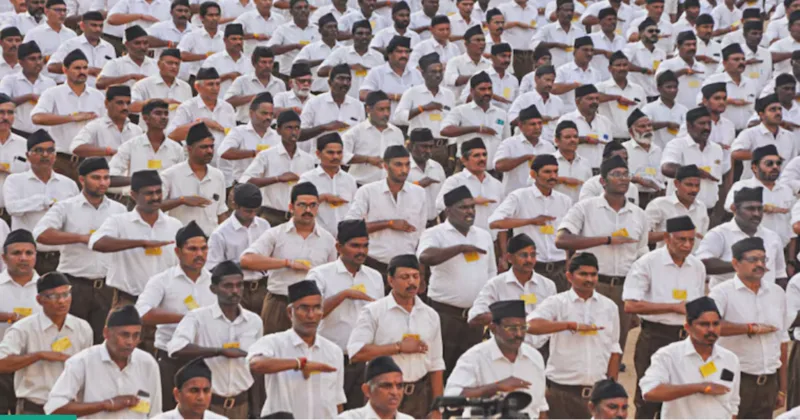
When all preparations for the tour programme were up to date, suddenly Madhavrao Mulle fell ill and got bed-ridden due to some chronic health issues. However, the programmes were conducted as per the schedule at all the three places. In Srinagar, the programme was organised in open on the grounds of the historic Sheetalnath and the swayamsevaks were in presence in large numbers in Sangh uniform. Thakur Ram Singh and Narayan Dass -Uttar Kshetra Sah-Kshetriya Pracharak and Punjab Prant Pracharak respectively attended all the three programmes at the three designated places. The main speech at Srinagar was delivered by Thakur Ram Singh who had come to Srinagar by air and travelled wearing full Sangh uniform. It was in the same year that Madhavrao Mulle passed away due to severe health complications. With the passing away of Madhavrao Mulle, RSS lost an invaluable asset of the organisation and the movement of Hindutva. The baton of Sarkaryawah of Sangh was passed on to Prof. Rajinder Singh also known as Rajju Bhaiya among the Swayamsevaks.
Immediately after the conduct of the Sangh function in April 1978 at Sheetalnath-Srinagar, there was a rush of RSS top functionaries who visited the Kashmir valley, particularly in the 1980s. Bhagwat Swaroop, Vibhag Pracharak of Kashmir played a key role in organising these visits. Due to the loss of documentary evidence, exact dates of the events may not be available for record purposes. An important programme of Bhartiya Mazdoor Sangh (BMS) was organised in Srinagar in late 1978 which was attended by a number of functionaries of the organisation active at state, zonal and national level. Here it may be recalled that the founder of BMS, Dattopant Dengdi had visited Kashmir in 1972 and August 1974 (prior to the Emergency era). In 1972, a meeting was organised at the residence of a senior swayamsevak of Kashmir, Amarnath Ganjoo and it was attended by most of the prominent Sangh activists in Kashmir. In 1974, a function was organised at the Arya Samaj hall at Wazir Bagh, Srinagar which was attended by a number of important swayamsevaks active in different parts of the valley. It is in this programme that Dattopant Thengdi introduced the BMS, its ideology and the functioning of the organisation to the gathering present in the function.
In April 1979, Balasaheb Deoras visited Jammu and addressed a huge programme thereat which was attended by a large number of swayamsevaks from different parts of Jammu and Kashmir state. It was his first visit to J&K; and also a visit by the Sarsanghchalak of RSS to J&K state after a gap of almost 8 years. He had several meetings with the activists and the prominent people of the state during his visit. He also met the then Chief Minister Sheikh Abdullah, on his invitation, at Jammu; and later called the meeting with him a ‘courtesy call’. This author was a Pracharak of RSS in Jammu city at that point of time and was fortunate enough to interact with the Sarsanghchalak. An interactive meeting with the prominent swayamsevaks of Kashmir valley was also held which was presided over by Balasaheb Deoras during the tour programme at Jammu which I also was asked to attend.
In the years 1979 and 1980, Brahma Dev, Kshetriya Pracharak -Uttar Kshetra paid a number of visits to Srinagar and also toured the hilly district of Doda. He addressed many programmes during his visits at Srinagar, Anantnag, Bhaderwah and Udhampur and had detailed discussions with the swayamsevaks about the Sangh work and the prevailing situation in the valley. He was accompanied by Narayan Dass, Punjab Prant Pracharak. His visits were followed by an elaborate tour programme of Mitrasen Gupta, Punjab Prant Karyavah. He addressed a function of swayamsevaks at Srinagar and also had an interactive session with the prominent Sangh activists of the valley.
In the year 1981, Rajju Bhaiya paid a visit to the Kashmir valley but the visit was not made public. He toured a number of places in the Srinagar city and made an in-depth study of the situation in the Kashmir valley during his three-day tour programme. He in particular went to the University of Kashmir area at Hazratbal-Srinagar. He had a detailed interaction with the prominent swayamsevaks of the valley in Srinagar. In the same year, a conference of Indian Council of Historical Research was organised in the University of Kashmir which was also attended by Thakur Ram Singh in the capacity of a representative of Bhartiya Itihas Sankhalan Yojana (BISY). A special conference under the aegis of BISY was also organised at S.P.College, Srinagar which was addressed by Thakur Ram Singh, Prof Zindlal Jalla, Prof Satya Bhushan, Principal of the college and Prof. D.N Madan. The programme was conducted by Utpal Kaul. It was in this programme that the concept of BISY was introduced formally by Thakur Ram Singh.
His visit was followed by the visit of Moropant Pingley, Akhil Bhartiya Prachar Pramukh of RSS. He stayed for two days in the valley of Kashmir and took the concept and activity of BISY further ahead as the patron of the project. An impressive programme of RSS was held at Srinagar that was addressed by him. He also went to Mata Vaishno Devi shrine at Katra and this author accompanied him along with others to the Mata-Darbar. Moropant Pingley’s tour programme in J&K was hugely successful and it helped the Sangh to make new inroads in the Kashmir valley.
In 1984, a three-day shivir of RSS was organised at Gosain-gund ashram in Anantnag district which was attended by all karyakartas of the Kashmir valley. Indresh Kumar, J&K Sambhag Pracharak was in the shivir for all the three days to guide and plan the future action plan. It was his first official visit in the capacity of the Sambhag Pracharak of J&K to the Kashmir valley. RSS in Kashmir would traditionally organise a three-day shivir every year for the swayamsevaks and these camps would mostly be organized at Kheer Bhawani, Tullamulla in Ganderbal tehsil (now district). It was for the first time that the shivir was organised at a new venue.
During the years 1984-85, two important (but seperate) visits of the top functionaries took place in the Kashmir valley. One was the visit of K.C.Sudarshan (the then Sah-Sar Karyavah) and the other was the visit of Bhaurao Deoras (again the then Sah-Sar Karyavah). Both these visits added a great impetus to the Sangh work. On both the occasions, two grand programmes were organised in the spacious hall of Vikram Guest House in Srinagar. An interactive programme with the prominent citizens was also organised with Bhaurao Deoras in the chair. He gave impactful replies to many queries and questions of the citizens about RSS, national security and the then prevailing situation in Punjab and Kashmir in the programme. K.C Sudershan also addressed a gathering of swayamsevaks in Srinagar. Besides attending a separate meeting with the karyakartas of Kashmir valley, he also visited Shankaracharya Mandir and Chashma Shahi in Srinagar and captured a view of the Srinagar city from these two places. He was accompanied by Utpal Kaul to both these places. Aabha ji Thatey accompanied Sudershan in his visit to the valley.
During the year 1984, Mahesh Sharma, the then All India General Secretary of ABVP paid a four-day visit to Srinagar and attended a number of meetings of youth and students at the outhouse of this author in Srinagar. This author organised these meetings in the capacity of the President of Hindu Yuvak Forum. It was also decided in the meetings to organise a two-day youth convention in the year 1985 in Srinagar which was later taken to the logical conclusion under the guidance of the Sabhag Pracharak, Indresh Kumar. This hugely successful convention was attended by 500 delegates. Justice Shivnath Katju, the President of VHP, Sushil Modi, General Secretary of ABVP, Prof. D.N.Madan, Principal of Gandhi Memorial college and Indresh Kumar attended the convention as special guests.
RSS Sar-Karyawah, Rajju Bhaiya paid one more visit to Kashmir in 1986 with a mission to explore a new destination for RSS in Ladakh. He was accompanied by Madan Agarwal (Trustee VHP) and Virender Kumar. He went to the Amarnath cave also and then onwards to Ladakh. Utpal Kaul guided the whole tour programme. Rajju Bhaiya had a darshan of Sindhu (Indus) near Leh and desired to organise a ‘darshan-programme of the Sindhu river’ in future. He visited a number of Buddhist monasteries in Leh namely, Hemis Gompa and LamaYuru Gompa. He had a detailed discussion with the President of the Ladakh Buddhist Association there and had a separate meeting with the Punjabi businessmen also. Again, his tour programme was kept away from the public glare as per his instructions.
The years 1986-87 unfolded the Islamisation plan in Kashmir. We witnessed the beginning of political upheaval and chaos in Kashmir valley followed by the bomb explosions and the acts of terrorism. It was all turmoil during the years ahead and the terror regime was allowed to grow by the then government of Jammu and Kashmir headed by Farooq Abdullah. The failure of the government of India to act timely and decisively added more confusion and the selective killings of the Hindu minorities started in the year 1989.
This created a great mess of the situation and the process of unfortunate genocide of the Hindus in the valley was followed by their ethnic cleansing. The story of the frequent visits of top RSS functionaries came to a sudden and temporary halt with the forced mass exodus of Hindu minority community from Kashmir. Rest is the history that most of us know…!






Comments