





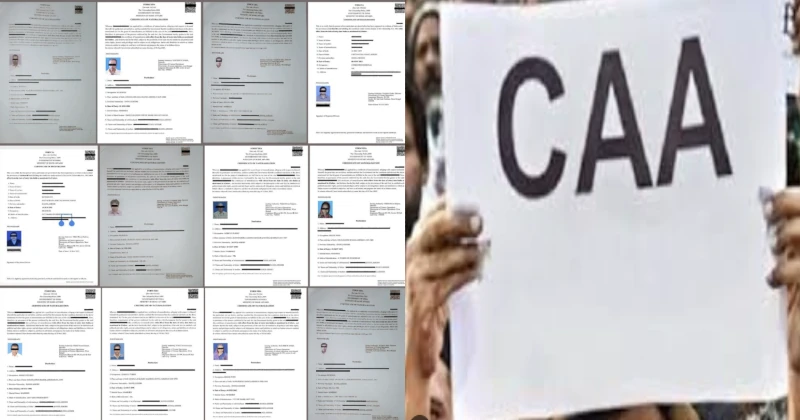
Twelve Hindu refugee families from Bangladesh were granted Indian citizenship this week under the Citizenship Amendment Act (CAA), ending decades of uncertainty, statelessness and bureaucratic hostility. Their new status marks a watershed moment in West Bengal where political conflict, allegations of obstruction, and tense battles over refugee rights have dominated public discourse for years.
For the families who crossed the border with nothing but fear and the clothes on their backs, the day their certificates arrived felt like the closing of a 75-year wound.
These families many from the Matua community and other displaced Hindu groups fled East Bengal over several decades following waves of religious persecution, discriminatory policies, and targeted violence. They hoped India would offer them safety. Instead, they found themselves trapped in a bureaucratic purgatory.
Without citizenship, they were denied:
- Formal employment
- Passports
- Land rights
- College admissions
- Government services
Every application from a ration card to a school form came with the same demand: pre-1971 documents, impossible for families who escaped with nothing. “We lived like criminals for no fault of our own,” said one newly recognised citizen from North 24 Parganas. “Officials humiliated us because we could not prove a past we had fled to survive.”
Many recount being detained by GRP upon arrival, interrogated, moved between Barasat and Sealdah, and forced to relive the same terror they thought they had escaped.
While refugee groups fought for decades for documentation and legal rights, political battles in West Bengal repeatedly stalled progress. According to refugee organisations, the governments led by TMC, CPM, and Congress did not support their citizenship demands for decades. Refugee associations accuse these parties of:
- delaying documentation
- refusing to certify refugee status
- obstructing inclusion in official registries
These allegations long voiced by Matua organisations have resurfaced forcefully following the recent issuance of CAA certificates. BJP says thousands of persecuted Hindu refugees lived in fear due to politically motivated resistance in Bengal.
Chief Minister Mamata Banerjee openly opposed the CAA, calling it discriminatory. She repeatedly declared the Act would not be implemented in West Bengal, even as refugees said they needed it to end their statelessness.
Last week, Mamata visited Thakurbari home of the Matua communityand warned she could “shake the entire country” if needed. Refugees say such statements added confusion rather than clarity.
For years, they say they were stuck between:
- TMC’s opposition to CAA,
- BJP’s promise of citizenship, and
- their own fear of removal or harassment.
After the Union Government notified the CAA rules earlier this year, thousands of refugees began submitting applications through help desks and camps set up across border districts by the BJP.
In Nadia, North 24 Parganas, Cooch Behar and other regions, these camps:
- helped refugees fill out forms
- verified old documents
- guided them through digital submissions
- assisted elderly applicants who were unable to navigate bureaucracy
For the first time in decades, refugee families felt the process was moving. This week’s issuance of certificates is the first tangible outcome for West Bengal.
BJP IT Cell chief Amit Malviya called the development the “final chapter of a long battle for justice.” He accused TMC governments of blocking citizenship for legitimate refugees while allegedly “appeasing illegal entrants for vote-bank calculations.”
He argued that:
- persecuted minorities were abandoned
- documentation was denied deliberately
- humanitarian suffering was prolonged for political advantage
The long battle for justice, fought by those who crossed the border with nothing but the clothes on their backs, has finally reached its rightful conclusion.
Those who were persecuted in East Bengal for their religion, culture and identity were driven out of their homeland with… pic.twitter.com/zcogIGmWms
— Amit Malviya (@amitmalviya) November 29, 2025
They contrast this with what they call “protection of illegal migrants” by TMC in border regions. BJP West Bengal President Dr Sukanta Majumdar delivered a detailed statement echoing the sentiments of refugee families:
- Hindus fled East Bengal because of religion and identity
- They were denied citizenship in Bengal for decades
- They lived without dignity or legal protection
- Their demand was simple the right to live as Indians
The struggle for justice of those who crossed the border with nothing but the clothes on their bodies — has finally become reality
Those who were once persecuted in East Bengal because of their religion, culture, and identity were forced to cross the border with just one cloth,… pic.twitter.com/UUL4xvkT4C
— Dr. Sukanta Majumdar (@DrSukantaBJP) November 29, 2025
Invoking Dr Syama Prasad Mookerjee and Babasaheb Ambedkar, Majumdar said the CAA fulfils an ideological and humanitarian responsibility ignored for decades.
“They no longer have to hide. They no longer have to justify their past. Today, they can finally say, ‘We are legal citizens of India.’” For the twelve families who received citizenship this week:
- anxiety has given way to pride
- humiliation has transformed into dignity
- uncertainty has been replaced with hope
Students can now apply freely for admissions. Elders can seek pensions. Workers can get proper jobs without fear of inspections or sudden eviction. One refugee summed up the transformation, “After 75 years, we finally belong.”















Comments