





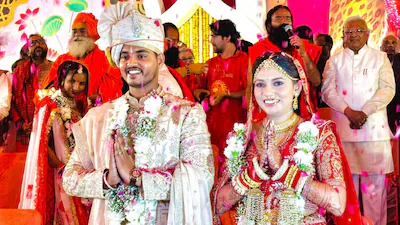
In a rare display of social inclusivity and simplicity, Madhya Pradesh Chief Minister Mohan Yadav’s younger son, Abhimanyu Yadav, tied the knot with Dr Ishita Yadav during a mass wedding ceremony held on Sunday (Nov 30) at Sanwara Khedi, Ujjain. The ceremony, which saw 21 couples exchanging vows under one roof, has triggered significant public attention and debate, given its departure from the grand, high-budget weddings typically associated with political families.
The grooms and brides arrived in a festive procession, some riding horses, others on beautifully decorated carriages, as family members, local residents, and dignitaries gathered to witness the ceremony. The event, organised in line with the vision of promoting “simple and inclusive weddings,” was attended by several prominent personalities, including Union Minister Jyotiraditya Scindia, Yoga Guru Baba Ramdev, and Bageshwar Dham head Pandit Dhirendra Krishna Shastri.
Speaking to reporters, Chief Minister Mohan Yadav said the family’s decision to choose a mass wedding format was inspired directly by Prime Minister Narendra Modi’s repeated calls to encourage minimalism in marriage ceremonies.
“The Prime Minister has always stressed that weddings should be simple. That is why everyone is getting married together,” CM Mohan Yadav.
His statement drew positive reactions from several quarters, with many praising the symbolic gesture coming from the state’s highest office. For many families present at the event, sharing the platform with the Chief Minister’s son offered a sense of dignity and equality.
The groom, Abhimanyu Yadav, described the ceremony as memorable and deeply symbolic.
“This is a royal wedding, many grooms are here with me,” Abhimanyu Yadav.
The unique choice of a mass wedding aims to promote financial prudence, communal harmony, and the upliftment of economically weaker families, who often struggle with the high costs associated with traditional ceremonies.
Union Minister Jyotiraditya Scindia, who attended the wedding and greeted the couples, said the decision carried a message that was far larger than the event itself.
“By getting married in a mass wedding ceremony, a very big message has been given,” Jyotiraditya Scindia.
He also called it an example of responsible social leadership at a time when extravagant destination weddings continue to dominate the public imagination.
Yoga guru Baba Ramdev praised the event as a national example, urging leaders and industrialists across India to adopt similar practices.
“A wedding like this will set an example. I believe that other Chief Ministers, leaders, and industrialists should take inspiration from this and reduce the expenses spent on extravagant weddings. Now we need to move from destination weddings to divine weddings,” Baba Ramdev.
Ramdev’s remarks come at a time when the cost of wedding celebrations has surged across India, making the symbolism of the Chief Minister’s modest approach even more impactful.
Also present at the ceremony was Pandit Dhirendra Krishna Shastri of Bageshwar Dham, who emphasised the social inclusivity reflected in the event.
He recalled their community’s earlier pledge during a foot march,“Bidaai casteism ko” (a farewell to casteism) and said that Sunday’s ceremony was a living embodiment of that promise.
“Under one roof, people from every caste and religion are taking their wedding vows together. This is a highly commendable step by the Chief Minister. On one side a driver is getting married, and on the other, the son of the man who ‘drives’ the state is also tying the knot on the same platform,” Dhirendra Krishna Shastri.
His remarks received loud applause from the gathering, underscoring the message of social unity.
For many, the joint wedding symbolised a powerful message against societal divisions, showing that the Chief Minister’s family chose to celebrate one of its most personal occasions alongside ordinary families, without discrimination.
As the 21 couples exchanged garlands and vowed to start their new lives, the event was widely seen as an attempt to inspire a wider societal shift, encouraging citizens to adopt simpler and more inclusive practices.









Comments