





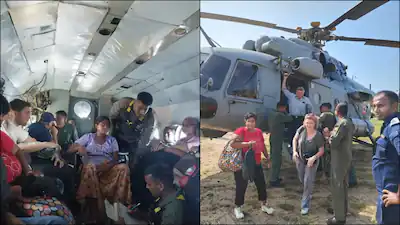
Amid one of the worst natural disasters to strike Sri Lanka in recent years, the Indian Air Force (IAF) has carried out a large-scale, multi-national rescue effort under Operation Sagar Bandhu, airlifting dozens of stranded foreigners, Sri Lankan civilians, and Indian nationals from cyclone-hit regions. Among those rescued was a Pakistani national, highlighting the wide humanitarian scope of India’s relief operation.
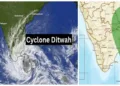
Sri Lanka has been battered by Cyclone Ditwah, which unleashed catastrophic rainfall, flash floods, and deadly landslides across several districts. The IAF’s rapid response, using Mi-17 helicopters, became a lifeline for stranded passengers trapped in inaccessible terrain.
The Indian Air Force deployed Mi-17 V5 helicopters capable of operating in difficult weather and high-altitude terrain. These aircraft conducted sorties across restricted and landslide-prone areas, where roads had collapsed and communication lines were cut off.
During the first phase of the operation, IAF teams evacuated multiple foreign nationals, including citizens of:
Germany (2)
South Africa (4)
Slovenia (2)
United Kingdom (2)
India (12)
Sri Lanka (5)
In addition to passengers, the IAF evacuated three critically injured civilian casualties who required urgent medical attention in Colombo.
The IAF described the rescue as a “hybrid extraction”, involving both air and ground manoeuvres.
A Garud commando was lowered via winch from the helicopter into a restricted zone. He led the stranded group through a cross-country route to a small, pre-identified helipad at Kotmale, one of the worst-affected regions hit by deadly landslides.
From here, 24 passengers were flown to Colombo, despite strong winds and poor visibility.
The second leg of the evacuation saw an even more diverse group of civilians rescued, including:
Poland: 2 adults + 1 casualty
Belarus: 4 adults + 2 casualties
Iran: 5
Australia: 1
Pakistan: 1
Bangladesh: 3
Sri Lanka: 8 passengers + 1 casualty
Infants: 4
These operations were coordinated jointly with Sri Lanka’s Disaster Management Centre and the Sri Lankan military.
Earlier in the day, five teams of Sri Lankan Army personnel, totalling 40 troops, were airlifted from Diyathalawa Army Camp to support relief efforts in the landslide-hit Kotmale district.
The combined operations between the IAF and Sri Lankan security forces allowed ground teams to open access routes, search for missing persons, and assist displaced families.
India also facilitated the return of nearly 400 Indians stuck at Colombo’s Bandaranaike International Airport due to the cyclone’s impact on flight operations. Emergency flights were arranged to bring the stranded citizens back to India on Saturday.
As the rescue missions continued, Sri Lanka grappled with the escalating human cost of Cyclone Ditwah. Latest figures from the Disaster Management Centre (DMC) at 4 pm Sunday placed the death toll at 212, with 218 people still missing.
Dozens of villages have been submerged, while many have reported total infrastructure collapse — homes swept away, bridges broken, and highways buried under mud.
This extreme weather system, after striking Sri Lanka, moved back over the Bay of Bengal, raising concerns of additional rainfall and rough sea conditions.
India was the first country to dispatch assistance to Sri Lanka immediately after the island nation issued distress calls. Under Operation Sagar Bandhu, New Delhi sent:
Two National Disaster Response Force (NDRF) teams
80 trained urban search-and-rescue personnel
Multiple IAF aircraft and helicopters
Relief material and medical supplies
The mission reaffirms India’s ‘Neighbourhood First’ policy, prioritising support to neighbouring countries struck by humanitarian crises.
The evacuation of a Pakistani national, alongside Europeans, Australians, Iranians, Bangladeshis, and Sri Lankans, reflects the Indian Air Force’s broader humanitarian commitment during regional disasters.










Comments