





A study conducted in the West around 1997 discovered that the average life span of Fortune 500 businesses is less than 40-50 years. One-third of the Fortune 500 corporations listed in 1970 had vanished by 1983, and 40% of all newly formed companies lasted fewer than ten years. According to a study conducted by IIM Bangalore, managers in these businesses face high stress, a struggle for dominance and control, cynicism, and a work climate that stifles human imagination/creativity, vitality, and commitment. There is a significant gap between overall quality of life and work life. Organizational sustainability and its impact on the environment remain a major concern. Managers and executives often agree that management has not progressed significantly in recent decades.
Corporate challenges
Work-life Integration has become a major issue in recent years. While there is no one-size-fits-all approach to work-life balance, employers and employees should collaborate to discover solutions that meet both competitive needs and personal concerns for each individual worker. Work-life integration occurs when individuals take charge of their lives and make choices to overcome problems. This can involve balancing job, personal, and family requirements. Individuals are unable to strike a work-life balance due to current complexities and problems in personal and professional lives. As a result, in order to combine work and life, an individual’s internal independence and position must be in harmony with the outside world. For the harmony and sound health of the body, all three gunas (sattava, rajas, and tamas) must be aligned, as an imbalance can render a person unwell physically or psychologically.
As a result, there is a need for an inner balance between personalities, which can be seen in terms of exterior health. However, interior peace can only be realized when our outward connections are balanced. An individual’s external environment includes elements such as nature (fire, earth, water, air, and ether), climatic circumstances, relationships with others, and labor. According to the Bhagavad-Gita, life is a continual conflict between cosmic and individual energies. A higher amount of Sattava guna (balancing guna) promotes inner and exterior balance, resulting in feelings of delight, joy, and happiness. Higher levels of Tamas guna might disrupt an individual’s relationship with the outside world. And this may result in a lack of joy, anguish, and sorrow. The third guna, Tamas, represents apathy. Resistance to action leads to negative consequences such as death, devastation, and loss. The Bhagavad-Gita and other scriptures are made available to persons who possess reason and insight. These ancient scriptures provide managers with easy and effective solutions for balancing work and home life, which are often overlooked.
The most significant barrier for modern management is the mindset toward performance metrics and assessments. Modern management approaches handle this issue from a dualistic perspective. It works in two steps. In the first stage, dual views are established. For example, all actions and outcomes are initially characterized using a framework of duality: good vs bad, desirable vs unwanted, performer vs non-performer, belongs to my camp vs opposite camp, positive vs negative, etc. Based on them, expectations are created for only the positive features of this dualistic reality. At the second stage, managers have the mistaken belief that only wonderful things will happen. Expecting negative results in this duality scheme is considered bad practice in modern management. As a result, they lack the ability to anticipate and cope with undesirable situations. This is obviously unrealistic. Managers who lack these qualities may encounter workplace friction, stress, and unprofessional behavior from their subordinates, which can negatively impact their professional and family life.
The ‘Bhagavad Gita’ is regarded as a comprehensive guide for improving employee efficiency and effectiveness in achieving desired goals by disseminating views such as transforming an individual’s weaknesses into strengths, sharing responsibilities, selecting the right person in the team, being aware of the challenges in the job environment, the need for charismatic leaders who inspire, energize, and counsel in dilemmas, and initiating knowledge of ground realities. The Bhagvad Gita achieves social agreement in the Working Equilibrium through ideas and actions, goals and success, plans and accomplishments, products and markets.
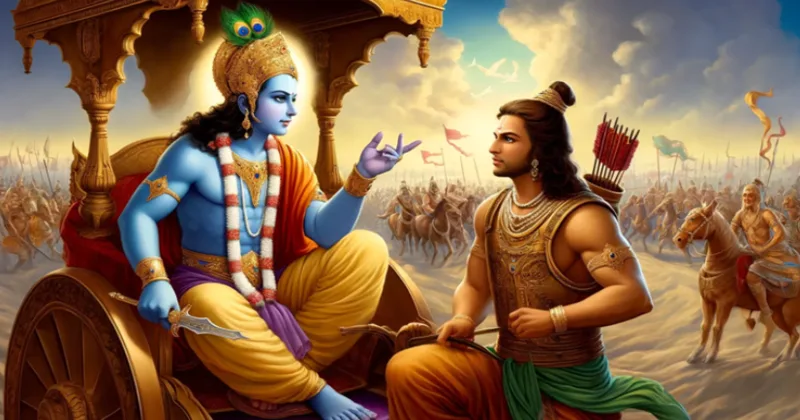
This sacred literature contains Bhagwan Krishna’s lessons to Arjuna, which reveal a significant reality that is relevant to modern workplace relations. Many professionals nowadays freeze at key situations, just as Arjuna did before his duty. His battlefield was more than simply a physical site; it represented the ultimate workplace dilemma, where personal ideals clashed with professional commitments. Arjuna’s symptoms correspond to what modern psychology refers to as acute stress responses: “limbs of my body quivering and mouth drying up, whole body trembling, hairs standing on end, and skin burning all over”. Executives report comparable physical symptoms while making high-stakes decisions—bodily reactions to psychological stress that impair judgment.
How does the Bhagavad Gita make you see the inner and outside worlds?
How to use karm yog in your job? Modern companies require realistic strategies to apply karm yog. Prioritize excellent work above rewards. Instead than focusing on emotions, make presentations that provide value and clarity. Consider your employment as a service beyond personal gain. This perspective gives regular chores purpose. According to the Bhagavad Gita’s second chapter, “Yogah karmasu kaushalam” refers to the skill of action. Excellence should shine through in all you do, regardless of the recognition. Maintain a balanced attitude while receiving both praise and criticism. Neither one determines your worth.
The Bhagwat Geeta is an ancient Bharatiya literature that includes a plethora of knowledge about how to live a meaningful and fulfilled life. The Gita emphasizes the necessity of achieving one’s dharma, or life goal. This notion can be applied to managerial work in a variety of ways. First, knowing and pursuing one’s dharma can assist managers in establishing clear goals and objectives for their team or business. Managers that integrate their activities with a higher cause might inspire greater dedication and commitment from their team. Furthermore, managers can use this focus to make difficult decisions while keeping the larger good in mind.
Second, the Bhagwat Geeta’s teachings on yoga and meditation can assist managers achieve greater self-awareness and emotional intelligence. These strategies can help managers learn to moderate their emotions to stressful situations and better understand their employees’ needs and motivations. Finally, the Bhagwat Geeta highlights the significance of serving others. This notion can be applied to management by fostering a company culture that emphasizes giving back to society. Managers, for example, can urge employees to volunteer their time or donate money and time to charitable organisations. Managers may cultivate an attitude of compassion in the workplace, making it more cheerful and productive.
Gita says, One of the most fundamental ideas is dissociation. A manager must be able to detach himself from the outcomes of his activities and not become connected to them. This allows him to concentrate on doing his best rather than being discouraged or frustrated when things do not go as planned. Detachment also enables for better decision making because it is unaffected by emotions or connection to results. The Bhagavad Gita summary demonstrates that cultivating detachment does not imply caring about work. Instead, it improves our productivity by removing emotional blockages that impede our thinking. Krishna states that a person of consistent wisdom “abandons all desires for sense gratification” and finds serenity. Another important principle is that of dharma, or obligation. A manager must fulfill his commitments to his team and organisation. He must do the right thing, even if it is not popular or simple. This necessitates a strong sense of ethics and moral integrity.
Finally, a leader must always demonstrate compassion and empathy. He should attempt to treat his staff with dignity and kindness, as they are all human beings with personal lives outside of work. Following these concepts allows a manager to establish a happy and productive work atmosphere in which everyone can thrive. The Bhagwat Geeta highlights the need of separation from material possessions. This notion can be used to management by staying focused on the organization’s goals and mission rather than becoming involved in personal gain or power battles.
Why should Gen Z study the Bhagavad Gita in depth and apply it in their daily lives?
Today’s youth are a valuable gift to our nation. Shaping and moulding them properly, as well as assisting them in enhancing their personalities, will allow their hearts to feel completely pure, while also taking them a step forward by making them better citizens of the universe, who will go on to create a better world tomorrow. The modern young of the universe are today enduring a great deal of stress, strain, and worry. They tend to age faster and are more susceptible to a variety of ailments. The teachings contained in the Bhagavad Gita can be used to assist Gen-Z have a positive outlook on their own lives, cultivate them spiritually, and tell them how to live a great and tranquil life. The intriguing aspect of the Bhagavad Gita is that it does not justify the adherent’s sacrifice of everything in this worldly realm. It only purifies the mind and soul, which fully distresses the individual and allows him to discover his inner self and the supreme one. Furthermore, it serves to instill values and ethics in young people, preparing them to be better global citizens for Bharat’s and the rest of the world’s new Golden Age. Reading the Bhagavad Gita on a daily basis and understanding the lessons and slokas, as well as living a life free of day-to-day anxieties and problems, helps you stay young and add years to your life, ensuring a peaceful future for the youth.
Bhagwan Krishna preached the ‘Bhagavad Gita’ to Arjuna to inspire him to complete his work and duty when he was faced with an ethical quandary over whether or not to defeat and kill his relatives and friends on the battlefield of ‘Kurukshetra’. The Bhagavad Gita is like the Ganga in that it emphasises knowledge, duty, and deed. As the river Ganga has flowed for many eras on this Earth, quenching the thirst of every thirsty man without regard for caste, color, creed, or country of origin, so does the Bhagavad Gita, which flows for the welfare of mankind regardless of caste, creed, religion, or nation.
















Comments