





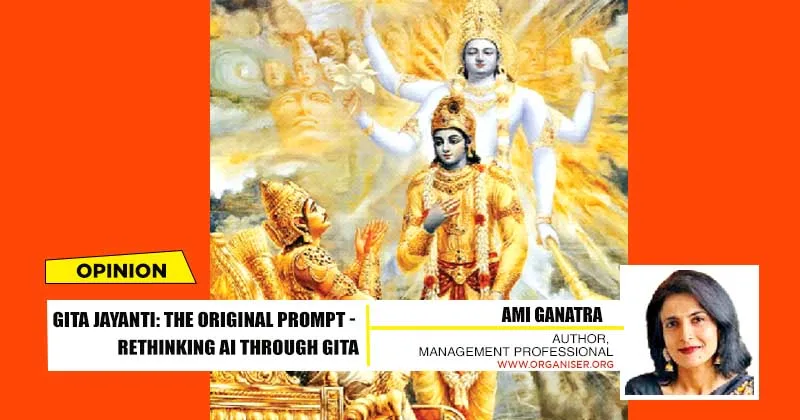
What Arjuna faced on the battlefield of Kurukshetra was anything but trivial. He stood before people he had grown up with, respected, and loved. The Pandavas had sought peace—even at the cost of their kingdom. They had bent over backwards to preserve family harmony. Yet a war was imposed upon them, fuelled by Duryodhana’s jealousy and pride, nourished by Dhritarashtra’s weakness, and amplified by the machinations of Karna and Shakuni.
As the conches sounded and the armies prepared, something collapsed within Arjuna. Overwhelmed by anxiety, he found his resolve dissolving. He wanted to withdraw—not out of fear of death, but because he could not imagine raising weapons against his own kin for what he, in that emotional moment, reduced to a “piece of land.”
War For dharma
But the war was never about land. It was about justice. It was about setting a line that adharma cannot become a trend, that a bully cannot have his way simply because he is powerful or well-supported. Arjuna knew all this. The decision to fight had been made with full awareness of the consequences. Yet in that moment, his clarity was hijacked by emotion, and he declared, “na yotsye govinda” — O Govinda, I will not fight.
Krishna initially dismisses Arjuna’s collapse as a momentary lapse and expresses incredulity that a warrior of his calibre could succumb to such weakness. Normally, Arjuna would have resisted such criticism. But this was different. His despair ran deeper than pride. Krishna’s firm nudge shook him awake to the awareness of his own confusion, “dharmasamuddhachetā”—my mind is bewildered about dharma.
And so Arjuna does something extraordinary. He surrenders—not in defeat, but in humility. He says, “I am your student, Krishna. Teach me that which leads to my śreyas.” He does not ask for victory or strategy. He asks for shreyas — lasting clarity, right action, and inner stability.
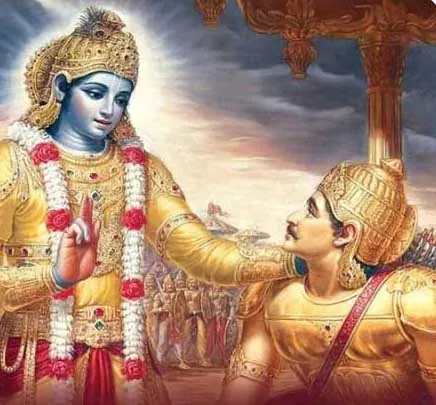
Had Arjuna asked “How do I win?”, Krishna’s answer would have been different. But because Arjuna asked, “What is right? What is my duty?”, the answer became the Bhagavad Gita — one of the world’s most profound dialogues on ethics, psychology, decision-making, self-mastery, and emancipation.
Spoken By Krishna, Shaped By Arjuna
The Gita is spoken by Krishna, but shaped by Arjuna. Krishna is the wisdom; Arjuna is the prompt. Without his vulnerability, sincerity, and depth of inquiry, there would be no Gita.
This is not unique to the Gita. The Bharatiya knowledge tradition rests on dialogue — Nachiketa and Yama, Gargi and Yajnavalkya, Maitreyi and Yajnavalkya — all showing that right questions open the right doors.Which brings us to the present moment.
There has never been a time in history when the ability to ask the right questions mattered more than today — the age of Artificial Intelligence, when every answer is instantly available at our fingertips.
Now, before anyone jumps up to ask — how can one even compare Krishna and AI? Let me say it clearly: one cannot. The difference is as stark as day and night.
Krishna And AI
Krishna is intuition perfected. He is Dharma embodied. When he speaks of yogastha buddhi — a steady, centred, uncluttered intelligence — he is not presenting a philosophical ideal. He is speaking from the authority of one who lives that state every moment. His words arise from a mind completely in mastery of its senses and fully aligned with cosmic order. He knows Arjuna not superficially, not through fragments, but entirely — his nature, his confusions, his duty, his fears, his latent strengths. His guidance comes from a place of omniscient compassion, the kind that sees the individual and the larger Dharma simultaneously.
AI, by contrast, has no personal clarity — it has collective data. It learns from what humanity uploads: the noble and the ignoble, the wise and the misguided, the refined and the chaotic. Its “knowledge” is an aggregate of human expression, not an inner awakening.
And while AI does learn about the individual user over time, it only knows what is fed into it — through prompts, patterns, and digital traces. In that sense, it is not very different from how most humans understand each other: through limited, curated displays. In fact, sometimes, AI may even appear more perceptive simply because people are more honest with machines than with fellow humans.
AI does not have any mandate to elevate anyone. It is a tool. Its purpose is not to make the seeker wiser or more moral. It mirrors what is asked of it, often reinforcing the user’s own assumptions. Its answers are shaped by inputs, not by an inherent clarity of right and wrong.
And yet — having said the obvious — there is a parallel worth considering. A parallel not between Krishna and AI, but between the seeker and the act of seeking.
Both respond to the questioner. Both adapt to the clarity of the prompt. Both reveal that the quality of the question shapes the quality of the answer.
Just as Krishna adapts his teaching to Arjuna’s evolving questions, AI adjusts its output based on the prompt. Vague questions produce vague answers; precise questions produce meaningful responses. The seeker shapes the knowledge. So how the Gita can guide our use of AI?
Quality Of Prompt Determines Quality Of Answer
Arjuna’s transformation begins when he refines his question from emotional panic to clear enquiry. Similarly, in the age of AI: Confused inputs generate confused outputs. Clarity invites clarity. Depth invites depth. If we ask better, we receive better.
Don’t Settle For Convenient Answers
AI, like our own minds, tends to reinforce our assumptions. Seekers must probe, verify, and explore. Arjuna does exactly this — he asks similar questions in multiple ways, revealing layers of his own doubt. Krishna indulges him and explains in ways he can understand.
With AI, too, reframing questions, testing assumptions, and prompting from different angles helps uncover nuance and reduces bias. It forces the tool to explore its vast data more meaningfully.
Answers Do Not Replace Responsibility
Krishna gives knowledge, but the action remains Arjuna’s. At the end of the long conversation, Krishna tells Arjuna: Yatha Icchasi Tatha Kuru – “Do as you think right!”
Likewise, AI can support, suggest, or synthesise — but it cannot carry the moral burden of our choices and actions. It cannot assume accountability and cannot replace viveka (discernment). AI may help us decide, but the responsibility remains ours.
Distinguish information from wisdom
Krishna speaks of jnana (information) and vijnana (realised wisdom). AI gives the former; humans must cultivate the latter. AI can bring multiple perspectives and provide a starter but wisdom comes from reflection, discipline, and lived experience.
Use AI As Support, Not Substitute
Even for Gita, transformation happens only when one engages with Krishna’s words, reflects on them, masters the senses, and develops a stable, discerning intellect, not otherwise.
Artificial Intelligence is not the new Krishna. It is not Buddhi, nor consciousness. But it can become a powerful ally if guided by the principles the Gita offers: Asking clearly, reflecting deeply, acting responsibly, using intellect consciously and most of all being rooted in Dharma
Similarly, AI is a remarkable support — a powerful tool that brings knowledge to us on an unprecedented scale. But no matter how advanced it becomes, it cannot cultivate our intelligence for us. AI can assist our thinking. But it cannot do the thinking for us. The growth of our buddhi will always remain our responsibility alone.
In conclusion, Artificial Intelligence is not the new Krishna. It is not Buddhi, nor consciousness, nor moral intelligence. But it can become a powerful ally if guided by the principles the Gita offers: Asking clearly, reflecting deeply, acting responsibly, using intellect consciously and most of all being rooted in Dharma. As AI evolves, our inner intelligence must evolve with it. And few texts prepare us for that journey as beautifully and profoundly as the Bhagavad Gita. May Krishna’s words continue to guide us all. Shubh Geeta Jayanti!















Comments