





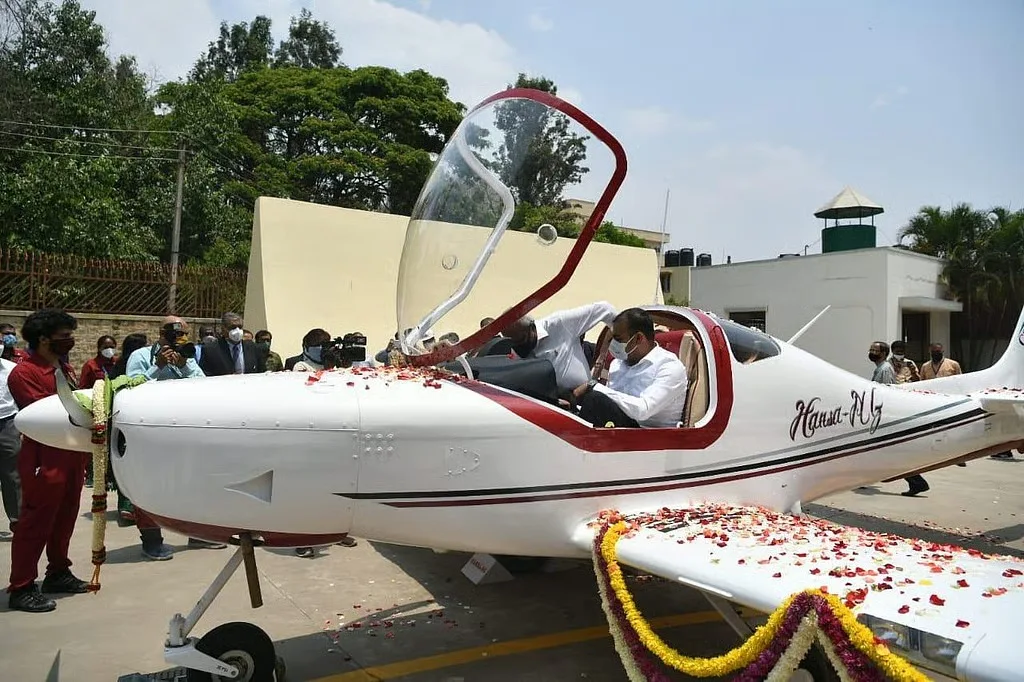
India took a major step towards becoming self-reliant in aviation as the government unveiled the new Hansa-3 NG trainer aircraft, designed and built entirely in India. The aircraft was showcased on Saturday at the CSIR–National Aerospace Laboratories (NAL) campus in Bengaluru. Along with this, the government also reviewed the progress of the SARAS Mk-2, a 19-seater aircraft being developed for regional air travel. These developments show how India is now focusing on building its own aircraft instead of depending on foreign companies.
Union Minister of State for Science and Technology Dr. Jitendra Singh led the event. Scientists, industry partners and defence officials were present to witness what many described as an important moment for India’s civil and defence aviation sectors. The announcements covered not just aircraft but also new facilities, UAV developments and high-altitude platforms, areas that are essential for India’s long-term aviation goals.
The main highlight of the event was the introduction of the Hansa-3 NG, which stands for “Next Generation.” This is a two-seater trainer aircraft made with modern composite materials. It is meant to help flying schools train new pilots at a lower cost and with more advanced technology.
India is expected to need about 30,000 new pilots in the next 20 years as the aviation sector grows quickly. Since training aircraft are the first step in a pilot’s journey, the Hansa-3 NG could play a crucial role. It has improved aerodynamics, fuel efficiency, a better cockpit design and modern avionics. This makes it both easier and safer for students to learn flying.
A private company, Pioneer Clean Amps, will manufacture the aircraft at a new ₹150-crore facility in Kuppam, Andhra Pradesh. This factory will be able to produce up to 100 aircraft per year, marking a major expansion in India’s civil aviation manufacturing.
Dr. Singh said that this aircraft would not only help Indian aviation schools but also support exports in the future. He added that as India becomes one of the world’s top aviation markets, having its own training aircraft is very important.
After launching the trainer aircraft, the Minister reviewed the progress of SARAS Mk-2, which is India’s first indigenous 19-seater light transport aircraft. This aircraft is being developed for both civilian and military use. It will be especially helpful under the government’s UDAN scheme, which connects small cities and remote areas through affordable flights.
The SARAS Mk-2 is being designed with modern features such as a pressurised cabin, digital cockpit, better fuel efficiency and the ability to take off from shorter runways. This makes it suitable for areas like the Northeast, the Himalayan region and other smaller towns.
To support testing and development, Dr. Singh also inaugurated the Iron Bird facility—a specialised system that allows engineers to test all aircraft systems on the ground before actual flight tests. This helps reduce risks and speeds up the certification process.
Another big announcement was the opening of a new manufacturing unit for High Altitude Platforms (HAPs). These are unmanned aircraft that fly at very high altitudes—above 20 km—and can stay in the air for long hours using solar power.
These platforms can help with:
- Surveillance
- Communication networks
- Environmental monitoring
- Disaster management
Scientists shared that a smaller version of the HAP has already been tested successfully, reaching 7.5 km altitude and flying for over 10 hours. A full-scale flight is expected by 2027, which would place India among the leading countries in this technology.
Dr. Singh also launched the new NAviMet weather monitoring system at HAL Airport in Bengaluru. This system helps pilots and air traffic controllers by providing real-time weather and visibility information. More than 175 such indigenous systems, including DRISHTI and AWOS are already in use across India.
CSIR-NAL also signed a partnership with Solar Defence & Aerospace Ltd. to develop a 150-kg class loitering munition UAV. This UAV will have a long range, low radar visibility and AI-based target detection. It will be powered by an indigenous Wankel rotary engine, a technology mastered by only a few countries.
Features being developed include:
- Range up to 900 km
- 6-9 hours endurance
- Precision strike capability
- AI-assisted surveillance
This UAV will help strengthen India’s tactical defence systems, especially in sensitive border regions.
Dr. Jitendra Singh said that all these developments, trainer aircraft, regional transport planes, UAVs and high-altitude systems are part of India’s plan to become a major aviation hub by 2035 and a fully developed country by 2047. The focus, he said, is on building everything indigenously so that India can reduce imports and become a global exporter of aviation technologies.
He added that platforms like Hansa-3 NG and SARAS Mk-2 will shape the future of India’s civil aviation sector, while new UAVs and high-altitude systems will boost defence preparedness.
The unveiling of Hansa-3 NG and the progress on SARAS Mk-2 show that India is moving from being just one of the world’s biggest aviation markets to becoming a strong aviation manufacturer. This marks an important step in the country’s journey towards technological advancement and self-reliance.
















Comments