





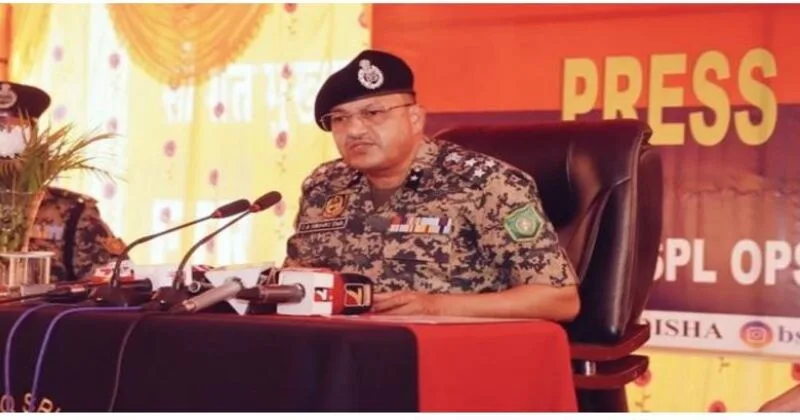
Bhubaneswar: In a strong and unequivocal message to Maoist outfits still operating in Odisha, the Border Security Force (BSF) warned that those who refuse to surrender will face stern action, including potential encounters. The warning came from BSF Inspector General (Frontier – Special Operations) Shiv Aadhar Shrivastava during a press conference in Bhubaneswar ahead of the force’s 61st Raising Day on December 1.
Shrivastava reiterated that the BSF remains committed to achieving a Maoist-free Odisha by March 2026, describing it as a “top operational priority” and a goal aligned with the vision of Union Home Minister Amit Shah. “This will be the last nail in the coffin of the Maoist problem in Odisha. We are determined to eradicate the menace by March 2026,” he said, underscoring that the remaining pockets of Maoist influence are shrinking rapidly.
Currently, six BSF battalions are deployed across Koraput, Malkangiri, Boudh, Kalahandi, Kandhamal, Rayagada, and Nabarangpur districts. The force has adopted a hybrid strategy that combines advanced technology with intelligence-led operations, executed in coordination with the Odisha Police and other Central Armed Police Forces (CAPFs). These measures aim to block Maoist mobility corridors, choke supply chains, and curtail infiltration from neighbouring Chhattisgarh and Andhra Pradesh.
One of the BSF’s most notable successes has been the transformation of the once inaccessible “cut-off” area in Malkangiri—previously a major Maoist sanctuary—into today’s peaceful and fast-developing Swabhiman Anchal. “The region, which once offered safe haven to Maoists, is now well-connected and progressing. It stands as a testament to our sustained operations and community engagement efforts,” Shrivastava said.
In recent months, the BSF has strengthened its deployment in the central Odisha districts, particularly Kandhamal. New operational bases have been set up, and units are carrying out longer, more intensive patrols through rugged and forested terrain. These tactical shifts have disrupted Maoist networks, forcing many cadres to surrender or retreat deeper into diminishing strongholds.
Since its induction into Odisha’s anti-Maoist operations in 2010, the BSF has achieved significant operational milestones: 86 Maoists neutralised, 710 arrested, and 2,508 Maoists and supporters surrendering. The force has also detected and defused 566 IEDs and explosives, substantially reducing threats to civilians and security personnel. Key infiltration routes along the state’s borders have been effectively sealed to prevent cross-border Maoist movement.
Emphasising that long-term peace cannot be achieved through force alone, Shrivastava said the BSF’s commitment extends to rebuilding trust and fostering development. The force has undertaken numerous civic action initiatives, including health camps, infrastructure support, and tribal youth exchange programmes. It has also organised exhibitions and district-level job fairs aimed at motivating the families and associates of Maoists to encourage surrender and rehabilitation.
The IG also highlighted the Odisha government’s enhanced surrender and rehabilitation policy, which includes an additional 10 per cent financial incentive for those laying down arms. The improved package, he said, is expected to further encourage militants to join the mainstream and embrace peaceful livelihoods.
Despite significant progress, challenges remain. Dense forests in Kalahandi, Kandhamal, and Boudh districts still witness sporadic Maoist activity, with IED threats posing a persistent hazard. Security officials also flagged the socio-economic dimensions of the insurgency, including narcotics-linked activities such as illegal ganja cultivation, which continue to fuel extremist networks.
Underscoring the sacrifices made during the anti-Maoist campaign, Shrivastava noted that 14 BSF personnel have laid down their lives since 2010 while combating extremists in the state. “Odisha, once synonymous with Naxal violence, now stands poised for a brighter future,” he said, expressing confidence that coordinated operations, improved intelligence, and growing public support will help eliminate Maoist influence completely by the 2026 deadline.















Comments