





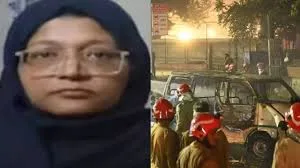
In a major development in the November 10 Delhi blast case, the National Investigation Agency (NIA) has uncovered startling details about accused Dr Shaheen Shahid’s attempts to build a women-led terror network. Shahid, a former pharmacologist at Al-Falah University in Faridabad and a key figure in the so-called “white-collar terror module,” is believed to have planned the recruitment of women to execute and support the attack, according to Faridabad police officials familiar with the probe.
On Thursday (Nov 27), the NIA escorted Shahid to the Al-Falah University campus for extensive on-site interrogation. The visit, which lasted nearly four hours, aimed to trace her movements, contacts, and possible radicalisation activities during her tenure at the institution. Investigators examined the university’s medical ward, classrooms, Shahid’s former cabin, and her hostel room as they attempted to reconstruct how she allegedly blended academic life with covert operational planning.
During questioning, Shahid reportedly revealed her intent to assemble a network of women operatives as part of the larger terror plot linked to the Delhi blast. This revelation has added a new dimension to the ongoing investigation, suggesting that the module had begun experimenting with new recruitment strategies to evade conventional surveillance patterns.
Sources quoted in media said that, the NIA is examining whether Shahid’s role extended beyond logistical support, expanding into active recruitment and indoctrination on the university campus. Interactions with female students, colleagues, and acquaintances are now under scrutiny, with investigators preparing a detailed list of individuals with whom she maintained close contact.
In a significant recovery, investigators reportedly found Rs 18.5 lakh in cash, multiple gold biscuits, and foreign currency during a search of Shahid’s hostel room. These findings have intensified suspicions about her financial links and potential overseas handlers.
Officials are also probing how such quantities of cash and valuables were moved and stored within a university hostel environment without triggering suspicion, and whether they were intended for operational funding, recruitment incentives, or escape logistics.
The NIA has been systematically bringing the accused back to locations connected to the case. Prior to Shahid’s on-site interrogation, officials had taken another accused, Dr Muzammil, to the same campus to identify areas used for planning and coordination. Investigators are expected to conduct a similar exercise with Dr Adil Ahmad, another arrested member of the module.
As part of Thursday’s probe, the NIA also took Shahid to a chemical shop from where Muzammil allegedly procured materials used in assembling the explosives recovered earlier. These spot verifications are aimed at tracing supply chains, mapping movement patterns, and establishing timelines related to the planning of the Delhi blast.
According to sources quoted in media, Shahid previously lived in Saudi Arabia for four years, from 2014 to 2018, where she worked as a professor at a medical college. Investigators are now examining whether her stay abroad played a role in her alleged radicalisation or whether she established links with foreign-based individuals connected to extremist outfits.
The NIA is working with international agencies to verify her foreign contacts and understand whether any financial or ideological influence during those years contributed to her activities in India.
During the four-hour campus visit, investigators meticulously reconstructed Shahid’s movements, reviewing her workplace interactions, classroom engagements, and activity logs. Multiple staff members and students are expected to be questioned based on the list prepared by officials.
Shahid was taken back to Delhi at around 9 pm after the verification exercise concluded.
A senior police officer quoted in media said that investigators now believe Shahid remained “actively involved in terror-linked activities” while employed at Al-Falah University. Her alleged attempts to build a network on campus, coupled with the recovery of cash and foreign currency, have strengthened suspicions that she operated at multiple levels within the module, financial, logistical, and ideological.
With the NIA tightening its investigative net and additional accused likely to be brought in for on-site verification, the probe into the Delhi blast continues to expand, revealing deeper layers of coordination and recruitment within the so-called white-collar terror module.















Comments