





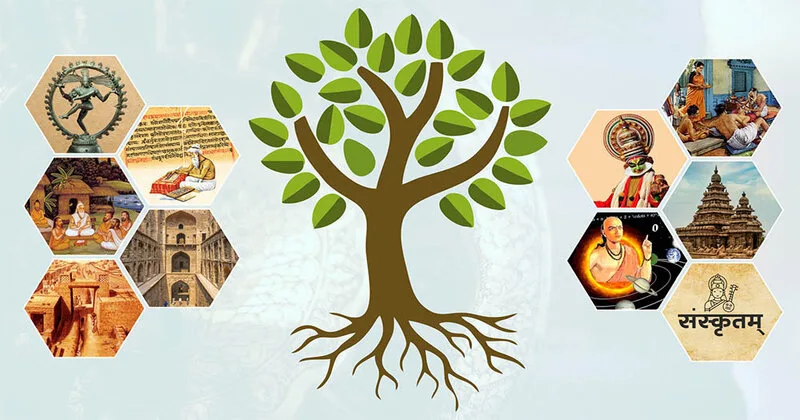
Modern discourse often compresses Hindutva into a narrow political label, overshadowing its deeper civilizational roots. When examined through the lens of India’s knowledge traditions, Hindutva emerges not as a religious ideology, but as a civilizational science, a framework that integrates metaphysics, epistemology, social ethics and lived cultural practices. It is a way of understanding the world, based on millennia of inquiry into consciousness (चैतन्य), nature (प्रकृति) and society (संस्कृति).
Veer Savarkar, often credited with articulating the modern definition of Hindutva, was explicit that Hindu identity extended beyond ritual or sect. As he wrote in Hindutva, Who is a Hindu? – “Hinduism is only a derivative, a fraction, a part of Hindutva… Hindutva is not merely a religious word”. For Savarkar, Hindutva embodied the collective continuity of the Indian civilization, its history, heroes, sacred geography and systems of knowledge. The civilizational lens requires understanding Hindutva in the way the ancient world viewed it, as a science and not as isolated disciplines, but as an integrated system of reasoning, inquiry and practice.
Continuity of knowledge systems
Defining Hindutva beyond religion requires seeing it as deeply rooted in the long continuity of Indian knowledge systems, philosophy (दर्शन), treatises (शास्त्र), oral traditions, arts, sciences and social institutions. These systems are unified by the principle of sanatanata, the idea of continuity without rupture. A foundational verse from the Srimad Bhagavad Gita expresses this sense of eternal continuity, “न जायते म्रियते वा कदाचित् … न हन्यते हन्यमाने शरीरे” (2.20), meaning “Eternal, unborn, undying, it is not destroyed when the body is destroyed”. In the Indian metaphysical imagination, civilization itself is understood as a living entity, persisting through cycles of creation and dissolution. Hindutva, therefore, is not a temporal or political construct but a form of civilizational self-awareness, the aphorism (सूत्र) that binds together Indian thought systems from Vedic phonetics and Nyaya logic to Ayurveda, classical arts and modern scientific perspectives.
Modern scholars often describe this continuity as “knowledge without borders and civilization without rupture”. The Indian knowledge traditions did not flourish through dogma or rigid doctrine, but through an open epistemic inquiry that defined the intellectual life of the civilization. This inquiry is exemplified in the six classical darsanas, Nyaya, which developed rigorous systems of logic and epistemology, Vaisesika, which articulated the categories and material principles of physical reality; Sankhya, which offered a detailed cosmology and psychology of existence; Yoga, which investigated the inner science of consciousness; Mimaṃsa, which perfected methods of hermeneutics and semiotics; and Vedanta, which explored metaphysical questions about self, universe and ultimate reality. Together, these knowledge systems form the scientific architecture of Hindutva, a holistic method of understanding truth (सत्य), knowledge (ज्ञान) and the human condition (पुरुषार्थ).
Sri Aurobindo, perhaps the most profound interpreter of Hindutva as civilizational science, emphasized this deeper meaning when he wrote, “The word Hindu expresses the law, the spirit, the characteristic power of the Indian people”. This ‘law’ (धर्म) is not dogma, it is the structural logic of civilization itself, comparable to how physics recognizes universal laws that govern matter and energy. Hindutva, in this sense, represents India’s civilizational epistemology, a dynamic, evolving and self-reflective system of knowledge that has persisted for thousands of years.
A scientific civilizational framework
Indian civilization has historically treated knowledge not as an article of faith, but as a disciplined science of inquiry. The Pramana (प्रमाण) tradition, its methods of validating knowledge illustrates this deeply rational foundation. Nyaya philosophy identifies four primary means of valid knowing, प्रत्यक्ष or direct perception; अनुमान or logical inference; उपमान or comparison and analogy; and शब्द or authoritative testimony, which is not blind belief but knowledge affirmed through verified tradition. This epistemic framework, remarkably relevant to contemporary fields such as cognitive science and artificial intelligence, shows why Hindutva can be understood as a civilizational epistemology. It seeks verifiable knowledge grounded equally in empirical observation and the systematic study of consciousness.
A celebrated Vedic verse captures this spirit of epistemic openness, “एकं सद् विप्रा बहुधा वदन्ति” (Ṛigveda 1.164.46 — Truth is one, the wise describe it in many ways). This pluralistic realism forms the bedrock of Hindu thought, not exclusivity but multiplicity, not dogma but dialectics, not fixed doctrine but layered interpretive possibilities. Such pluralism explains why Indian knowledge traditions could integrate diverse philosophies, sciences and metaphysical systems without internal contradiction.
Swami Vivekananda articulated this scientific pluralism with exceptional clarity. He affirmed that “We must learn the science by which the diverse manifestations of the universe are unified”. For him, Hindutva was not a sectarian identity but a form of “applied spirituality”, a science capable of explaining human potential, moral development and social organization. It provided a methodological lens through which the universe, society and the self could be studied with coherence.
In this sense, Hindutva functions as a civilizational science because it unifies metaphysical and empirical knowledge, integrates ethics with rational inquiry, sustains traditions through memory and reasoning and upholds pluralism as an intellectual virtue. Its strength lies in its epistemic flexibility, its capacity to evolve while preserving continuity and in its ability to bridge empirical sciences with inner sciences such as yoga, psychology and consciousness studies. Thus, Hindutva becomes not merely a cultural identity, but an enduring scientific framework that has shaped India’s intellectual history for millennia.
Savarkar: Hindutva as national-cultural science
Savarkar viewed Hindutva as the geocultural coherence of Indian civilization, a civilizational unity shaped not by religion alone but by shared rivers, shared heroes and shared cultural memories. His interpretation aligns closely with the idea of civilizational science in several important ways. First, Savarkar practiced what may be called synthetic history, reconstructing Indian history as a logical and continuous narrative, much like assembling a scientific timeline built on interconnected data points. Second, his approach reflected a form of cultural phenomenology, where festivals, rituals and myths were understood as civilizational algorithms, mechanisms through which societies encode, preserve and transmit knowledge across generations. Third, Savarkar insisted on rational reform, advocating scientific temper, social transformation and the rejection of superstition as he emphasized, “Superstition is the enemy of progress”. In this sense, Savarkar’s Hindutva stands at the intersection of ancient continuity and modern rationality, integrating the depth of India’s civilizational memory with a forward looking commitment to reason and reform.
Aurobindo: The integral science of civilization
Sri Aurobindo’s interpretation is perhaps the clearest articulation of Hindutva as a civilizational science. His philosophy rests on three pillars; Integral Yoga, which he conceived as a systematic, experiential method for studying and transforming consciousness; Evolutionary Theory, through which he argued that civilizations evolve just as biological organisms do; and Cultural Psychology, the idea that nations possess collective personalities shaped by history and aspiration. He famously wrote, “India’s unity is not an artificial mechanical unity, but a living psychological fact”, capturing his view that civilization is an organic expression of collective consciousness. For Aurobindo, civilization itself was a vast laboratory of human evolution, and Hindutva represented India’s distinctive experiment in harmonizing spirit and matter. The verse often invoked in his writings, “उत्तिष्ठत जाग्रत प्राप्य वरान्निबोधत” (Kaṭha Upaniṣad 1.3.14), meaning “Arise, awake and learn from the wise” became, in his interpretation, the civilizational call for intellectual awakening and transformative self-realization.
Vivekananda: Practical vedanta and social science
Vivekananda’s interpretation adds a pragmatic and scientific dimension, presenting Vedanta as a universal science of consciousness and Hindutva as its cultural expression. He famously declared, “Religion is realization, not talk, nor doctrine. It is being and becoming”, emphasizing that truth must be experienced rather than merely believed. In contemporary terms, his approach resembles a phenomenology of experience, much like what cognitive science studies today. Vivekananda’s perspective contributes three essential insights: Civilizational Humanism, the idea that India’s strength lies in its scientific exploration of the inner world; Ethical Universalism, encapsulated in the axiom “Each soul is potentially divine”; and Social Empowerment, the principle that all knowledge, spiritual or material, must serve to uplift society. In this way, Hindutva in Vivekananda’s thought becomes a dynamic harmonization of science, ethics and social responsibility, rooted in both rational inquiry and spiritual depth.
Hindutva as the scientific self of a civilization
When the political dust is cleared, Hindutva reveals itself as a civilizational science, a long, unbroken inquiry into the nature of reality, consciousness, ethics and society. It is not limited to religion, nor reducible to ideology. It is India’s civilizational method of knowing the universe.
Its foundational principles, pluralism, inquiry, continuity and synthesis, are expressed across texts, thinkers and epochs. From Savarkar’s cultural analytics to Aurobindo’s evolutionary metaphysics to Vivekananda’s scientific spirituality, Hindutva stands not as a sectarian concept but as a framework for civilizational knowledge.
In an age seeking models beyond Western epistemology, Hindutva offers a unique template. A civilization where science and spirituality are complementary, where diversity is the method of truth and where knowledge is the measure of identity.














Comments