





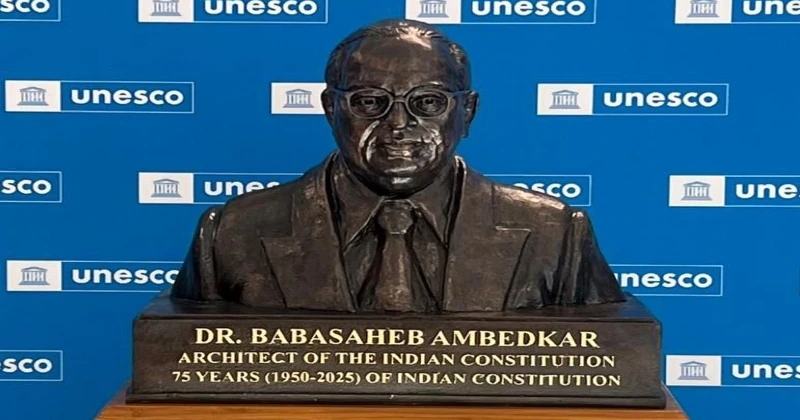
On Constitution Day, India unveiled a bronze bust of Dr. Bhimrao Ramji Ambedkar at the UNESCO Headquarters in Paris a historic moment that firmly positions the chief architect of the Indian Constitution among the world’s most influential champions of human rights and social justice.
The installation, held on November 26, 2025, marks Dr. Ambedkar as the first Indian leader after Mahatma Gandhi to be commemorated in UNESCO’s prestigious Garden of Peace, joining global icons such as Nelson Mandela and Martin Luther King Jr. The move signals India’s growing efforts to project its democratic thinkers onto the world stage.
The bronze sculpture, crafted by noted artist Naresh Kumawat, was unveiled by India’s Permanent Representative to UNESCO, Vishal V. Sharma, in the presence of UNESCO Director-General Audrey Azoulay, senior diplomats, and representatives of the Indian diaspora.
The ceremony underscored not just India’s respect for Ambedkar but also UNESCO’s acknowledgment of his global relevance. Senior officials noted that Ambedkar’s fight against caste discrimination and his championing of constitutional democracy align seamlessly with UNESCO’s commitment to human rights, equality, and inclusive education.
Prime Minister Narendra Modi, in a message posted on X, called the unveiling “a matter of immense pride” for India. He described it as a fitting homage to Ambedkar’s vision, which continues to empower millions across the world.
“His thoughts and ideals give strength and hope to innumerable people,” the Prime Minister wrote, emphasising that Ambedkar’s influence extends far beyond Indian borders and continues to inspire global movements for equality.
It is a matter of immense pride that today, on Constitution Day, a bust of Dr. Babasaheb Ambedkar was unveiled at the UNESCO Headquarters in Paris. This is a fitting tribute to Dr. Ambedkar and his role in the making of our Constitution. His thoughts and ideals give strength and… pic.twitter.com/CbbsMEK7ji
— Narendra Modi (@narendramodi) November 26, 2025
The unveiling was not just ceremonial it was a deliberate strategic cultural move. India’s Permanent Delegation to UNESCO organised the event in conjunction with Constitution Day celebrations, highlighting India’s intent to internationalise its foundational democratic values.
Ambassador Sharma, in his address, stressed that Dr. Ambedkar’s advocacy for justice, liberty, equality, and fraternity remains deeply relevant today, especially at a time when nations worldwide grapple with issues of discrimination, inequality, and democratic erosion.
With similar installations already present at the United Nations headquarters in New York, the British Parliament, and Columbia University where Ambedkar completed his doctoral studies the Paris unveiling solidifies Ambedkar’s position as one of the world’s great thinkers on social reform.
UNESCO’s endorsement reinforces the global significance of Ambedkar’s lifelong fight against structural discrimination and his belief in education as the basis of liberation.
India has observed Constitution Day annually on November 26 since 2015, honouring the adoption of the world’s longest written constitution. This year’s commemoration, amplified by the Paris ceremony, elevated the day into a global celebration of India’s democratic values.
















Comments