





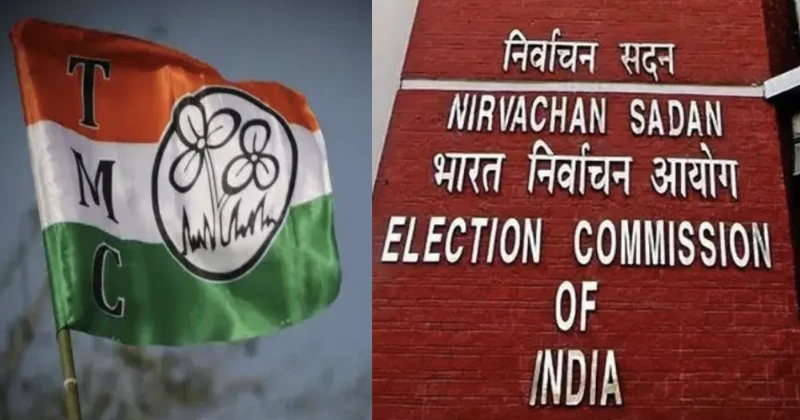
The Election Commission of India (ECI), firmly rejected the Trinamool Congress’ (TMC) accusation that Chief Election Commissioner Gyanesh Kumar failed to respond to the party’s questions regarding the ongoing Special Intensive Revision (SIR) of electoral rolls in West Bengal. Senior officials at Nirvachan Sadan said the Commission not only addressed each point raised by the 10-member TMC parliamentary delegation but also confronted the party on several critical concerns linked to the revision process and the treatment of Booth Level Officers (BLOs).
One of the commission’s strongest interventions came on the issue of pressure on BLOs and data-entry staff. According to officials, the ECI has issued a formal communication to the Director General of Police, West Bengal, and the Kolkata Police Commissioner, instructing them to ensure that BLOs, EROs, AEROs, and data-entry operators are not threatened, coerced, or influenced by any political outfit.
The commission told the TMC delegation that it “takes such complaints very seriously” and expects the state administration to guarantee a safe working environment for these officers, who are employees of the state government assigned to ECI duties.
The Commission also pointedly told the TMC delegation that no political party has the right to intimidate or influence BLOs dealing with dead, shifted, or duplicate voter entries. The ECI reportedly made it unambiguous that BLOs must be allowed to carry out their statutory tasks independently and free from external pressure.
On the issue of alleged “infiltrators” and “fake voters”, raised by the TMC after the meeting, ECI sources said the delegation was categorically told that Indian citizenship is the sole eligibility criterion for voting. Citing Article 326 of the Constitution, the Commission clarified that no foreign national can be allowed on the electoral rolls and that the SIR aims to ensure the removal of all ineligible entries through a lawful, structured process.
The Commission also expressed surprise that the West Bengal government has not disbursed the enhanced honorarium sanctioned by the ECI for BLOs and EROs. Calling the delay “very strange”, senior officials told the TMC delegation that this payment meant to support staff engaged in demanding electoral work—must be released immediately.
Contradicting TMC’s public claim that the ECI did not answer whether West Bengal was being singled out for the SIR while other border states were spared, the Commission said it had already clarified that all objections, evidence, and documentation related to the revision process must be formally lodged only after the draft rolls are published on December 9.
Only at that point, the Commission said, can claims and objections be legally examined.
Asserting its constitutional authority, the ECI told the TMC MPs that preparation of electoral rolls and conduct of elections in India are carried out in full transparency and in strict accordance with electoral law. Every stakeholder including political parties must operate within this legal and constitutional framework, the Commission said.
In another pointed response, the Commission confronted the TMC over its resistance to the establishment of polling stations in high-rise residential buildings in West Bengal. The ECI maintains that such polling stations are meant purely for voter convenience and are part of nationwide efforts to increase accessibility.
After the meeting, the TMC publicly alleged that the ECI “gave no credible answers” on issues such as alleged identification of “infiltrators”, workload pressures on field staff, and the rationale behind the timing of the SIR. But senior ECI officials have rejected these accusations, insisting that every question was addressed point-wise and that the delegation has been advised to raise formal objections only after the draft rolls are made public.









Comments