




At a time when Bharat is undergoing a broader civilisational resurgence, reclaiming long-suppressed cultural confidence and reasserting indigenous frameworks across public life, the Indian Armed Forces stand out as an institution that has never lost its intrinsic Bharatiya soul. Even during the decades when political leadership and intellectual discourse drifted heavily towards Western paradigms and deracinated notions of secularism, the fauj remained rooted in the values of unity, discipline, and dharma—values that have defined this civilisation for millennia.
The recent Supreme Court judgment upholding the dismissal of Lieutenant Samuel Kamalesan must be understood within this deeper context. It is not merely a decision about the disciplinary infraction of one officer; it is a landmark moment in the ongoing negotiation between civilisational unity and rising hyper-individualism, between institutional discipline and personal dogma, between the unique Sarva Dharma traditions of the Indian Army and the encroachment of Western-style absolutist interpretations of religious freedom. The Court’s verdict, in essence, reaffirms the foundational principle that no personal belief can override the collective ethos of an institution whose very survival depends on cohesion and uniformity.
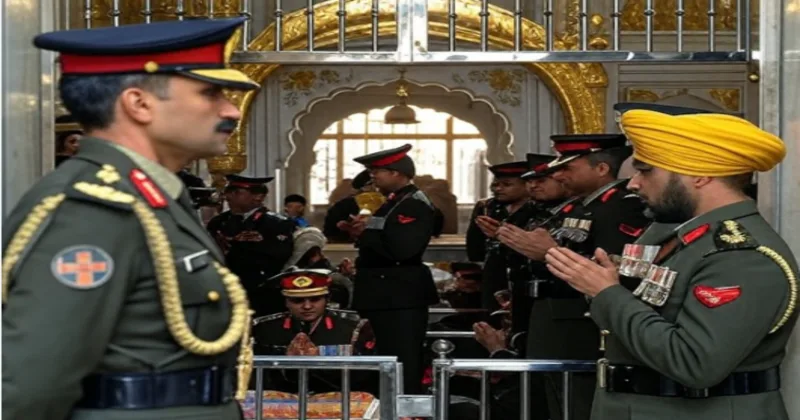
Lieutenant Kamalesan was commissioned into the Army in 2017 and posted to a regiment composed predominantly of Hindu and Sikh troops. Like all Army units, his regiment had longstanding religious-parade traditions—a mandir parade, a gurdwara parade, and visits to the Sarva Dharma Sthal. These are not religious compulsions imposed upon officers; they are integral components of regimental life, developed over generations, and meant to foster unity, mutual respect, and shared identity. Officers are expected to attend, not as participants in ritual worship, but as visible symbols of leadership and solidarity. The presence of an officer signifies to the troops that he stands with them in their cultural spaces, that he respects their traditions, and that he embodies the spirit of the unit in letter and spirit.
Yet, despite being counselled repeatedly for years, Kamalesan refused to enter either the mandir precincts or the Sarva Dharma Sthal, insisting that doing so violated his Christian faith. The Army, far from acting in haste, showed remarkable patience. Senior officers spent considerable time helping him understand the difference between participation in worship and symbolic attendance. Pastors were arranged to counsel him and explain that entering a mandir does not amount to worship, nor does standing at a Sarva Dharma Sthal compromise Christian belief. Even after multiple rounds of counselling spread over several years, he remained adamant. His refusal was not the result of coercion, misunderstanding or sudden confusion. It was a sustained, conscious rejection of an essential regimental obligation.
Eventually, after exhausting every option, the Army dismissed him for persistent indiscipline. The Armed Forces Tribunal upheld the dismissal. The Delhi High Court upheld it. The Supreme Court has now added its weight, making it clear that institutional cohesion cannot be subordinated to personal interpretations of faith. The judgment is legally sound, operationally essential, and civilisationally aligned with how Bharat has always understood unity—not as erasure of difference, but as respectful coexistence.
To appreciate why this case matters so profoundly, one must understand the nature and purpose of mandir-parade traditions in the Indian Army. These traditions are not remnants of a bygone era or ornamental ceremonies. They are the living framework of regimental identity. In Bharat, identity and spirituality are intertwined in a manner that is intricate, organic and deeply meaningful to the ordinary soldier. The village boy who joins the Army brings with him not only physical courage but also emotional and spiritual foundations derived from his family, community and dharma. Regimental mandirs, gurdwaras and Sarva Dharma Sthals provide continuity to these foundations and transform individual identities into a collective regimental spirit.
In this environment, the role of the officer is not merely functional or transactional. It is profoundly symbolic. An officer’s presence at such parades is a reaffirmation that he shares the soldiers’ journey, that he respects their customs and that he is one with them in spirit. The officer does not attend as a believer of a particular faith; he attends as the leader of men, as the custodian of regimental unity, as the visible representative of the institution. When an officer stands apart from the troops in spaces that they hold sacred, not for theological reasons but as a matter of identity and morale, he creates an emotional distance that erodes trust. And in war, trust is everything.
Those who attempt to frame this case as an instance of “persecution” or “targeting of a minority faith” either do not understand the nuances of military culture or are wilfully ignoring them for ideological reasons. At no point was Lt Kamalesan prevented from practising his Christian faith. He was not barred from Sunday church, prayer meetings, Bible study or personal devotion. Not a single restriction was placed on his personal religious practice. The issue was not about compelling worship; it was about requiring attendance at a regimental ceremony, an obligation that every officer—Hindu, Sikh, Muslim, Christian, Jain or Buddhist—has fulfilled for generations.
The Army’s Sarva Dharma Sthal system is perhaps the most remarkable reflection of Bharatiya inclusive ethos. It is a civilisational contribution unique to this land—neither Abrahamic nor atheistic, but deeply Dharmic in its approach. It represents a worldview where multiple spiritual symbols coexist without conflict, where unity is achieved through accommodation rather than insistence on sameness. The officer who stands in such a space is not endorsing one faith over another; he is endorsing the unity of the regiment.
It is also important to recognise the dangerous precedent that would have been set had Lt Kamalesan’s refusal been accepted. Militaries across the world, irrespective of political systems, rely on uniformity, predictability and ritualised coherence. They cannot survive if individual preferences, however sincerely held, begin to dictate participation in institutional practices. The moment personal religious interpretations become grounds for exemption, the chain of command begins to weaken. Today, one officer refuses to stand in a mandir. Tomorrow, another may refuse to attend a regimental langar. A third may claim that a farewell event violates his beliefs. A fourth may decline to participate in flag-hoisting ceremonies. This is not a hypothetical slippery slope; it is the logical consequence of undermining a principle that has held militaries together across centuries.
The Army’s insistence on adherence to tradition is therefore not arbitrary. It is necessary for institutional survival. It is also consistent with global military standards. The United States Army, the British Army, the French Armed Forces, the Israeli Defence Forces—all of them require officers to participate in unit ceremonies irrespective of personal religious convictions. None of these forces tolerate refusal to attend mandatory events that are integral to cohesion. In this respect, the Indian Army was far more patient and accommodating than most militaries would have been.
The Supreme Court recognised these realities with clarity. In upholding the dismissal, the Court noted that military discipline is not comparable to civilian employment. Armed Forces demand a higher, stricter, non-negotiable standard of compliance. A soldier in uniform cannot claim the full range of individual liberties available to a civilian. The Constitution itself recognises that the rights of members of the Army can be reasonably curtailed in the interest of discipline. Freedom of religion does not entitle an officer to rewrite regimental traditions. Nor can personal discomfort be elevated above organisational necessity.
What makes the judgment particularly significant is that it implicitly rejects the creeping influence of Western hyper-individualism within Indian institutional spaces. Over the last few decades, certain ideological groups have tried to transplant Western notions of identity rights, entitlement, and grievance culture into the Indian context. This may have produced confusion in universities, NGOs and parts of the media, but the Indian Army is not a laboratory for such experiments. Bharat’s military ethos is rooted in collective obligation, shared ritual and a Dharmic understanding of unity. It cannot and must not be reshaped to accommodate individualistic doctrines that emerged in societies far removed from our civilisational experience.
The Kamalesan case must also be viewed in the larger framework of Bharat’s modern civilisational moment. As the nation reclaims its cultural symbols, restores historical narratives and asserts the legitimacy of indigenous frameworks, institutions like the Army must remain anchored in their own traditions. Attempts to dilute or delegitimise those traditions in the name of imported models of “secularism” or “rights” must be understood as threats to cohesion, not as reforms. The Army’s Sarva Dharma tradition represents one of the finest embodiments of India’s pluralistic ethos—one that predates colonisation, one that survived colonial distortions, and one that continues to serve the nation effectively. It must be protected, not weakened.
There is a deeper philosophical principle at play here: the Dharmic understanding that duty to the collective supersedes individual preference. In the Indian worldview, dharma sustains society, institutions and cosmic order. Personal desire or aversion cannot be placed above dharma without causing imbalance. For a soldier, dharma lies in loyalty to the regiment, obedience to orders, and commitment to unity. When personal interpretations conflict with institutional dharma, the institution must prevail. This is not coercion but the recognition that in certain spheres of national life, especially in the Armed Forces, the individual aligns with the collective for the greater good.
The Kamalesan verdict, therefore, is not just a legal affirmation of military discipline. It is a civilisational correction. It restores the primacy of shared duty over personal dogma. It reasserts the sacred space of the Army’s institutional traditions. It reinforces the fact that Bharat’s unity emerges from harmony, not homogenisation—and that this harmony requires respect, participation and leadership, not withdrawal or exclusion.
Ultimately, the uniform cannot bend to individual whim. It is the fabric of national security and must remain untorn. Kamalesan was not dismissed because he was Christian, but because he was unwilling to fulfil the obligations of leadership. The Army did not fail him. The courts did not fail him. He failed the Army. And the Supreme Court’s verdict ensures that such failure will not be allowed to weaken the institution again.
In the Indian Army, as in the larger civilisational ethos of this land, discipline comes before the self, unity comes before personal belief, and dharma comes before individual preference. This is not merely a military principle—it is a national imperative. The Supreme Court has reminded the nation of this truth at exactly the moment it was needed. And for that, Bharat should be grateful.











Comments