





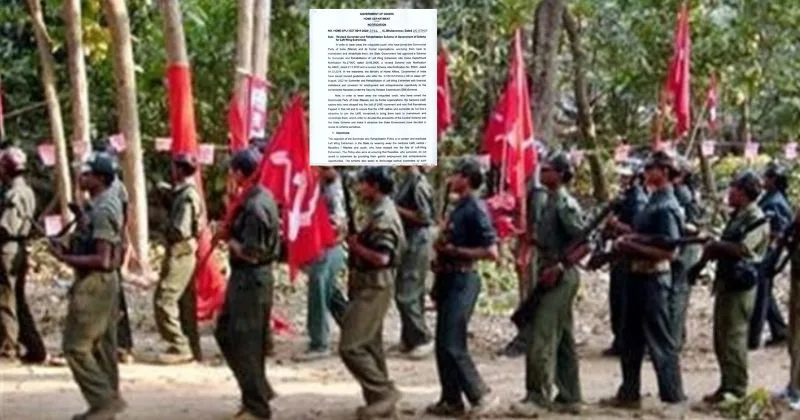
Bhubaneswar: In a significant move to eradicate Maoism from the state, the Odisha government has introduced a revised and considerably strengthened Maoist Surrender and Rehabilitation Policy. This new policy increases financial assistance, raises rewards for surrendered firearms, and expands rehabilitation benefits through various welfare schemes. Officials stated that the goal is to encourage active Maoists to renounce violence and reintegrate into mainstream society.
A senior official praised the decision, declaring that the revised framework is “among the best in the country” and will further enhance efforts to combat extremism. According to a notification from the Home Department, the updated policy aims not only to draw hardcore cadres away from Maoist affiliations but also to ensure that surrendered individuals do not revert to extremism. This will be accomplished by providing gainful employment opportunities, entrepreneurial support, and social security benefits.
Under the new guidelines, surrendered cadres will be categorized into two groups—A and B. Category A includes senior-level Maoists, such as central committee secretaries, politburo members, central military commission members, state committee members, regional committee leaders, and special zonal committee members. Category B consists of divisional committee secretaries, military platoon commanders, divisional committee members, area committee secretaries, and area committee members.
Financial assistance has been doubled for top-tier cadres. Category A surrenderers will now receive ₹5 lakh, up from the previous cap of Rs 2.5 lakh, while Category B cadres will receive ₹2.5 lakh. Rewards for surrendering weapons have also been significantly revised. A Maoist surrendering a light machine gun will be eligible for Rs 4.95 lakh, while those surrendering AK-47 rifles will receive Rs 3.3 lakh, a substantial increase from just Rs 10,000 earlier. Similarly, the reward for SLR/INSAS rifles has been raised to Rs1.65 lakh, and for .303 rifles to Rs 82,500.
Active cadres with a reward of Rs 5 lakh or more will receive an additional Rs 10 lakh upon surrender. This amount will be deposited as a fixed deposit for three years in the name of the surrendered cadre. The accrued interest will be distributed periodically, and the principal amount will be released after three years, contingent upon satisfactory conduct and verification by the Surrender and Rehabilitation Committee.
In addition to financial incentives, the government will offer a variety of welfare benefits, including housing under the Antyodaya Gruha Yojana, healthcare support through health cards, and free rations under the Pradhan Mantri Garib Kalyan Anna Yojana.
The revised bounty structure for wanted Maoists has also been formalized, with central committee or politburo members carrying a bounty of Rs 1.10 crore, followed by Rs 55 lakh for state or zonal committee members, Rs 33 lakh for regional committee members, Rs 27.5 lakh for divisional secretaries, and Rs 22 lakh for divisional committee members.
The policy further recognizes married Maoist couples as separate beneficiaries, ensuring both partners receive full rehabilitation support independently. Legal aspects have also been addressed.
“Trials for heinous crimes committed by surrendered Maoists will continue in court. However, the government may consider withdrawing prosecution on a case-by-case basis, depending on the antecedents and merits. For minor offenses, plea bargaining may be permitted at the government’s discretion. Free legal aid could also be extended to surrendered Maoist cadres,” the policy stated.
Officials emphasized that the revised policy reflects Odisha’s commitment to achieving a comprehensive and lasting solution to red terrorism through rehabilitation, empowerment, and reintegration, rather than relying solely on force.












Comments