





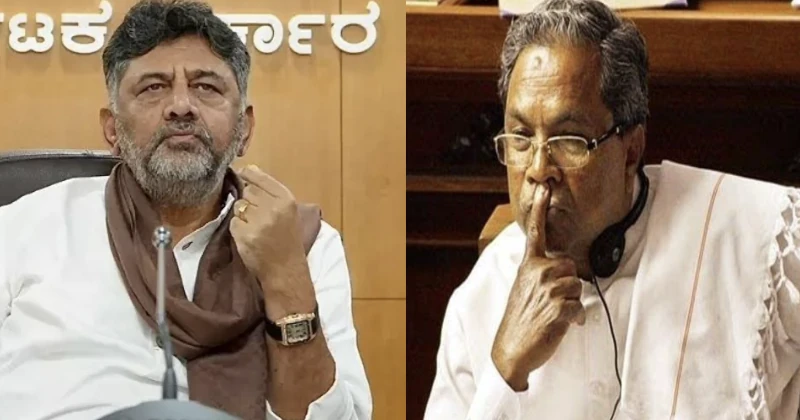
BENGALURU: The Siddaramaiah-led Congress government, once buoyed by a strong mandate and high expectations, is now caught in an internal power struggle that has severely eroded its credibility. A fresh CVoter survey indicates that the ongoing tussle between Chief Minister Siddaramaiah and Deputy Chief Minister D.K. Shivakumar has led to a sharp decline in public confidence, exposing deep cracks within the ruling party and raising serious questions about its administrative focus.
According to the survey, public satisfaction with the government, already modest at the start of 2024, had dipped alarmingly by late November 2025. In January 2024, 30.3 per cent of respondents rated the government’s performance as “satisfactory.” Today, that number has shrunk to 26.9 per cent, signalling a significant loss of goodwill. More worrying for Congress is the rise in dissatisfaction: from 39 per cent in early 2024 to 42 per cent by November 2025. For a government that promised stability and welfare-oriented governance, the growing discontent starkly contrasts with the optimism generated after coming to power.
At the heart of this credibility crisis is the unending tug-of-war between Siddaramaiah and Shivakumar—two leaders who claim to work together, yet operate from parallel centres of power. The Congress high command’s ambiguity over the “rotational chief ministership” formula has only intensified the divide. Instead of a unified government focused on governance, Karnataka today witnesses factionalism, contradictory messaging, and administrative drift. Cabinet decisions, transfers, district-level appointments, and even public outreach programmes have become battlegrounds for the two camps.
This internal bickering has not only damaged Congress’s public standing but also given the opposition BJP ammunition, successfully mounting a narrative that the government is too distracted by infighting to deliver on its promises.
The CVoter survey reveals a political shift that Congress can no longer ignore. When asked who should lead Karnataka, a majority across social groups preferred a BJP or NDA Chief Minister. The figures speak for themselves:
- 47.2 per cent of SCs
- 56.3 per cent of STs
- 59.3 per cent of OBCs
- 14.8 per cent of Muslims
These numbers indicate increasing disenchantment with Congress, especially among communities that played a key role in its electoral victory.
Despite a decline in popularity, Siddaramaiah remains Congress’s most preferred face within the party. The survey shows that:
- 41.7 per cent of SCs,
- 35.4 per cent of STs,
- 63.3 per cent of OBCs, and
- 74.9 per cent of Muslims
Still favour him over other Congress leaders. This indicates that, while the government as an institution is losing credibility, Siddaramaiah individually retains a sizeable support base. However, this support hasn’t translated into broader approval for the government’s performance, suggesting widespread frustration over the administration’s inefficiency and internal conflicts.
The Deputy Chief Minister, often portrayed as the party’s organisational powerhouse, fares poorly in the survey. Only:
- 7.4 per cent of SCs,
- 5.9 per cent of STs,
- 6 per cent of OBCs, and
- 9.1 per cent of Muslims
Want him to become Chief Minister. His limited acceptance beyond the Vokkaliga base and the perception of being embroiled in internal political manoeuvring seem to have hurt his prospects. The survey also shows negligible support for Mallikarjun Kharge and other Congress heavyweights, indicating a severe leadership vacuum beyond Siddaramaiah.













Comments