





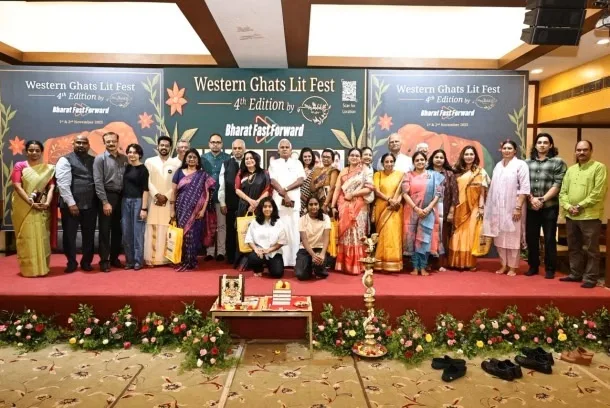
The two-day session of the 4th edition of the Western Ghats Literature Festival, conceived as a confluence of India’s intellectual, cultural, and literary currents, has evolved into one of India’s most thoughtfully curated platforms for the celebration of Bharatiya ideas, creativity, and consciousness, and was held on November 1 and 2. This year’s 4th edition theme was “Bharat Fast Forward”.
This year too, as in earlier successful editions, the 4th-year event brought together 32 distinguished speakers from across Bharat, featuring prominent authors, thinkers, and cultural figures. The event included panel discussions, book launches, keynote addresses, and cultural performances covering a wide spectrum of topics. This year’s special edition included dedicated sessions on Defence, Indian Knowledge Systems, and Yoga.
The two-day event began with the lighting of the ceremonial lamp, an invocation song by Sankar Narayanan, disciple of Carnatic singer KJ Yesudas, and Vedic chanting. The event made obituary references to Pahalgam victims and literary doyens who passed away.
Shefali Vaidya, Director of Verandah Club, in her address said, “The Western Ghats Lit, a premier literary event in South India, is back with the fouth edition on November 1 and 2,” saying it is building on the success of its previous editions. She added that Western Ghats Lit Fest 2025 promises an immersive experience with a global perspective and a diverse range of speakers. Shefali Vaidya, who has been curating the events, said it was launched in 2022, amidst uncertainties after the COVID-19 pandemic. The first edition featured 16 speakers and laid the foundation for a vibrant literary platform to follow. Now they are in the 4th edition. She said, “We have an elite crowd, no shouting. This year there would be 15 book launches against 16 in last year’s 3rd edition. It is a meeting of minds,” she added.
She described the Western Ghats Litfest as “rooted yet rational, emotional yet cultured, contemporary yet deeply civilisational”.
Dushyant Sridhar, spiritual discourse speaker and author, in his keynote address titled “The Eternal Echo of Epics”, compared this event to the place where three Vaishnavite Alwars met in a small space to escape from the rain and gave the Divya Prabandhams (a composition of 4,000 songs in Tamil praising Bhagwan Vishnu). He said the Lit Festival was the starting point of many ideas and a confluence of identical ones. “It is an event of knowledge.” He traced the Ramayan. Sage Agasthiyar’s student Tholkappian says his guru was the leader of the elite literature festival.
The speaker quoted from the Ramayan’s Kishkinda Kanda and the dialogue between Rama, Lakshmana, Vanara king Sugriva, and Tara to underscore the necessity for ethical governance, promise-keeping, leadership restraint, and dharma sankalp in public life. Sridhar said the Ramayan exemplifies the four purusharthas—Dharma, Artha, Kama and Moksha. He explained that it applied Kautilya’s Saptanga model, Mandala theory, and Sadgunya diplomacy to highlight strategic clarity and ethical statecraft relevant to contemporary Bharat.
The speaker cautioned against internal erosion, saying, “Societies collapse first in mind, then in matter. To protect Bharat, we must defend philosophy with practice, confidence, and continuity.” He also spoke on Sanatana Dharmas (which, he said, the present state government wanted to destroy). Sridhar said, “Atheists should not be ministers. But here, the entire cabinet is full of non-Hindu god believers.” Both the Ramayan and Mahabharat give us clues on these aspects.
Next followed the panel discussion on “Swayam Bhodha, Shatru Bhodha” (knowing self and knowing others). Author Saiswaroopa Iyer moderated the panel with members Sumedha Verma Ojha, Pankaj Saxena, and Sampadananda Mishra. Pankaj Saxena said, “Without ruling ourselves, we can’t rule others. First conquer oneself before conquering others.” The panellists discussed the theme at length, quoting history and itihasas.
The ‘Rishi’s Tradition of Bharat’ book was launched. In this session, advocate and writer MR Venkatesh and Sumedha Verma Ojha discussed Bharat’s ancient sense of statecraft. Venkatesh said, “We have a Christian Constitution in a Hindu nation because of past PM Nehru’s proximity with Britishers. He did not refer to or consider our trusted statecrafts like Chanakya’s Arthashastra or others to make our Constitution. There are stone inscriptions in Uthiramerur in Tamil Nadu which talked about civil democracy—the process to select village committee chiefs and members. Even PM Modi mentioned this in one of his addresses.” He said the Election Commission of India also noted this process, “but Nehru Westernised it as if we were not.”
He said the British left India when the country had 505 princely states. Sardar Patel brought them into one national umbrella. “All Hindu kings readily accepted his idea, but two Muslim rulers did not—one was the Hyderabad Nizam and another was Jammu & Kashmir’s Sheikh Abdullah. We are duty-bound to rewrite our Constitution for the benefit of younger generations.”
Venkatesh said there was “Romanisation” in 1491 by the Pope’s order. It talked about discovering new lands to convert them into Christian lands. “Discovery of India was one among them. Nehru copied this title for his book. Ambedkar was against Nehru’s way of writing the Constitution, but Nehru convinced others to toe his line. We are in a ‘Prestrevelika Tria Phobia’.” Historian Ojha recalled how tribals followed democracy in the sixth century. Their system had a chief executive or “head of state” (sometimes called a Raja or Pramukh) who was elected by the assembly for a limited term.
The next session was a speech by Priyam Gandhi Mody on “No Congress, No Nonsense: Chronicles from Political Bharat”. She said, “For reasons, Kashmir was kept burning. The Maharaja wanted Kashmir integrated into Bharat. He wanted to join. But Mountbatten spoke to him pressing him to join Pakistan, echoing Nehru’s stand. For the sake of Sheikh Abdullah, Nehru tried all tricks to prevent Kashmir from joining India. His stance was that Kashmiris were not Hindus but only Muslims. This continues even today.”
On Operation Sindoor, she said, “We said it is not escalation, but it ought to be. We should know that with our non-alignment stand we were isolated. We are bound to follow the pact. Nehru mishandled the Tibetan issue and helped China gain the upper hand. It was like giving in on a golden plate. Patel wrote this in the 1940s itself. Following Nehru’s footsteps, our current opposition, including Congress, want to divide the nation. Vote-bank politics prevents us from declaring ours a ‘Hindu Nation’.”
A book authored by Vignesh Ganesh titled ‘Pallavas of Kanchi – Stones That Speak’ dwelt at length on history, saying they were the ones who traded with other countries without compromising Hindu identity. They did a roaring trade.
Ganesh, an advocate suffering severe kidney failure who read extensively and wrote the book, said, “Pallava kings believed the kingdom is ruled by all, not by the king alone.”
Verandah Club founder S. Jaganathan’s book ‘Operation Phoenix: Bharat Protocol, Rising from the Ashes’ was launched. It belongs to the crime-thriller genre. He said till 2014 there were over 6,000 terror attacks in Bharat in a 21-year period. “But things were different under PM Modi’s rule. The whole world is looking at Bharat.”
Another book titled ‘Operation Sindoor and the Spirit of Sacrifice’, authored by Retd Wing Commander Sudarshan, was launched. He spoke about Operation Sindoor with technical details such as the type of warheads, warfare strategies, and warplanes used.
In the post-lunch session, a panel discussion moderated by Shefali Vaidya included panellists Swami Vigyananda and Swami Mitrananda. Some commented that it was “saffronisation” as two monks in saffron attire sat on the dais. The topic was “The Hindu Manifesto: Youth, Dharma and the Digital Dilemma”. Swami Mitrananda said, “Today’s youth are over-informed. Make them know what you want. Initiate them into higher techniques and guide them. They do wonders. They do not want to be coached and follow your orders. Wealth creation is important. How is it created? We are known for making charities. It is wrong to say Christians were the only ones doing it. For generations, we have been strong creators of wealth only to do sevas in various forms. All well-known and good educational institutions were started by us, not by government. We have been serving collectively through ashrams and temples in Bharat. RSS is the best example.”
Another speaker said defeating the enemy in war is dharma. “That is what Bhagwan Krishna told Arjuna.” The Rig Veda names 28 female rishis. They said a book can be reviewed under six heads that our ancestors prescribed for us.
The next was a discussion with author Ashwin Sanghi and Shefali Vaidya on “Myths, Murders and Manuscripts: Why India Loves Her Stories Ancient”. He explained why he took to writing, how he became a writer, hurdles faced, the return of his manuscripts by publishers for a long time, and having catchy titles once he became popular. He underscored: “empathy, entertain, educate and enlighten”—the formula for writing.
In the next session, Retd Lt General Vinod G. Khandare spoke on Operation Sindoor: “Defending Dharma”. It was an enthralling talk that took delegates to the battlefield and boardrooms. He said that veering away from the past soft approach, then defence minister late Manohar Parrikar told one of the meetings, “No soft approach on terrorists,” and gave them a free hand. “We are adopting no similar mode of tactics, changing them to avoid our enemies’ guess. In Sindoor operation we adopted a different method.” He said in the 1962 war, “We lost. It was not a loss for the military; PM Nehru wanted to see us lose the war to help China. The Army is a living example of diversity in equality.” He spoke about the Kargil War and other operations till Sindoor. He criticised certain section of Indian media for lacking credibility in reporting in the western sector. “Its coverage of Operation Sindoor proved this.”
The second day session started with a prayer, lamp lighting, and Vedic chanting by children of Anaadhi Foundation, followed by an invocation. Retd Maj General (Dr) Bipin Bakshi delivered a keynote address on “Cold Start to Dynamic Response: India’s New Normal”. He spoke about post-1989 issues, particularly after the Pathankot Air Force attack. He gave a presentation using his graphic novel detailing the Uri attack in 2016, Nagrota 2016, Sunjuwan 2018, Pulwama, Pahalgam 2025, and India’s retaliation. He elaborated on the Sunderji doctrine and “deceive retaliation”. In Operation Sindoor, “Army attacked 7 targets (including 2 by BSF), Navy 2, Air Force 2, totalling 9 targets. It was coordination of all forces. We did not cross the international border; no human killing. Midnight operation to avoid civilian loss. It was not at Namaz time. It was careful planning.” He said, “1962 war is not a template.”
The next panel discussion was moderated by Nandini Sengupta with Aishwarya Rao, Abhijit Joag and Priyam Gandhi Mody.
Archeologist Dr Suresh Sethuraman spoke at length on “Bharat Meets Rome: Spice, Silk, Silver”. Through a PowerPoint presentation, he linked Roman artefacts and coins found in Tamil Nadu at various sites. Pepper (black gold) was their main commodity, which included 30 spices like nutmeg, clove, and cardamom. He said they bought live peacocks for pets in Roman aristocracy, textiles, sandalwood, ivory, and rosewood in exchange for wine, gold, silver, antimony, and glass vessels. One Pan Attha was the chief supplier of gems from Tamil Nadu, according to Latin literature. Gold coins carrying Augustus Caesar and Julius Caesar were found in Tamil Nadu. Only a few are with government; most were in the hands of illiterate men who did not know the value and sold them to goldsmiths (who melted them for high-quality gold) or to traders. Coins were found in the Palghat Pass, also known as the Palakkad Gap, a major natural pass through the Western Ghats linking Kerala and Tamil Nadu.
This was followed by a panel discussion chaired by Sundar Raman with N. Muthuraman, Sandeep Singh and Guru Vittal on “Economics of Viksit Bharat: The Dharma of Artha”. The speakers talked about the temple economy. “Mandir is a symbol of civilisation. Visit the temple daily and donate if possible. Never allow it to be destroyed.”
Advocate Ashwin Sampath Kumaran then spoke on the importance of rearing cows through goshalas. Anuradha Goyal posed him a question about his Dakshin Brindavan, where he takes care of over 700 cows—lactating, old, and bulls. He said the cow is one of the seven mothers mentioned in our customs. There is an economic model in running cow shelters. “We never touch the excreta of man or animals except cow dung, which is good for purification, maintaining hygiene, besides being the best manure. Its urine contains medicinal values. Both urine and excreta are like gold. Desi cows are native to the place. They can deliver seven calves, but foreign breeds stop after two in most cases. But yield-wise they are superior.” He explained how he started the cow shelter and runs it. He advised youngsters to rear a cow at home instead of other pets like dogs or parrots. Housing condominiums, he said, should have exclusive space for cow shelters and encourage residents to adopt or rear their own. “Assault on the cow is an unpardonable sin. Westerners are trying to destroy cow-dharma with the dog as a status symbol. There is no ban on cow killing in West Bengal or Kerala.”
A panel discussion moderated by Saiswaroopa Iyer with Shefali Vaidya and Nandini Sengupta as panellists was held on “Unsung, Unbowed: Women Who Refused to Fade”. They praised queens and women who carried the mantle of kings against enemies, and spoke about women achievers of pre- and post-Independence. In his keynote address, retired High Court Judge N. Seshasayee faulted the public for bringing to courts cases that were not worthy before trying other modes of resolving disputes. He criticised comments about judges’ long leave, perks, and privileges. “Judges work from morning to midnight and during holidays. Such comments should be avoided.” He said the piling up of cases was the result of the public approaching courts for all their woes. “They need a solution but blame us. They do not want to take responsibility. Courts have become garbage bins. Thirty per cent of cases that came to me were useless during my 21 years as a judge. Criticising judges is easier. We too come from the same society.”
This was followed by a panel discussion chaired by Rithwik Subramanya with Anuradha Goyal, Saiswaroopa Iyer and Pankaj Saxena on “Living Temples, Living Traditions”. The last event was the panel discussion by Prof Kanagasabapathy with author Sandeep Singh on “Rethinking Prosperity: Clarity, Not Charity”. Kanagasabapathy said we are still studying Adam Smith and other western economists’ theories which are outdated and irrelevant for Bharat’s conditions.
The Verandah-Smart Awards were given to seven awardees. Among them, the media partner ‘Organiser’ was also felicitated. This was followed by a display of gymnastics through yoga by students of Anaadhi Foundation. The event ended with a vote of thanks by Veranda Club coordinator N. Saravanakumar, who said the 5th edition would be held on October 24 and 25 next year.











Comments