





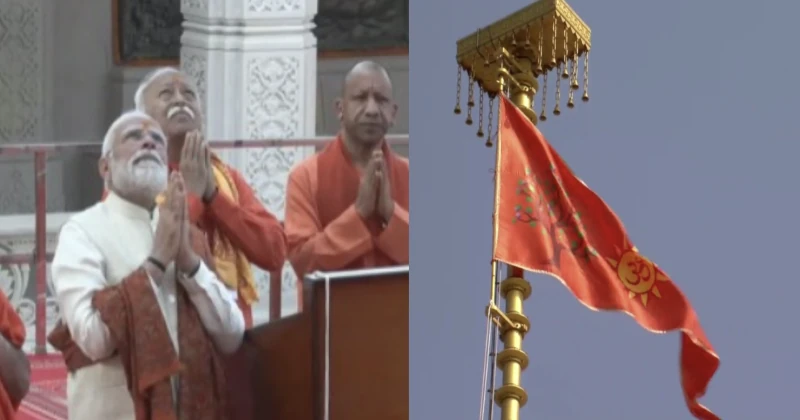
Prime Minister Narendra Modi and Rashtriya Swayamsevak Sangh (RSS) Sarsanghchalak Mohan Bhagwat performed Dhwajarohan atop the shikhar of the Ram Mandir in Ayodhya on November 25. The grand ceremony witnessed by Uttar Pradesh Chief Minister Yogi Adityanath, Governor Anandiben Patel, and thousands of devotees marked the formal completion of the Ram temple’s construction and the beginning of a new chapter in India’s cultural resurgence.
The event was timed with extraordinary precision. The Dhwajarohan coincided with the auspicious Vivah Panchami, the celestial moment marking the divine union of Bhagwan Shri Ram and Maa Sita. Aligned with the Abhijit Muhurat, the moment carried profound spiritual resonance.
#WATCH | PM Narendra Modi and RSS Sarsanghchalak Dr. Mohan Bhagwat ceremonially hoist the saffron flag on the Shikhar of the sacred Shri Ram Janmbhoomi Mandir, symbolising the completion of the Mandir’s construction.
The right-angled triangular flag, measuring 10 feet in height… pic.twitter.com/CeSbuxuRYg
— Organiser Weekly (@eOrganiser) November 25, 2025
As PM Modi and Dr Bhagwat jointly unfurled the Dharma Dhwaj, right-angled triangular flag, measuring 10 feet in height and 20 feet in length atop the 191-foot-high shikhar, conch shells echoed, bells rang, and chants of “Jai Shri Ram” filled the air. The saffron flag is rich in symbolism:
- The radiant Sun represents Bhagwan Ram’s Suryavanshi lineage and his unwavering brilliance.
- The sacred Kovidara tree, a hybrid creation attributed to Rishi Kashyap, embodies ancient wisdom and cultural continuity.
- The ‘Om’ symbol signifies the eternal spiritual essence of the Sanatan tradition and the ethos of Ram Rajya.
The hoisting of the Dharma Dhwaj not only marks architectural completion but also stands as a cultural declaration celebrating unity, resilience, and a revival of civilisational pride.
Before the ceremony, PM Modi offered prayers at the Ram Lalla Garbha Grah, followed by a solemn visit to the Saptmandir, which houses temples dedicated to revered figures including Maharshi Vashishtha, Maharshi Vishwamitra, Maharshi Agastya, Maharshi Valmiki, Devi Ahilya, Nishadraj Guha, and Mata Shabari. He later visited the Sheshavtar Mandir, paying homage to Ayodhya’s ancient spiritual tapestry.
Surrounded by devotees waving the tricolour, the Prime Minister’s roadshow leading to the Mandir became a vibrant display of national and spiritual unity.
The Ram Mandir stands as an architectural marvel an embodiment of India’s diverse temple traditions:
- The Nagara-style shikhar represents classical North Indian temple design.
- The 800-metre Parkota encircling the structure incorporates South Indian architectural aesthetics, underscoring Bharat’s cultural fusion.
- The temple walls are adorned with 87 intricately carved stone episodes from the Valmiki Ramayana.
- The enclosure features 79 bronze-cast cultural episodes, creating a massive open-air gallery of Indian civilisation.
This immersive design transforms the Mandir into not just a place of worship but a living museum of Indian heritage.














Comments