





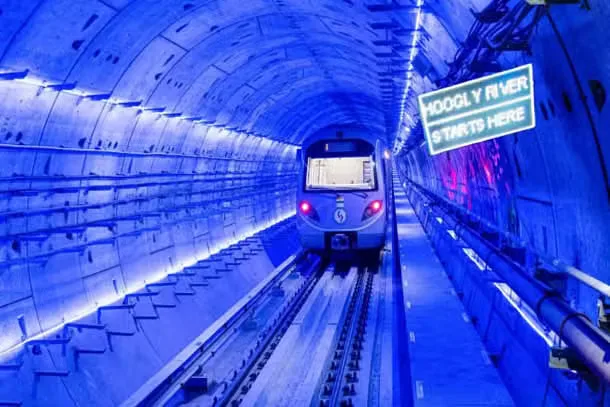
After four decades of continuous operation, the Kolkata Metro’s Blue Line is preparing for a transformative upgrade designed to bring the country’s oldest metro network on par with modern rapid transit systems. The extensive project includes the installation of multiple traction substations (TSS) along the corridor, introduction of a state-of-the-art tunnel ventilation system, and major environmental control improvements inside tunnels and stations.
According to officials, seven new traction substations will be set up between Dakshineswar and Sahid Khudiram (Birji), covering the length of the Blue Line. This section of the Metro, which continues to remain the backbone of Kolkata’s urban transport, has long required infrastructure modernisation to cope with increased train frequency and passenger load.
The substations will be strategically placed at Kalighat, Netaji Bhawan, Maidan, Esplanade, MG Road, Sovabazar–Sutanuti, and between Belgachia and Shyambazar. Once operational, these additions will ensure that the Blue Line has a substation at every station, mimicking the power distribution model used in the newly built Purple Line (Joka–Majerhat) and Orange Line (Kavi Subhas–Beleghata).
Metro officials emphasised that the installation of new traction substations is central to strengthening the power supply network. These substations convert high-voltage electrical input into the traction power needed to run metro trains and station systems. A more distributed power network will reduce the chances of outages, ensure smoother train operations, and allow better regulation of train intervals.
Along with the seven new substations, two more are being built at Chandni Chowk and Geetanjali (Naktala). These are expected to address long-standing operational challenges, especially around the busy Esplanade–Central stretch, where rakes often pile up due to power and signalling constraints.
A spokesperson for Metro Railway highlighted the importance of the Chandni Chowk installation, saying, “The TSS coming up at Chandni Chowk will help avoid congestion of rakes between Esplanade and Central stations. This has been a persistent issue on the Blue Line, and the new substation will significantly streamline train movement.”
Beyond power enhancements, Kolkata Metro is preparing for a major shift in its tunnel ventilation infrastructure. For decades, tunnels were kept cool primarily because the metro ran non-air-conditioned rakes that required significant ambient temperature control. With the network now operating a fully air-conditioned fleet, the ventilation requirement has changed fundamentally.
Currently, the Blue Line relies on heavy-duty mechanical ventilation using 110 kW centrifugal fans installed at fourteen midpoint locations. These fans operate round the clock to maintain airflow. Until a few years ago, running these fans cost the Metro around Rs 21 crore annually. However, the introduction of energy-saving mechanisms in 2021-22 cut power consumption by half. Even then, the ageing system continued to pose maintenance challenges and needed modernisation.
The new Tunnel Ventilation System (TVS) being installed will not only regulate airflow more efficiently but also play a crucial role in emergency responses. The system will activate automatically based on temperature changes, smoke levels, or elevated CO₂ concentration inside tunnels. It includes high-capacity axial fans capable of running for up to two hours even at 250°C, a specification considered essential for fire evacuation scenarios.
Kolkata Metro authorities noted that the new ventilation setup will drastically improve fire and smoke extraction capabilities during emergencies. In modern metro systems, TVS is a key safety feature that guides smoke away from evacuation routes and helps maintain tenable conditions for passengers and first responders.
A Japanese subsidiary has been awarded the contract for the comprehensive environmental control upgrade. Engineers from the company have already inspected installations at Jatin Das Park station and begun outlining the replacement cycle for existing fans and duct systems. The collaboration is expected to bring global standards of tunnel safety and energy efficiency to the Kolkata network.
Apart from enhancing safety, the upgrade promises significant environmental benefits. Metro Railway estimates an annual reduction of at least 12,300 metric tonnes of carbon emissions once the project is fully implemented. This reduction stems from both the energy-efficient ventilation technology and the improved load management facilitated by new substations.
The modernisation of the Kolkata Metro Blue Line represents a major effort to align legacy infrastructure with the evolving needs of a rapidly growing metropolis. With passenger volumes increasing and train frequencies set to rise further, both power and environmental control systems require strengthening.
Officials have indicated that the upgrades will be completed in phases to avoid disruptions to daily services. Once fully implemented, the Blue Line is expected to deliver smoother rides, reduced congestion, faster turnaround times, and enhanced safety for millions of commuters.
For a network that has been operational since 1984, the new developments mark a crucial step toward future-proofing one of India’s most iconic transportation systems.











Comments