





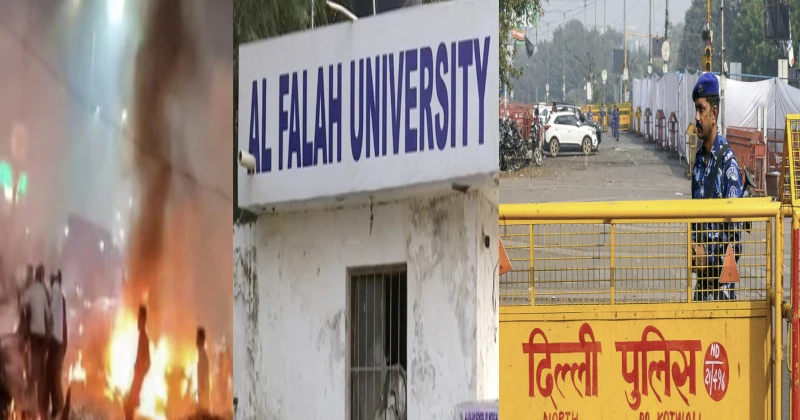
The Enforcement Directorate (ED) on November 18, launched coordinated raids at 25 locations across Delhi, Faridabad, Haryana, and other cities, targeting the terror-linked Al-Falah University, its trustees, and a web of associated firms and individuals. The marathon operation triggered by the agency’s newly registered Enforcement Case Information Report (ECIR) has brought to light a deeper financial and institutional rot surrounding the Faridabad-based university, already emerging as the hub of a Jaish-e-Mohammad (JeM) “white-collar” terror module.
Armed with specific intelligence inputs, ED officers descended at 5 a.m. on the residence of university chairman Javed Ahmad Siddiqui, who had been “untraceable” for days. Officers found him at home and began immediate on-site questioning. Parallel searches unfolded simultaneously at the university’s Delhi headquarters, trustees’ residences, associated business entities, shell firms, and offices linked to Al-Falah’s financial network.
The ED is examining suspected violations under the Prevention of Money Laundering Act (PMLA) probing alleged diversion of funds, suspicious financial transactions, irregular income declarations, and payments routed through shell companies tied to the institution and its management.
Investigators have increasingly zeroed in on Al-Falah University as the operational hub where the Jaish-e-Mohammad-backed Delhi bombing conspiracy was planned and executed by a cluster of radicalised doctors associated with the university’s medical and academic departments.
The Red Fort bomber, Dr Umar un Nabi, and multiple other accused worked at the university. A staggering 2,900 kg of IED-making material was recovered from the rented premises of Dr Muzammil Shakeel, another university employee, earlier on the day of the blast. Dr Shaheen Shahid, accused of setting up the JeM women’s wing in India, was arrested with a rifle and live cartridges recovered from her vehicle.
Two more doctors from the university and the cleric of its internal mosque have been detained for links with Umar un Nabi. The NIA has so far arrested two persons directly involved with the doctor-turned-bomber. The high-intensity explosion claimed 14 lives and left more than 20 injured, sending shockwaves through the capital and exposing a chilling nexus between academia, radicalisation, and organised terrorism.
The ED’s PMLA probe is directly linked to two FIRs recently filed by the Delhi Police Crime Branch against the university one for cheating, the other for forgery. Both complaints were filed by the University Grants Commission (UGC) after disputes emerged regarding the institution’s accreditation claims. Even the National Assessment and Accreditation Council (NAAC) has issued notices to the university over discrepancies in its submissions.
Al-Falah’s membership in the Association of Indian Universities (AIU) has already been revoked following the terror link revelations. Sources say the ED’s ECIR is likely tied to these FIRs, enabling a deeper financial probe into whether the alleged fraudulent activities created “proceeds of crime” laundered through the university’s trust, businesses, and investment arms.
Javed Ahmad Siddiqui’s business and financial network has been under scrutiny for years. He became a director of Al-Falah Investment Company in 1992, later establishing the Al-Falah Trust, which expanded into education, software, energy, financial services, and real estate.
This is not his first brush with law enforcement. In 2000, Delhi Police booked Siddiqui for allegedly defrauding investors through so-called Halal investment schemes. The ED believes Siddiqui’s statement is key to resolving inconsistencies in Al-Falah’s financial operations, fund movements, and personnel activities connected to the terror module.
On November 17, Siddiqui’s younger brother, Hamood Ahmad Siddiqui, was arrested by Madhya Pradesh Police in Hyderabad for a 25-year-old financial fraud case in Mhow. His arrest adds another layer to the expanding network of fraud and irregularities tied to Al-Falah’s founding family.
The Al-Falah case has rattled investigative agencies, exposing how a university campus meant to nurture education was allegedly transformed into a covert recruitment and planning site for a Pakistan-backed terror group. The role of well-educated, seemingly respectable professionals like doctors has raised alarms across security establishments.
Central agencies are examining:
- Institutional records
- Digital communication trails
- Footfall and access logs
- Recruitment patterns
- Funding sources
- Administrative approvals
- Cross-linked financial transactions
The ED is expected to seize documents, digital storage devices, financial ledgers, payment trails, and details of “donors” or “funders” during the searches. Once material recovered in today’s raids is analysed, more trustees, staffers, financial managers, and owners of associated firms are likely to be summoned.
Al-Falah University maintains it is “cooperating fully” and claims ongoing investigations relate to “actions of individuals, not the institution”. But investigators argue that the university’s infrastructure, administrative approvals, and internal networks were clearly misused in the terror plot.















Comments