





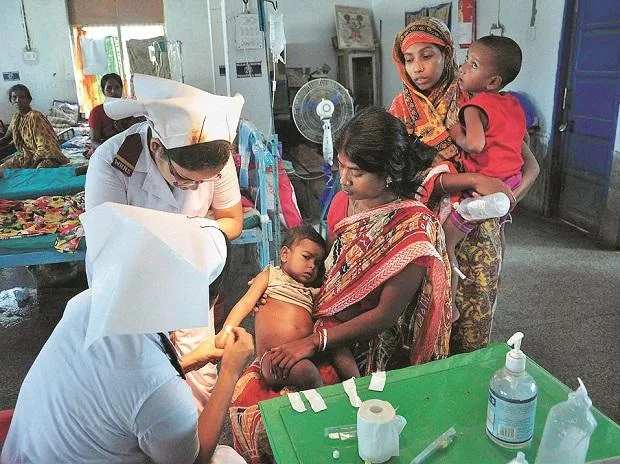
Over the last four years, Bharat has rewritten the way a nation responds to disease. What once looked like scattered improvements has now turned into a steady, measurable transformation. Tuberculosis numbers are falling faster than expected, malaria is being pushed out of global high-burden lists, and chronic infections like trachoma and kala-azar are reaching the edge of elimination. This period is not about isolated achievements; it’s about a country steadily upgrading its entire health ecosystem.
Here’s what matters: The current government treated health not as a routine department, but as a frontline responsibility. The result shows in the data. Surveillance networks expanded into smaller districts. Diagnostics became sharper. Institutional deliveries crossed record highs. Clean water and sanitation projects improved the ground reality in places that had waited decades. Even complex challenges like encephalitis in Uttar Pradesh saw dramatic correction once the administration aligned healthcare, nutrition, and local outreach.
Global recognition of Bharat’s capacity
Bharat did not just strengthen its own defences; it earned the world’s respect. From WHO certifications to U.N. awards for health innovation and research leadership, global bodies acknowledged the country’s progress. At a time when many nations struggled with post-pandemic fatigue, Bharat moved forward with clearer strategies, long-term planning, and ambitious elimination goals.
Together, the twelve cases in this report capture a turning point. They show a system becoming faster, deeper, and more confident. They highlight communities that adapted, health workers who pushed through challenges, and a national leadership that backed science, data, and delivery. This is not just progress on paper; it is the quiet rise of a stronger, healthier Bharat.
1. India sees 21 percent drop in TB cases
On November 13, 2025, the World Health Organisation released its Global TB Report 2025, confirming a strong decline in India’s tuberculosis burden. India has registered a sharp 21 percent decline in tuberculosis cases over the last decade, a pace nearly twice the global average of 12 percent. The World Health Organisation’s Global TB Report 2025 places the country’s TB burden at 187 per lakh population in 2024, down from 237 per lakh in 2015.
The Health Ministry attributes this improvement to stronger case-finding strategies that boosted diagnosis and treatment coverage. Notably, the report records no significant rise in multidrug-resistant TB.
Mortality figures also reflect the same downward slope, dropping from 28 per lakh population in 2015 to 21 per lakh last year. Government programmes such as TB Mukt Bharat Abhiyan, Ayushman Arogya Mandirs, and the Ni-kshay Poshan Yojana continue to form the backbone of India’s effort to eliminate the disease.
2. India cuts Malaria cases and deaths by 69 percent
On December 11, 2024, the World Health Organisation released its World Malaria Report, confirming a major breakthrough for India. The country has reduced its malaria caseload by 69 percent, dropping from 6.4 million cases in 2017 to 2 million in 2023. The estimated malaria deaths have also fallen by 69 percent, from 11,100 in 2017 to 3,500 in 2023.
The report notes that India has successfully controlled malaria transmission and brought down mortality enough to move out of the High-Burden-High-Impact (HBHI) category of endemic nations. The document, which reviews malaria trends across 83 countries, highlights the impact of combination drug therapies and insecticidal mosquito nets in India’s efforts.
3. India reports 44 percent drop in new HIV infections
At a high-level United Nations side event on the theme Revitalised Multilateralism: Recommitting to Ending AIDS Together, Union Minister of State for Health Anupriya Patel stated that new annual HIV infections in India have decreased by 44 percent since 2010, surpassing the global reduction rate of 39 percent. The event was organised by UNAIDS, the Global Fund, and PEPFAR, according to the Health Ministry.
Patel said India remains committed to meeting the United Nations’ goal of ending HIV/AIDS as a public health threat by 2030. She outlined ongoing efforts under the 5th phase of the National AIDS and STD Control Programme (2021–2026), which is fully funded by the Government of India. Citing the India HIV Estimations 2023 report, the minister noted that over 2.5 million people are currently living with HIV in the country. India’s adult HIV prevalence stands at 0.2 percent, and estimated annual new HIV infections are around 66,400.
Patel highlighted that more than 30 million free HIV tests are conducted each year, including comprehensive HIV and syphilis testing for all pregnant women. She added that over 1.7 million people are receiving free antiretroviral therapy through public healthcare systems.
Efforts to reduce stigma have been strengthened through the HIV and AIDS (Prevention and Control) Act 2017, which requires every Indian state to appoint an ombudsman for grievance redressal and policy enforcement.
4. WHO validates India for eliminating trachoma
The World Health Organisation has officially validated India for eliminating trachoma as a public health problem, marking a major milestone against one of the world’s leading causes of blindness.
“India’s elimination of trachoma as a public health problem is a testimony to the country’s commitment to alleviating the suffering that millions have faced from this debilitating disease,” said Dr Tedros Adhanom Ghebreyesus, WHO Director-General. He added that WHO worked closely with India to reach this achievement.
India now joins Nepal and Myanmar within the WHO South-East Asia Region and 19 other countries globally that have previously achieved the same feat. Trachoma still remains a public health issue in 39 countries, causing blindness in about 1.9 million people worldwide.
By 2005, trachoma accounted for 4 percent of blindness in India. By 2018, prevalence had dropped to 0.008 percent. A series of impact, pre-validation, and trichiasis-only surveys completed in 2024 confirmed that elimination targets were met in all previously endemic evaluation units.
5. India TB report 2024: Missing cases fall to 2.3 lakh
On March 28, 2024, the Union Health Ministry released the India TB Report 2024, confirming that the gap between estimated and notified tuberculosis cases has narrowed significantly. The report shows that missing TB cases dropped to 2.3 lakh in 2023, down from 3.2 lakh in 2022.
The shrinking gap is considered a crucial marker because unreported patients are assumed to remain untreated, contributing to continued transmission. According to the report, this improvement is driven largely by the government’s Ni-kshay portal, which tracks TB cases across the country and strengthens monitoring.
The document also notes that 95 percent of all TB patients received treatment in 2023, reflecting wider diagnosis coverage and stronger reporting mechanisms.
6. India reports 98.7 percent decline in Kala-Azar cases
On January 4, 2023, Union Health Minister Mansukh Mandaviya announced that India’s kala-azar cases have fallen by 98.7 percent, dropping from 44,533 cases in 2007 to 834 cases in 2022.
Mandaviya shared these figures while chairing a high-level review meeting on the disease status in Bihar, Uttar Pradesh, Jharkhand, and West Bengal – the four endemic states. According to the statement, 632 endemic blocks, accounting for 99.8 percent of all affected areas, have achieved elimination status-defined as fewer than one case per 10,000 population.
Only one block, Littipara in Pakur district of Jharkhand, remains in the endemic category with 1.23 cases per 10,000 population, as reported by PTI.
Currently, more than 90 percent of India’s kala-azar cases are concentrated in Bihar and Jharkhand, while Uttar Pradesh (2019) and West Bengal (2017) have already achieved their elimination targets at the block level.
7. India’s hypertension control drive
India’s push to control high blood pressure, one of the country’s most widespread health threats has seen major progress between 2017 and 2025, driven by large-scale public health programmes and expanding coverage across states.
Hypertension affects an estimated 20 crore adults in India, with prevalence almost doubling between 1980 and 2010. Studies have shown that nearly 90 percent of patients, particularly in rural regions, had uncontrolled blood pressure due to missed diagnoses, limited access to healthcare, and low treatment adherence. This has contributed to rising rates of heart disease, chronic kidney disease and stroke, challenges made worse by India’s high diabetes burden.
The global backdrop came in 2013, when the World Health Organisation set its “25 by 25” goal to reduce non-communicable disease risks by 25 percent by 2025. India adopted this target, including a voluntary goal of reducing hypertension prevalence by 25 percent. In response, the Ministry of Health & Family Welfare and the Indian Council of Medical Research launched the India Hypertension Control Initiative (IHCI) in 2017.
The IHCI focused on five core strategies, standard treatment protocols, assured drug availability, team-based care at public health centres, technology-enabled monitoring, and patient-centred services across regions and socioeconomic groups.
Initially launched in five states, the IHCI expanded rapidly. By 2022, it was operational in more than 20,000 healthcare centres across 141 districts in 25 states, covering a population of 303 million. Over 60,000 healthcare workers received training in hypertension diagnosis, treatment and monitoring.
Between 2018 and 2022, 40 lakh patients were enrolled, roughly 12.5 percent of India’s estimated hypertensive population. By early 2021, 47 percent of those under care had consistent blood pressure control. Retention rates exceeded 72 percent, and the programme recorded a ten-fold rise in blood pressure control between 2019 and 2022.
International recognition followed, with the United Nations awarding India for its integrated primary care efforts under the IHCI.
8. ICMR receives 2024 U.N. inter-agency task force award
The Indian Council of Medical Research has been honoured with the 2024 United Nations Inter-Agency Task Force Award for its work in advancing multi-sectoral action on the prevention and control of non-communicable diseases, mental health, and related Sustainable Development Goals. The announcement was made by Union Health Minister J. P. Nadda on September 18, 2024.
According to the Minister, the recognition reflects ICMR’s initiatives ranging from establishing national centres for assistive health technology to promoting sustainable assistive products and conducting what he described as the world’s largest assistive technology survey.
9. Bengaluru receives WHO award for tobacco control measures
Bengaluru has been recognised by the World Health Organisation with a $150,000 award for its tobacco control work, particularly its efforts to curb smoking in public places and strengthen compliance with public-smoking bans. The announcement came during the inaugural Partnership for Healthy Cities Summit held in London on March 16, 2023.
According to WHO, Bengaluru is one of five global cities selected for demonstrating effective interventions to reduce non-communicable diseases and injuries. The other awardees are Athens for its initiatives to reduce drug use, Mexico City for improving road safety, Montevideo for enhancing access to better nutrition, and Vancouver for expanding inclusive and accessible public health data.
The Partnership for Healthy Cities, founded in 2017 and supported by Bloomberg Philanthropies along with WHO and Vital Strategies, now includes 70 cities working on high-impact policies to prevent NCDs and injuries. Each of the five selected cities received $150,000 to advance their ongoing initiatives.
10. UP brings encephalitis deaths down from 149 in 2018 to Zero in 2024
Uttar Pradesh has recorded zero deaths from encephalitis in 2024, marking a major turnaround in a state that once struggled with recurring outbreaks of Japanese Encephalitis (JE) and Acute Encephalitis Syndrome (AES). An official spokesperson shared the updated figures on Thursday, noting that both cases and fatalities have sharply declined.
The scale of improvement becomes clear against the long history of outbreaks. In 2005, more than 6,000 children were affected and over 1,400 died during a severe JE-AES epidemic. By 2017, cumulative deaths in Purvanchal had crossed 50,000, with Gorakhpur at the centre of the crisis.
According to reports, deaths fell from 149 in 2018-137 from AES and 12 from JE-to zero as of October 2024. Reported AES cases dropped from 1,472 in 2018 to 116 in 2024, and JE cases from 174 to five in the same period. Districts that historically bore the highest burden included Gorakhpur, Basti, Maharajganj, Kushinagar, Siddharthnagar and Sant Kabir Nagar.
The spokesperson said the turning point came with the expansion of the Har Ghar Nal Se Jal scheme under the Jal Jeevan Mission. The push for household tap-water connections accelerated after 2017, especially in the districts most affected by JE and AES. Citing Jal Jeevan Mission assessment reports, officials said that 85-92 percent of households in these districts now have tap-water access.
Additional Chief Secretary of the Namami Gange and Rural Water Supply Department, Anurag Srivastava, said: “The availability of clean water across eastern Uttar Pradesh has reduced cases of deadly AES, including JE, which claimed the lives of thousands of children in the past. We will soon achieve our goal of providing tap water to 100 percent of households. Clean water is the primary requirement for a healthy life, and we are committed to achieving this goal.”
District-wise data up to August 13, 2024, shows the shift. Gorakhpur, with 92.13 percent household tap-water coverage, reported no JE deaths in 2024, compared to three in 2018. Maharajganj (87.83 percent coverage) and Basti (86.53 percent) reported no JE deaths in both years. Siddharthnagar reached 85.06 percent connectivity, with zero deaths this year despite four in 2018. Kushinagar recorded 90.73 percent coverage with no deaths this year versus two in 2018. Sant Kabir Nagar, at 89.20 percent, reported no JE deaths in either year. Balarampur has reached 93 percent connectivity, and Bahraich 92.66 percent.
11. Rajasthan records sharpest drop in maternal mortality
Rajasthan has registered the highest decline in the Maternal Mortality Ratio (MMR) in the country, according to two successive reports released by the Centre. The state’s MMR fell by 28 points, dropping from 141 maternal deaths per 1 lakh live births in 2017-19 to 113 in 2018–20.
The latest figures are part of the Special Bulletin on Maternal Mortality in India, 2019-20, issued by the Ministry of Home Affairs on November 28. While the improvement is notable, the state still has to bring the figure down to 70 or below by 2030 to meet national and global targets.
Health department officials attributed the progress to a major rise in institutional deliveries. Training initiatives under the Dakshta programme have also played a role, strengthening the skills of labour-room staff in key life-saving practices.
Improved referral systems for high-risk pregnancies have further contributed, supported by stronger health infrastructure and wider outreach of government schemes.
12. Maharashtra sees 11 percent drop in child mortality in four years
Maharashtra’s child mortality has declined by 11 percent over the past four years, according to state public health department data released on Wednesday. The numbers show deaths among children up to five years old fell from 19,185 in 2019-20 to 17,150 in 2022-23. Nearly two-thirds of these deaths continue to occur in babies less than a month old, a group most vulnerable to sepsis, pneumonia, and low birth weight. The sharpest improvement has been in infant deaths (0-1 year), which dropped by 15 percent.
District-wise data indicate neonatal deaths (0–28 days) reduced by almost 9 percent between 2019-20 and 2022-23, while deaths among children aged one to five years fell by 13 percent. Officials said the trend aligns with the Sample Registration System 2020 report, which recorded a decline in infant mortality rate from 19 per 1,000 live births in 2018 to 16 in 2020.
The government attributed the mortality decline to the establishment of 53 Special Newborn Care Units, which treated 56,467 infants, including nearly 5,500 babies under 1,500 grams, and to 200 Newborn Stabilisation Units that handled more than 24,060 cases.
The Mother Absolute Affection programme also counselled around 14 lakh mothers on exclusive breastfeeding. Activists acknowledged the improvement but urged vigilance, citing incidents like the cluster of 24 deaths, including 12 newborns, reported in October last year at Shankarrao Chavan Hospital in Nanded.
Bharat’s health journey
Bharat’s health journey between 2021 and 2025 tells a simple truth: when intent meets execution, transformation isn’t distant-it becomes visible in every district. The decline in child mortality, the pushback against infectious diseases, the surge in early diagnostics, and the renewed focus on mothers and infants all point to the same direction. A nation that once struggled with fragmented health responses is now building a disciplined, data-driven framework.
The government’s commitment to last-mile delivery, especially in tribal and rural belts, changed the pace of improvement. Newborn care units, high-risk pregnancy screening, ASHA-led home-based care, and targeted interventions in vulnerable regions show what coordinated governance can achieve. Bharat still has challenges-nutrition gaps, difficult geographies, and lingering infections the momentum is unmistakable.
This is the rise of a confident healthcare system that’s learning, evolving, and moving toward a future where every child, every mother, and every family gets a fair chance at life. Bharat is not just improving its health metrics; it is shaping a resilient model for the world.










Comments