





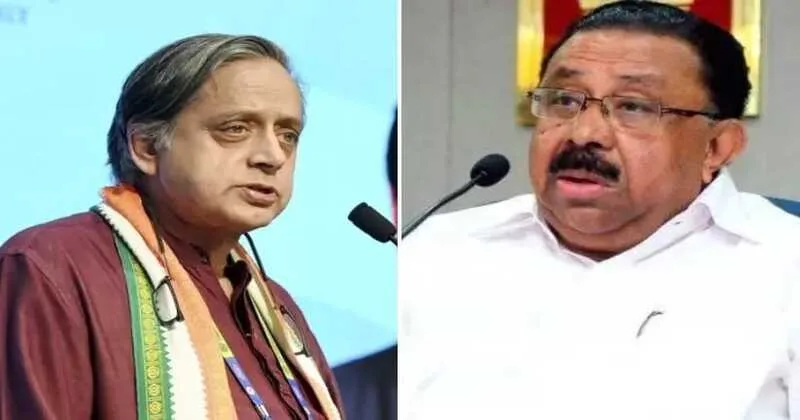
Former KPCC president M M Hassan launched a sharp attack on senior Congress leader Shashi Tharoor, accusing him of undermining the Nehru family and demanding that he resign from the party. Hassan argued that Tharoor owed his political rise to the generosity of the Nehru-Gandhi leadership and claimed that the Thiruvananthapuram MP “had never worked hard for society.” According to Hassan, Tharoor’s recent article, which contained a reference to the Nehru family, crossed a red line by projecting them as people who viewed power as their birthright. Hassan alleged that Tharoor was attempting to elevate his own political stature at the cost of the party’s legacy and insisted that he should step down from the Congress Working Committee. He further asserted that the party had no room for leaders who handed the BJP ammunition to attack the Congress.
Hassan’s criticism of Tharoor came against the backdrop of the MP’s recent comments in Hyderabad, where Tharoor addressed the Jyoti Komireddy Memorial Lecture. In his talk, Tharoor assessed the Congress’s ideological trajectory over the past two decades, suggesting that the party had leaned further towards the left in recent years as a response to BJP’s politics. He emphasised that his concerns were rooted in ideological clarity rather than tactical politics, arguing that certain gaps in the party’s belief structure needed to be addressed.
During the lecture, Tharoor was asked whether the Congress’s cooperation with Left parties to counter the BJP constituted an example of radical centrism. He responded by recalling the economic reforms implemented by the Congress under former Prime Minister P.V. Narasimha Rao in the 1990s, noting that the BJP had later continued several of those policy directions when it came to power. Tharoor argued that the Congress had experienced a period marked by centralisation between 1991 and 2009 but had since drifted away from that approach. In his view, years spent in the opposition had contributed to the party adopting a more overtly left-leaning ideological posture than it had in earlier periods. Asked whether he would consider contesting the AICC presidency again, Tharoor indicated that it was unlikely unless political circumstances changed significantly. However, he insisted that intra-party democracy is essential not only within the Congress but across all political parties in the country.
Tharoor flags need for introspection after Bihar setback
Tharoor also reacted to the Congress’s poor performance in the Bihar Assembly election results. He stated that the party must undertake a serious internal review to identify where mistakes were made and examine the underlying causes of the defeat. Tharoor remarked that responsibility lay particularly with those who were directly involved in the Bihar campaign, although he pointed out that he had not been invited to participate, a comment widely seen as a subtle criticism of the party high command. Commenting on reports that women voters had received financial assistance shortly before polling, Tharoor noted that such steps by state governments were not unprecedented and argued that administrations could not be prevented from extending routine welfare measures.
The Congress had contested 61 seats in Bihar but won only five as per the latest tallies. Tharoor’s earlier observations on the party’s ideological direction continued to echo through his remarks, as he reiterated that his concerns stemmed from questions of principle and vision.







Comments