





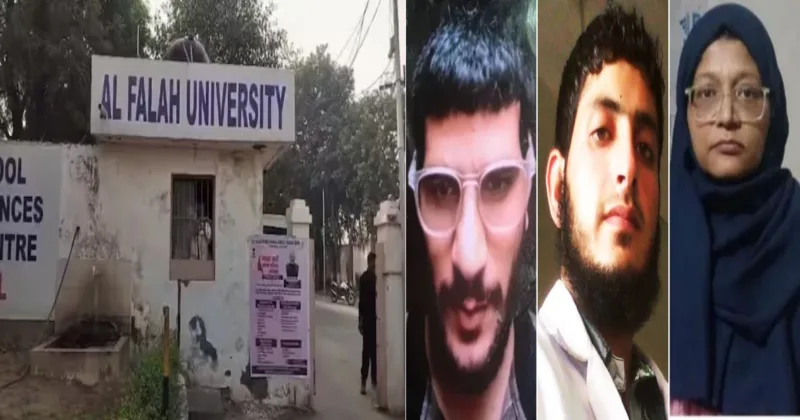
A sting operation by media house at Al Falah University in Faridabad has revealed disturbing accounts about two doctors now arrested of involvement in the Red Fort bomb blast case. The two men, Dr Umar Mohammad and Dr Muzammil Saeed, both linked to the “doctors’ terror module”, had previously served as faculty members at the institution. Students and staff who interacted with them shared details that investigators now consider significant as the probe deepens.
During the media team’s visit, students recounted their encounters with Dr Umar Nabi, the suicide bomber in the i20 car explosion near the Red Fort on November 10. According to several students, Umar enforced strict gender segregation in the classroom, a practice they described as resembling a “Taliban-style” model of conduct. Earlier, students in those batches would sit together, but Umar reportedly insisted on separating male and female students whenever he entered to take a class. Although his behaviour was noticed, they said it had not raised major alarms at the time. Students also recalled that Umar had lived in one of the university hostels. Staff members pointed out the building where he stayed and described him as a withdrawn individual who did not mingle easily. One of the junior faculty members, who had joined just a week earlier, said he had never met Umar or Muzammil. According to him, the two doctors remained largely unknown to the newly recruited staff.
The impact of the Red Fort blast has been felt strongly across the university campus. Students said that in the days following the incident, the number of patients visiting the Al Falah University hospital dropped drastically. They described an atmosphere filled with fear and whispers, especially as more details of the investigation began to emerge. Some of them said patients had been reluctant to visit the hospital since the explosion, contributing to the tense mood. Several students also expressed concerns unrelated to the terror probe, pointing to longstanding issues in education quality and campus infrastructure. They said lectures were inconsistent, facilities inadequate, and practical sessions often delayed. Yet, amid these complaints, one faculty member was remembered : Dr Shaheen Saeed who too has been arrested as part of the terror module, now under close scrutiny by security agencies.
The investigation reached beyond campus walls into a nearby residential colony, where Dr Muzammil Saeed Ganai had rented two rooms prior to the blast. A local landlord described how Muzammil had approached him on September 13, expressing interest in renting accommodation. After inspecting the rooms, Muzammil reportedly paid two months’ rent in advance and left his belongings inside. According to the landlord, the doctor never returned afterwards. The landlord recalled asking him for basic personal details and handing over a copy of the key before Muzammil left that night. Recent developments have drawn further attention to those rooms. The landlord said that a few days ago, plainclothes police officers had visited, asking whether any doctors had left items behind. Later that same morning, a group of men from Kashmir also arrived, seeking the exact room Muzammil had rented. They reportedly collected all the belongings that had been left there and left without further conversation. These revelations have become crucial for agencies piecing together the larger conspiracy behind the Red Fort explosion. Investigators now believe the “white collar terror module” operated with a level of concealment that allowed its members to integrate themselves into academic and residential environments without attracting suspicion. Officials involved in the probe have said reconstructing the sequence of events and the operational structure of the module will require careful analysis, given the complexity of the case.
Meanwhile, the Al Falah University campus remains under close watch. Authorities continue to question how individuals with links to terrorism were able to function as educators while simultaneously planning violent operations. The ongoing enquiries aim to understand whether warning signs were overlooked and how such activities could have gone unnoticed within an academic institution. As the investigation progresses, more layers of the case are being uncovered, offering insight into how the accused used professional respectability to mask radical intentions. The sting operation has added student testimonies and local accounts to the growing body of evidence, painting a troubling picture of infiltration, concealment, and ideological imposition within an educational setting.










Comments