





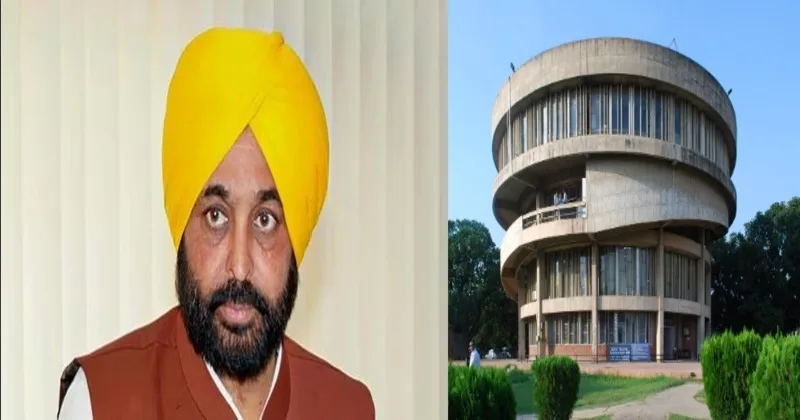
On October 28, 2025, the Union Ministry of Education, Department of Higher Education, issued a notification that restructured the Panjab University senate and syndicate. To justify its action, the Union Government invoked powers vested upon it by Section 72 of the Punjab Reorganisation Act, 1966, whereby, inter-state body corporates are subject to directions issued by the Centre.
Among other aspects, the order directed reducing the strength of the university senate to about 31 members from the present about 91 members. It also abolished elections to the syndicate, and removed the graduate constituency from the election process. In effect, the ministry sought to modify the composition of the Panjab University senate by downsizing it to about one third of its original strength and turning the syndicate into a wholly nominated rather than an elected body.
The justification provided for the restructuring was that the reforms are directed towards reducing the lengthy process associated with the elections to the senate and adherence to the National Education Policy (NEP) 2020 that calls for governance reforms in higher education institutions. Further, the reforms had been in the pipeline since 2015 and were in accordance with a panel set for the purpose in 2021 by then Vice President and Chancellor of Panjab University, M Venkaiah Naidu.
The notification faced severe criticism and led to strong opposition from student bodies, faculty and alumni of the university as also political parties and social organisations in Punjab. The general feeling being expressed was that the new system would erode the university’s autonomous and federal character by negatively impacting the existing democratic norms based on representation of all stakeholders. It would also give absolute power to the offices of the Vice Chancellor and Chancellor. Many also look upon the move as an attempt to undermine the historical rights of Punjab over the university.
The Chief Minister of Punjab, Bhagwant Mann, announced that the state would challenge the decision in the Punjab and Haryana High Court even as protests in the University started mounting with extraordinary momentum in social media platforms.
On November 5, the Union Government issued two notifications. The first one effectively withdrew the original notification but the second one kept it alive by stating that the Act would have effect from a future date as decided by the Central Government.
On November 7, the Ministry of Education removed all ambiguity by officially rescinding the order. The senate and syndicate will, as of now, continue to function under the framework of the Panjab University Act, 1947 as it existed before October 28. The Union Government has stated that the decision to do away with the proposed reforms was taken on receipt of extensive feedback and representations from a wide range of stakeholders, including students, teachers, former Vice Chancellors, even the current Vice Chancellor and student organizations.
It is reported that post the notification of October 28, a delegation of representatives of various student organisations conferred with the Secretary, Higher Education, Government of India.
The Origin of Panjab University
Panjab University traces its origins to Government College, Lahore. It was set up on January 1, 1864, and renamed University College in 1869. The university was formally established in its present form in 1882 as the fourth university of British India. It was primarily a public funded university, the seed money for which was given by the people of Punjab. In 1904, a common representative calendar was created for the first five universities, Calcutta, Bombay, Madras, Lahore, and Allahabad. The senate formed part of this democratic structure, Post-independence and on the partition of Punjab, the iconic institution was established as East Punjab University and housed in Solan cantonment, then a part of the state of East Punjab. It was re-established in Indian Punjab on October 1, 1947, with its legal status being confirmed through the Punjab University Act, 1947 that received the assent of the Governor of East Punjab on November 26, 1947. Through the act, the University retained the original system of Governance established in 1904.
It was renamed Panjab University and relocated to its existing campus in Chandigarh in an area spanning about 550 acres and covering Sectors 14 and 25 of the capital city of Punjab that is now a Union Territory.
In its present form, the university is an Indian collegiate public state university funded through both State and Union government while being considered to be a state university. Presently, it has 78 teaching and research departments and 10 centres/chairs at the main campus located at Chandigarh.
The Affiliated Colleges of the University
At the time of reorganisation of Punjab in 1966 the university had affiliated colleges in areas that now form part of the states of Haryana and Himachal Pradesh. After the reorganisation, with time, Haryana and Himachal Pradesh affiliated their colleges to their own universities.
Now the University has about 201 affiliated colleges in Punjab spread over the eight districts of the state and the union territory of Chandigarh. It has regional centres at Sri Muktsar Sahib, Ludhiana and Hoshiarpur.
The affiliated colleges are also contributing a substantial amount as revenue for the university. The amount is being disbursed in the form of fee for initial affiliation and for the extension of affiliation for specific subjects or courses. Colleges collect examination fees from students and transfer them to the university. Colleges also collect various other dues from students, such as registration fees, and remit a portion or the full amount to the university as per regulations.
The Senate and the Syndicate
In accordance with the Punjab University Act, 1947, the Senate is the supreme governing body that holds responsibility to manage university affairs and property. It makes key policy decisions, discusses academic matters, elects other bodies such as the syndicate, the finance committee, and faculty deans.
The syndicate headed by the Vice Chancellor of the university is the executive body that implements the policies set by the senate and handles administrative matters.
The 91-member senate includes the Chancellor, Vice Chancellor, ex-officio members, and ordinary fellows (elected members and nominees). Section 13 of the Punjab University Act, 1947 provides that the number of ordinary fellows shall not exceed eighty-five. Broadly, the working system has about 46 elected members, 12 ex-officio members and about 33 nominated members to complete a forum of 91. These numbers may vary from time to time.
The elected members include professors, principals, teachers, and registered university graduates (alumni). The ex-officio members mainly include the Chancellor, Vice Chancellor, Chief Justice of Punjab and Haryana High Court, Chief Minister of Punjab, Education Minister of Punjab and a few other officials. The registered university graduates have historically been a significant part of the elected body and have a large electorate. This constituency was proposed to be removed in the restructuring that the Union Government was proposing. The notification also proposed reduction of the number of elected members from among other Constituencies to around 14 instead of the existing 32.
The Moot Points
The statement of the central government indicates that it has rescinded the decision “due to receipt of extensive feedback and representations from a wide range of stakeholders.” It would have been more appropriate for the government to open dialogue and debate with the stakeholders before taking the decision. Had such a course been adopted the result may have been beneficial for all.
The stakeholders of the university also cannot stay free from blame. The matter of reforms in the university has been in the pipeline since 2015. Many committees and sub-committees have been formed on the subject. It gained momentum in 2021. Why did the stakeholders, who are now lining up the streets and agitating most vigorously, not reach out to the centre for a debate and discourse?
The chief minister of Punjab, who is leading the chorus of dissent, has not attended a single senate meeting during his tenure and nor has his education minister. This apart, the state government has not paid the university its due share of the budgetary allotment. The university is functioning on the disbursements coming from the centre and from the affiliated colleges. What moral right does he have to speak about the university?
When considered objectively, it becomes quite apparent that the reforms sought by the central government hold some merit. A huge 91-member governing body based on a more than one century old practice does need a second look. Management practices in the modern age are based on lean and efficient structures that provide efficient and decisive governance.
A cursory research indicates that out of the original five universities of the British era that were following the senate system only the University of Bombay (Mumbai) has a senate that goes beyond 90 members, all others have cut down the numbers. The University of Mumbai is also facing issues in this matter and is looking for reforms. Why has Punjab been found lacking in forging a way forward?
Focus on Academics
The primary task of any centre of learning and university is to ensure academic excellence by maintaining the highest standard of education. The result can be seen from the placement of University pass-outs and professional proficiency of the alumni.
It is sadly noted that in the field of academics, the Panjab University is not producing results commensurate with its stature. At the national level it is ranked a lowly 57th and among universities it holds the 35th rank.
The university also conducts Student Council elections and about 20 student activist bodies representing student wings of national and regional parties. Regional associations from Haryana and Himachal Pradesh exist on the campus. This system adds a political colour to several decisions to an extent that needs to be avoided in an elite education institution.
In light of the competitive field of higher education, the focus of all stakeholders should be on producing professional results rather than indulging in frivolous political and social issues.
The Way Forward
The university needs reform and rejuvenation. The way forward for the same lies in debate and discussion. Historical and modern imperatives need to be kept centre-stage in such an exercise.
The university may have been the product of unified Punjab, but to refer to it as a multiple state entity post the re-organisation of states in 1966 does not keep its historical identity as a Punjabi institution in perspective. Maintaining its historical identity should be the primary focus.
The main academic contribution of the university lies more in its affiliated colleges from where a considerable revenue is also generated. They are strung out over 300 kms. The elected graduate members of the senate play an important role in facilitating the association of the students and assisting in administrative issues. This segment of stakeholders cannot and should not be ignored.
For the last three centuries the people of Punjab have fought for their land and their identity and made sacrifices that have no parallels in the annals of history. The biggest ever was the holocaust that followed the partition of Punjab post-independence. Punjabis are, therefore, very sensitive about their land and their heritage.
A big reason for the above could be the communication gap that exists between the central and the state government. It could also be the exclusion of the state leadership of the ruling dispensation in the decision making process or its inability to influence important matters. Whatever the reason, it is the people of Punjab who suffer. The arbitrary nature of dealing with Punjab creates a sense of insecurity amongst the Punjabi people and negatively impacts their relations with the Indian Union. There is a need to reconsider central policy dealing with the sensitive border state of Punjab.
The iconic Panjab University, holds a higher emotional place in the hearts of the Punjabis than all other education and cultural institutions in the state since it symbolises all that Punjab stands for.














Comments