





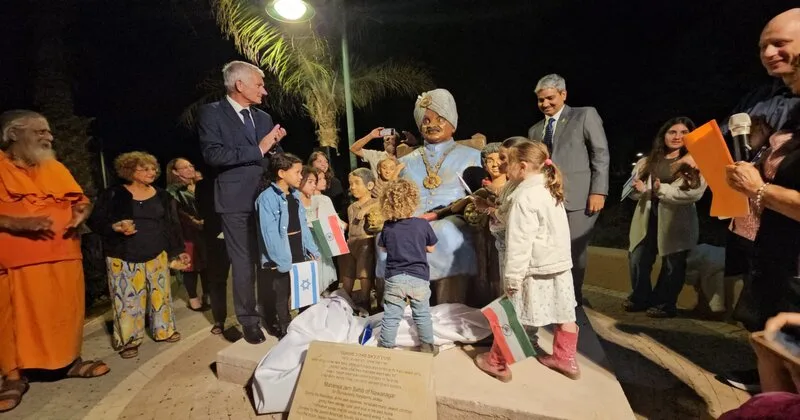
A statue of Jamsaheb Digvijaysinh Jadeja, the former Maharaja of Nawanagar (present-day Jamnagar), was recently unveiled in Nevatim, southern Israel. The monument commemorates his compassion and empathy in providing refuge to Polish children, including Jewish children, during World War II.
A moving tribute at Moshav Nevatim 🇮🇳🤝🇮🇱
The statue of Maharaja Jam Saheb of Nawanagar (Gujarat) was unveiled in Nevatim honouring his exemplary compassion during World War-II. He adopted hundreds of Polish children including Jewish children and built a home for them in 1942… pic.twitter.com/MLKg9satnk
— India in Israel (@indemtel) November 11, 2025
The Indian Jewish Heritage Centre (IJHC) and the Cochin Jewish Heritage Centre (CJHC) organised an event to honour the Maharaja and unveil his statue. Originally scheduled for completion in September 2024, the statue’s unveiling was repeatedly postponed due to Israel’s ongoing military conflict with Hamas. Indian Ambassador J P Singh, along with the Polish Ambassador and officials from the Israeli Foreign Ministry, attended the event.
Who was Jamsaheb Digvijaysinh Jadeja?
Maharaja Digvijaysinh Ranjitsinh Jadeja was the last ruler of the Nawanagar state. Like many rulers of his era, he was affectionately called “Bapusaheb,” a title that reflected the deep respect and love his people held for him. His guiding principle, or jeevan mantra, was simple yet profound: “May the people of my state prosper.”
Rulers such as Bhavnagar’s King Krishnakumarsinhji and Jamsaheb Digvijaysinh Jadeja were true “Bapusahebs,” protecting their subjects with the care and dedication of a father. Even decades later, their names are remembered with reverence. Digvijaysinh’s compassion extended far beyond his kingdom; during difficult times, he provided refuge to citizens of a distant country, such as Poland, over six and a half thousand kilometres away. He fulfilled his dharma selflessly, without expecting anything in return. Even today, nations such as Poland and Israel continue to honour and remember Maharaja Digvijaysinh Jadeja for his extraordinary humanity.
Jamsaheb Digvijaysinh Jadeja was born in 1895. He attended Rajkumar College before pursuing higher studies at University College, London. In 1919, he was commissioned as a Second Lieutenant in the British Army. After a military career of nearly two decades, he retired in 1931, though he continued to serve in the Indian Army in an honorary role until 1947. In 1933, two years after his retirement, he succeeded his uncle, Ranjitsinh Jadeja, and was crowned Maharaja of Nawanagar.
Digvijaysinh served as the Maharaja of Nawanagar until his death in 1966. Following India’s independence in 1947, he integrated his state, along with other princely states, into the Indian Union, making him the last reigning Maharaja of Jamnagar. His son, Shatrushalyasinh Jadeja, is the current titular king of Jamnagar. Although princely states no longer exist as governing entities, royal traditions such as coronations and ceremonial rituals continue, and the people still hold their kings in deep respect.
During World War II, Poland was invaded by the Soviet Union and Germany in 1939, causing the collapse of the Polish government, whose leaders fled to London. Meanwhile, thousands of Polish citizens, including many women, children, orphans, and disabled individuals, were deported to the Soviet Union. They were placed in refugee camps and orphanages, where harsh conditions, disease, and hunger claimed many lives for nearly two years. In 1941, the Soviet authorities granted amnesty and ordered the release of these refugees, leaving thousands, particularly children, without a safe place to go. Some found refuge in Mexico, a few in New Zealand, and others in various countries around the world.
At that time, Maharaja Digvijaysinh Jadeja served as the Hindu representative in the British War Cabinet and was well aware of the global crisis. Upon learning about the plight of the Polish refugees, he immediately stepped forward to help. After negotiations, an agreement was reached to bring them to India, offering them safety and shelter.
In 1942, the first group of Polish children arrived in Nawanagar, and it is said that the Maharaja personally welcomed them. He reportedly told the children, “You are no longer orphans. Though you have lost your parents, from today I am your father. You are now residents of Nawanagar, and I will care for you as my own.”
Jam Sahib took comprehensive measures to care for the children, providing housing, food, and medical support. A camp was set up near Balachadi, where the children received attentive care. Schools were established, and a special library of Polish-language books was created to help them maintain a connection to their mother tongue. The Maharaja personally oversaw all arrangements, visiting the camp regularly to ensure everything was in order and attending to even the smallest needs of the children. When some of the children found India’s spicy cuisine difficult to eat, he employed seven Polish cooks to prepare meals suited to their taste. Additionally, Polish teachers were appointed to continue their education, ensuring the children felt both cared for and culturally connected.
Jam Saheb fulfilled his duty selflessly, without expecting anything in return. Yet the grateful nation of Poland continues to remember the Indian Maharaja who provided shelter to thousands of children during a time of crisis, becoming their ‘father.’ He is still celebrated there as the “Good Maharaja.” In his honour, a monument called the Jam Saheb Memorial of Nawanagar has been erected in Warsaw, Poland’s capital, with the first inscription reading: “Tribute to the kind Maharaja, from the grateful nation of Poland.” Additionally, a school in Warsaw, designed in Indian architectural style, has been named after Jam Saheb, further commemorating his enduring legacy.
Not only Poland, but also Israel, honours Maharaja Digvijaysinh Jadeja with deep respect. Many Jewish children found refuge in Nawanagar under his care. Even today, the Jewish community remembers that when this Hindu king opened his treasury to children from abroad, he did not discriminate based on religion. Every child, whether Jewish or of any other faith, was treated with equal kindness and compassion.












Comments