





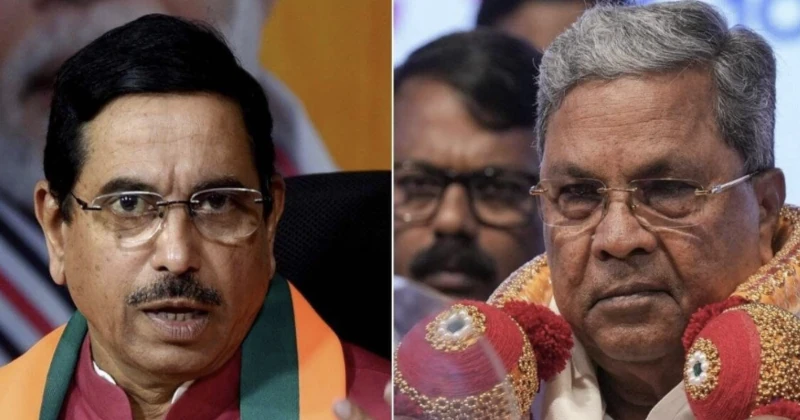
Karnataka Chief Minister Siddaramaiah is facing mounting criticism over his handling of the ongoing sugarcane farmers’ agitation, which entered its eighth day without resolution. Farmers across several districts, including Bidar, Bagalkot, and Belagavi, have continued their protests, demanding a fair price of Rs 3,500 per quintal and rejecting the government’s offer of Rs 3,300 per quintal.
Amid the escalating unrest, Union Minister Pralhad Joshi has fired a scathing open letter to the Chief Minister, accusing the Congress-led state government of “economic mismanagement, policy paralysis, and deliberate neglect” of Karnataka’s agrarian sector.
In his letter, Joshi wrote that while the Union had implemented “transformational reforms” to ensure the long-term stability of the sugar sector, the Siddaramaiah government has failed to complement those efforts at the state level.
“The Fair and Remunerative Price (FRP) for 2025–26 has been fixed at Rs 355 per quintal at 10.25 per cent recovery, providing a margin of more than 105 per cent over the cost of production an unprecedented level of protection for farmers,” Joshi said. He noted that while states are free to declare a State Advisory Price (SAP) above the FRP, Karnataka has failed to declare any SAP, leaving farmers in limbo.
Joshi further highlighted that the Ethanol Blending Programme, initiated by the Union, had generated over Rs 2.18 lakh crore in income for distilleries nationwide, stabilising sugar prices and facilitating timely payments to farmers. Karnataka’s contribution was particularly significant, with 139.8 crore litres of ethanol supplied during 2024–25 and 133 crore litres already allocated for 2025–26.
The Union Minister accused Siddaramaiah’s government of burdening farmers and industries with excessive taxes while diverting funds toward “vote-driven guarantee schemes.”
“Instead of reducing the burden on farmers, your government has increased it. Water supply charges for sugar factories have risen from Rs 5 lakh to Rs 1 crore per year. An energy cess of 60 paise per unit and a 50 per cent hike in VAT on diesel have crippled sugar mills,” Joshi wrote.
He further claimed that the 276 per cent tax on over 30 consumer products and the expected Rs 39,000 crore in revenue from liquor excise show that the Congress government is “profiting off the people while neglecting farmers.” The repeated hikes in fuel prices, Joshi said, have inflated transport costs from Rs 500–Rs 550 to Rs 750–Rs 800 per tonne, deepening the crisis.
Joshi expressed outrage that not a single state minister had visited the agitating farmers even after a week of protests. “This shows the apathy of your administration. Farmers are on the streets, yet your ministers are silent spectators,” he said.
The letter also highlighted Karnataka’s failure to renew Power Purchase Agreements (PPAs) with sugar mills, which had expired in the 2017–18 fiscal year. PPAs, Joshi noted, ensure guaranteed income for cogeneration units and enable sugar mills to access bank finance. “By not renewing them, the state has deprived mills — and in turn, farmers of vital financial security,” he said.
Joshi argued that between 2014–15 and 2020–21, the Modi government introduced comprehensive schemes to improve liquidity in sugar factories and ensure timely payments to farmers, including buffer stock support, export assistance, and freight reimbursement. “It is false to say that the Union has ignored farmers’ problems. The Union has ensured both price stability and market diversification,” he said, while emphasising that “implementation responsibilities like payment enforcement, irrigation, and subsidy distribution lie with the state.”
Farmers’ organisations across North Karnataka have accused the state government of betraying their trust. “The Chief Minister is busy defending his guarantee schemes in the Assembly, while we are struggling to survive,” said Ramesh Patil, a protesting farmer from Mudhol, who accused the government of playing politics with farmers’ livelihoods.
Meanwhile, farmer unions have warned that the agitation will intensify if the state fails to declare a SAP of Rs 3,500 per quintal and clear pending dues within a week.














Comments